SMARACA4 Deficient Uterine Sarcoma Complicated with Endometrial Carcinoma: A Case Report and Literature Review
- 1. Department of Obstetrics and Gynecology, Shanxi Bethune Hospital, China
- 2. Department of Imaging, Shanxi Bethune Hospital, China
- 3. Department of Pathology, Shanxi Bethune Hospital, China
Abstract
SMARACA4 deficient uterine sarcoma (SDUS) is a new type of cervical sarcoma discovered in recent years, with high invasion, poor prognosis and very rare occurrence. Case: This article shares a 53 years old woman with postmenopausal vaginal bleeding. Colposcopy examination and cervical biopsy confirmed SMARACA4 Deficient Uterine Sarcoma. She underwent total hysterectomy and bilateral salpingo-oophorectomy, and the postoperative examination revealed that the patient also had endometrial cancer. She was treated with supplementary radiotherapy and chemotherapy and passed away 7 months after surgery. Conclusion: SMARACA4 Deficient Uterine Sarcoma still has poor prognosis after active surgical treatment and supplementary treatment. During surgery do not removed pelvic lymph nodes did not shorten the patient’s survival period. Early diagnosis and identification of high-risk populations are particularly important, and immunotherapy and targeted therapy are still being studied and explored.
Keywords
• Uterine Sarcoma
• Endometrial Carcinoma
• Surgical treatment
Citation
Fenga N, Weia L, Yangb P, Sic C, Liua X (2026) SMARACA4 Deficient Uterine Sarcoma Complicated with Endometrial Carcinoma: A Case Report and Literature Review. Ann Clin Pathol 13(1): 1184.
INTRODUCTION
Uterine sarcomas account for about 1% of female genital tract malignancies and 3% ~ 7% of uterine malignancies [1]. Sarcomas originating in the cervix are even rarer, accounting for only 1% of cervical tumors [2]. SMARACA4 Deficient Uterine Sarcoma (SDUS) are a class of tumors first identified and defined in 2018. Such disease has been discovered in recent years. All such cases have been reported as individual cases [3,4]. At present, there are less than 30 reported cases, most of which have been found to be in the late stage. The onset age is relatively young, and the prognosis is extremely poor. After diagnosis, the survival period fluctuates between 7-9 months. Clinical characteristics are relatively individualized. The driving event of this type of tumor is the absence of SMARCA4, which can be diagnosed through immunohistochemistry or genetic testing. The choice of treatment methods such as surgery, chemotherapy, radiotherapy, or targeted therapy remains a challenge for the disease, and there is currently no unified and effective treatment plan. This paper describes a rare case of SMARACA4 deficient uterine sarcoma combined with endometrial carcinoma and reviews the relevant literature.
CASE REPORT
The patient is a 53-year-old postmenopausal woman, who complained of vaginal bleeding for two months. She had regular periods, three spontaneous births and underwent sterilization. Family history of cancer was denied. The cervix can see a diameter of 4 cm cauliflower-like tissue, which is contact blooding, and the surface is black and fragile (Figure 1B).
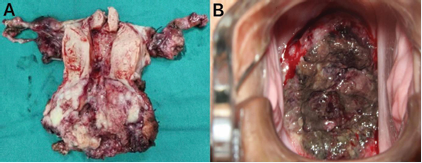
Figure 1: (A) Gross specimens of whole uterus and tumor. (B) Tumor manifestations by colposcopy: the surface of the tumor is black and fragile
Therefore, we performed colposcopy cervical biopsy and the result of pathological examination is malignant tumor. Combined with immunohistochemical labeling results, in accordance with the SMARACA4 deficient undifferentiated uterine sarcoma. MRI showed uneven nodular thickening of the endometrium in the bottom of the uterine cavity about 0.54 cm. DMI showed high signal, ADC showed low signal, enhanced scan showed slight enhancement, the continuity of the endometrial band was poor. The cervical mass was about 5.64 cm × 5.04 cm × 5.38 cm in size (Figure 2).
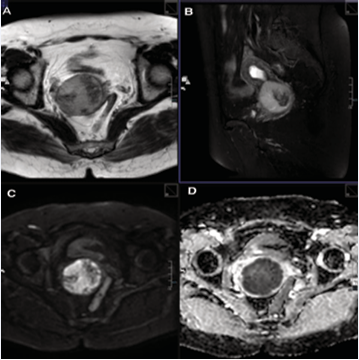
Figure 2: MRI shows lesion in the uterus. (A) T2W1 showed high signal lesion visible in the cervix. (B) fat suppresses the sequence showed cervical high signal lesion with uneven signal and clear boundary with the surrounding area. (C) DWI showed high signal lesion visible in the cervix. (D) ADC showed low signal lesion visible in the cervix.
The lesion involved the mucosa and submucosa, did not break through the serosa, did not involve the vagina and the side of uterus, did not reach the pelvic wall, no obvious enlarged lymph nodes were found in the pelvic cavity. Microscopically, tumor cells were diffusely distributed, accompanied by necrosis. The tumor cells were epithelioid cells with abundant eosinophilic cytoplasm. Tumor cells show obvious nuclear deviation and mitosis. Tumor cells were epithelioid medium-to large cells. By immunohistochemistry, showed Vimentin expression and the lack of expression of WT-1, AE1/AE3, CK, CEA, Desmin and SMARCA4. The tumor cells showed a high (90%) Ki-67 proliferation index (Figure 3).
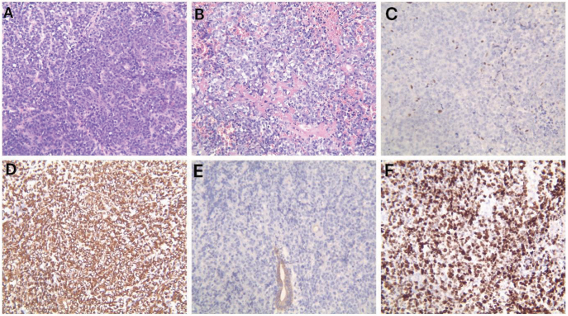
Figure 3: Hematoxylin-eosin and immunohistochemical staining of SDUS lesions. (A) Tumor cells were epithelioid cells, with abundant cytoplasm and eosinophilic. (200×); (B) Tumor necrosis area (200×). (C) Tumor cells showed the lack of expression of SMARCA4. (D) Tumor cells showed Vimentin expression. (E) Tumor cells showed the lack of expression of AE1/AE3.(F) the tumor cells showed a high (90%) Ki-67 proliferation index.
After discussion, the patient underwent total hysterectomy and bilateral salpingo-oophorectomy. After the operation, we can see a pattern of tissue was found from the internal opening of the cervix to the external opening of the cervix (Figure 1A). The location is consistent with the previously reported cases about SUDS. Postoperative examination results showed that cervical malignancy was SMARACA4 deficient uterine sarcoma, no clear vascular and nerve invasion was observed. We also found another pattern of tissue with a diameter of 0.3cm at the bottom of the uterine wall behind the uterine cavity.
Pathological reports showed that focal endometrial carcinoma. Considering that the patient had a large lesion scope, poor tissue differentiation, the lesion was located in the cervix, and the prognosis was poor, the patient was treated with supplementary radiotherapy and chemotherapy after surgery. The patient was referred to a county hospital for external irradiation and 4 times chemotherapy (paclitaxel and cisplatin) treatment. But the patient passed away 7 months after surgery.
DISCUSSION
SMARCA4 is a tumor suppressor gene, a member of the SWI/SNF chromosome remodeling complex [5]. SMARCA4 genes encode the production of BRG1 protein, an ATP dependent transcriptional activator, and the deletion of BRG1 protein which can lead to the development of malignant tumors. In the field of gynecology, SMARCA4 deficiency occurs in ovarian small cell carcinoma, hypercalcemia type (SCCOHT), and Undifferentiated and Dedifferentiated Endometrial Carcinoma (UDEC) [6-9]. In 2018, Kolin et al., first proposed SMARACA4 Deficient Undifferentiated Uterine Sarcoma (SDUS) [10]. Lin et al., subsequently added 16 new cases, further expanding the characteristics of this type of tumor [11].
SMARACA4 deficient undifferentiated uterine sarcoma is clinically invasive. In the case report of Kolin et al. the median age is 33 years old [10], while Lin et al., reported that the median age of the disease was 49 years old [11]. Our patient is 55 years old, which is similar with the study of Lin et al., 80% to 90% of cases are presented with FIGO stage III or above [11], often with cervical or uterine tumors and vaginal bleeding and the invasion extends beyond the uterus. Our patient’s lesion is located in the cervix, the symptom is postmenopausal vaginal bleeding, which is similar to the characteristics of this case. In Kolin’s study, the median overall survival of patients was only 7-9months [10-12]. Our patient died 7 months after a clear diagnosis. It has been proved poor prognosis of this disease, and even active treatment cannot change the outcome.
SMARACA4 deficient undifferentiated uterine sarcoma often shows diffuse epithelioid large cells with rhabdomytic morphology, abundant cytoplasm, some small cells and spindle cells, eosinophilic cytoplasm, and distinct nucleoli. The typical immunohistochemical manifestation is the deletion of SMARCA4 expression. At the molecular level, SMARCA4-defificient uterine sarcoma is characterized by truncating mutations (nonsense, frame shift, or inversions). Lin’s study found that 81% of SMARCA4-deficient uterine sarcoma genes were only SMARCA4 deletion, without additional carcinogenic changes, and 19% of them showed changes in pathogenicity in genes other than SMARCA4, such as TP53, RB1 and CTNNB1, indicating that SMARCA4 inactivation is the main driving event of tumor occurrence [11-13]. Therefore, through the test of SMARCA4 gene, the diagnosis of the disease can be clear. Our patient’s tumor cells exhibit diffuse distribution of epithelial cells, with abundant eosinophilic cytoplasm. Tumor cells were epithelioid medium-to-large cells. Immunohistochemical results confirmed the absence of SMARCA4 expression, but declined genetic testing for financial reasons.
The diagnosis of SDUS should be differentiated from small cell carcinoma of the ovary hypercalcaemic type and undifferentiated/dedifferentiated carcinoma. especially from hypercalcemic small cell carcinoma of ovary (SCCOHT), both of which show loss of SMARCA4 expression, but can be distinguished by clinical manifestations. SDUS, most of which originate from the uterus, are mainly manifested as cervical mass and vaginal bleeding. The lesions may involve bilateral fallopian tubes or bilateral ovaries. Immunohistochemistry shows that WT1 is negative. SCCOHT usually presents as a mass in the ovary, mainly manifested as abdominal distension and abdominal pain. The morphological characteristics of SDUS and undifferentiated endometrial cancer cells are similar, both of which can present as epithelioid cells, high mitosis rate, necrosis and infiltration of lymphatic vascular space. The cytological morphology of most SDUS patients is uniform atypical cells, some of which may have matrix hyalinization and foliate structure. However, it is difficult to distinguish SDUS by cytological morphology alone. The differential diagnosis was mainly made by immunohistochemistry. Immunohistochemistry shows loss of SMARCA4 expression, retention/integrity of SMARCB1 and MMR staining, and loss of epithelial markers such as keratin, EMA, and claudin-4 expression. The sensitivity and specificity of this method reach 100% and 92% [12]. At the molecular level, mutations of TP53, PTEN and PIK3CA are common in UDEC, while only SMARCA4 deletion is found in SDUS. Therefore, identifying the source of tumor, clinical manifestations, the use of immunohistochemical and genetic tests can help diagnose SDUS.
The treatment of cervical sarcoma mainly involves total hysterectomy and double adnexal resection. There is no consensus on whether to clean lymph nodes, most studies have found that lymph node dissection for cervical sarcoma is of little significance [12-16], among which 67 patients with cervical leiomyosarcoma who had pelvic lymph nodes removed did not find metastatic lesions,and only 3% of cervical adenosarcoma patients had lymph node metastasis [2]. Lin et al. [11], found that most SMARCA4-deficient uterine sarcoma presented lymphatic vessel infiltration, and 31% of tumors presented lymph node metastasis if lymph node dissection was performed. However, stage I patients only accounted for 3% in this research, and most of them were advanced patients, who still need sufficient case analysis to confirm the relationship between tumor and lymphatic vessels. In this case, the stage of our patient was earlier, and no suspicious lymph node metastasis was observed by abdominal pelvic CT and MRI before surgery. Therefore, total hysterectomy with double adnexal resection was performed according to the treatment of uterine sarcoma, without lymph node excision. Postoperative examination results confirmed that the patient was complicated with stage IA endometrial cancer. The lesion area of endometrial cancer is less than 2cm, and the invasion depth of cancer tissue is relatively shallow (<1/4 of the uterine myometrium). The degree of differentiation is G1, and there are no enlarged lymph nodes. Lymph node resection was not allowed according to Mayo criteria, so pelvic lymph node resection was not performed again. This can avoid excessive medical treatment, reduce the physical harm and economic burden on patients. Meanwhile, our patient’s postoperative survival period is 7 months, similar to previous reports of pelvic lymph node dissection. Therefore, considering pelvic lymph node dissection does not improve prognosis.
Among the known cases reported so far, most of them are retrospective individual cases, lacking multi-center studies, and it has been found that combined treatment with surgery, chemotherapy and radiotherapy can improve the overall survival rate and prognosis of patients [10-14]. Palliative radiation therapy seems to be a good treatment option for metastatic SMARCA4-deficient undifferentiated uterine sarcoma, especially low-dose radiation therapy not only ameliorated the symptoms but also reduced in a significant radiologic response [17]. Our patient continued to receive supplementary radiotherapy and chemotherapy after surgery, but she passed away 7 months. Considering the poor prognosis of the disease, more case studies are needed to summarize and find better treatment plans.
Clear diagnosis of SMARCA4-deficient uterine sarcoma plays an important role in subsequent treatment, and targeted therapy has attracted increasing attention in the treatment of SMARCA4-deficient tumors. Studies have found that anti-PD-1 and PDL-1 have anti-proliferation effects when used in the treatment of SCCOHT [15,16], CDK4-6 inhibitors are very sensitive to SMARCA4-deficient lung non-small cell lung cancer and hypercalcium-type small cell carcinoma of the ovary [10-19]. EZH2 inhibitors induce anti-proliferation and anti-tumor effects in SMARCA4-deficient tumors [15-20]. As SCCOHT and SDUS both show loss of SMARCA4 expression and as both are low mutation load tumors?high immunogenicity and the similarity in invasiveness and genetics, these drugs are considered for the treatment of SMARCA4-deficient uterine sarcoma. But there is one patient with SDUS underwent tumor immune microenvironment research. The results showed its immunogenicity is weak. Considering the poor efficacy of immunotherapy. We need to find more study of SUDS and extended treatment methods [21].
Two cases of SMARCA4-deficient tumors were identified in one family in Connor’s study. Five months after the death of a 32-year-old daughter with SMARCA4-mutated hypercalcium-type small cell carcinoma of the ovary, her 55-year-old mother was diagnosed with SMARACA4 deficient uterine sarcoma. Although the two patients were actively treated with surgery and chemotherapy after diagnosis, they died after 6 months and 9 months, respectively, which proved that the disease was characterized by familial inheritance, strong invasiveness and poor prognosis. Considering that SMARCA4 deletion is the only pathogenic/carcinogenic driving mutation, only this gene test can be performed to reduce the economic burden and shorten the testing time. Therefore, if conditions permit, genetic testing should be conducted for patients with SDUS to identify the hereditary cancer risk in the family [22]. If a germ line mutation is found, male family members should be recommended for genetic monitoring, given that male carriers may pass on the mutated gene to their female offspring, increasing their risk of developing the disease. All family members at risk should be offered genetic testing and further genetic counselling and treatment advice.
CONCLUSION
SMARCA4 deficient uterine sarcoma has been discovered and diagnosed in recent years. Most of the reported cases are retrospective cases, and relevant immunohistochemical and genetic tests have been performed to confirm the diagnosis. In our case, the patient’s staging was early and no significant lymph node enlargement was observed in pelvic imaging, during the surgery, pelvic lymph nodes were not removed, and the patient’s survival time was not significantly shortened. Therefore, we hoped that the report of this case can provide certain clinical evidence for the diagnosis and treatment of this tumor, so as to develop a unified and standardized diagnosis and treatment plan as soon as possible, find out the high-risk factors affecting the prognosis of the disease, and guide genetic counseling. The diagnosis of this case relies on immunohistochemical markers without molecular evidence. Single-cell sequencing may be performed in future studies to further understand the pathogenesis of the disease
CRediT Authorship Contribution Statement
Na Feng: Conceptualization, Investigation, Methodology, Writing- review & editing Writing-original draft. Lingyun Wei: Data curation. Peng Yang: Data curation. Caifeng Si: Data curation. Xiaochun Liu: conceptualization, Writing-review & editing.
REFERENCES
- Mbatani N, AB Olawaiye, J Prat, Uterine sarcomas. International journal of gynaecology and obstetrics: the official organ of the International Federation of Gynaecology and Obstetrics, 2018; 143: 51-58.
- Bansal S, Lewin SN, Burke WM, Deutsch I, Sun X, Herzog TJ, et al. Sarcoma of the cervix: natural history and outcomes. Gynecol Oncol. 2010; 118: 134-138.
- Baa AK, Rastogi S, Tripathy S, Shamim SA, Menon S. Unfolding the rarity of SMARCA4 deficient uterine sarcoma (SDUS): A case report. Gynecol Oncol Rep. 2021; 37: 100788.
- Nakra T, Kakkar A, Mathur SR, Jain D, Kumar S. SMARCA4-deficient Undifferentiated Uterine Sarcoma: Clinicopathological Features of an Emerging Entity. Int J Surg Pathol. 2023; 31: 104-109.
- Savas S, Skardasi G. The SWI/SNF complex subunit genes: Their functions, variations, and links to risk and survival outcomes in human cancers. Crit Rev Oncol Hematol. 2018; 123: 114-131.
- Witkowski L, Carrot-Zhang J, Albrecht S, Fahiminiya S, Hamel N, Tomiak E, et al. Germline and somatic SMARCA4 mutations characterize small cell carcinoma of the ovary, hypercalcemic type. Nat Genet. 2014; 46: 438-443.
- Karnezis AN, Hoang LN, Coatham M, Ravn S, Almadani N, Tessier-Cloutier B, et al. Loss of switch/sucrose non-fermenting complex protein expression is associated with dedifferentiation in endometrial carcinomas. Mod Pathol. 2016; 29: 302-314.
- Ramos P, Karnezis AN, Craig DW, Sekulic A, Russell ML, Hendricks WP, et al. Small cell carcinoma of the ovary, hypercalcemic type, displays frequent inactivating germline and somatic mutations in SMARCA4. Nat Genet. 2014; 46: 427-429.
- Jelinic P, Mueller JJ, Olvera N, Dao F, Scott SN, Shah R, et al. Recurrent SMARCA4 mutations in small cell carcinoma of the ovary. Nat Genet. 2014; 46: 424-426.
- Kolin DL, Dong F, Baltay M, Lindeman N, MacConaill L, Nucci MR, et al. SMARCA4-deficient undifferentiated uterine sarcoma (malignant rhabdoid tumor of the uterus): a clinicopathologic entity distinct from undifferentiated carcinoma. Mod Pathol. 2018; 31: 1442-1456.
- Lin DI, Allen JM, Hecht JL, Killian JK, Ngo NT, Edgerly C, et al. SMARCA4 inactivation defines a subset of undifferentiated uterine sarcomas with rhabdoid and small cell features and germline mutation association. Mod Pathol. 2019; 32: 1675-1687.
- Kolin DL, Quick CM, Dong F, Fletcher CDM, Stewart CJR, Soma A, et al. SMARCA4-deficient Uterine Sarcoma and Undifferentiated Endometrial Carcinoma Are Distinct Clinicopathologic Entities. Am J Surg Pathol. 2020; 44: 263-270.
- Karnezis AN, Wang Y, Ramos P, Hendricks WP, Oliva E, D’Angelo E, et al. Dual loss of the SWI/SNF complex ATPases SMARCA4/BRG1 and SMARCA2/BRM is highly sensitive and specific for small cell carcinoma of the ovary, hypercalcaemic type. J Pathol. 2016; 238: 389-400.
- Khosla D, Gupta R, Srinivasan R, Patel FD, Rajwanshi A. Sarcomas of uterine cervix: clinicopathological features, treatment, and outcome. Int J Gynecol Cancer. 2012; 22: 1026-1030.
- Chan-Penebre E, Armstrong K, Drew A, Grassian AR, Feldman I, Knutson SK, et al. Selective Killing of SMARCA2- and SMARCA4-deficient Small Cell Carcinoma of the Ovary, Hypercalcemic Type Cells by Inhibition of EZH2: In Vitro and In Vivo Preclinical Models. Mol Cancer Ther. 2017; 16: 850-860.
- Jelinic P, Ricca J, Van Oudenhove E, Olvera N, Merghoub T, Levine DA, et al. Immune-Active Microenvironment in Small Cell Carcinoma of the Ovary, Hypercalcemic Type: Rationale for Immune Checkpoint Blockade. J Natl Cancer Inst. 2018; 110: 787-790.
- Kurokawa M, Shimizuguchi T, Ito K, Takao M, Motoi T, Taguchi A, et al. Notable Response of SMARCA4-Deficient Undifferentiated Uterine Sarcoma to Palliative Radiation Therapy. Adv Radiat Oncol. 2021; 6: 100728.
- Xue Y, Meehan B, Macdonald E, Venneti S, Wang XQD, Witkowski L, et al. CDK4/6 inhibitors target SMARCA4-determined cyclin D1 deficiency in hypercalcemic small cell carcinoma of the ovary. Nat Commun. 2019; 10: 558.
- Xue Y, Meehan B, Fu Z, Wang QXD, Fiset PO, et al. SMARCA4 loss is synthetic lethal with CDK4/6 inhibition in non-small cell lung cancer. Nature communications, 2019; 10: 557.
- Kurmasheva RT, Sammons M, Favours E, Wu J, Kurmashev D, Cosmopoulos K, Keilhack H, et al. Initial testing (stage 1) of tazemetostat (EPZ-6438), a novel EZH2 inhibitor, by the Pediatric Preclinical Testing Program. Pediatr Blood Cancer. 2017; 64: 10.
- Gao J, Fan R, Chen D, Hou J, Chen H, Lu M. Pathological characteristics and immune microenvironment of SMARCA4-deficient undifferentiated uterine sarcoma. Diagn Pathol. 2023; 18: 62.
- Connor YD, Miao D, Lin DI, Hayne C, Howitt BE, Dalrymple JL, et al. Germline mutations of SMARCA4 in small cell carcinoma of the ovary, hypercalcemic type and in SMARCA4-deficient undifferentiated uterine sarcoma: Clinical features of a single family and comparison of large cohorts. Gynecol Oncol. 2020; 157: 106-114.