Dual Transition of HIV/AIDS in Asia: Rising Prevalence, Aging Survivors, and Widening Inequalities: A GBD 1990-2023 Analysis with Projections to 2040
- 1. The affiliated Hospital of Guizhou Medical University, China
- #. These authors have contributed equally to this work
Abstract
Objective: To characterize spatiotemporal trends, age-period-cohort dynamics, and health inequalities of HIV/AIDS in Asia from 1990 to 2023, and project the burden to 2040, with a specific focus on older adults.
Methods: Using Global Burden of Disease (GBD) 2023 data from 49 Asian countries and territories, we estimated prevalence, incidence, mortality, and disability-adjusted life years (DALYs), with age-standardized rates (ASR). Joinpoint regression assessed temporal trends. Age-period-cohort (APC) effects were examined, and Das Gupta decomposition identified drivers of burden change. Frontier analysis and health inequality indices (Slope Index of Inequality, Concentration Index) were linked to the Socio-demographic Index (SDI). Bayesian APC models projected the burden from 2024 to 2040.
Results: In 2023, approximately 4.70 million people were living with HIV/AIDS in Asia (ASPR: 90.18/100,000). Southeast Asia had the highest prevalence and mortality, while Central Asia had the highest incidence (ASIR: 22.22/100,000). From 1990 to 2023, ASPR increased (EAPC=4.64%), whereas ASIR declined (EAPC=-1.04%). Adults aged ≥65 years showed a persistent ASPR increase throughout the entire period. The Slope Index of Inequality shifted from positive (10.80 in 1990) to negative (-97.57 in 2023), indicating absolute burden concentration in lower-SDI regions. Projections to 2040 indicate that ASPR will continue rising, while ASIR, ASMR, and ASDR will decline.
Conclusions: Asia faces a dual transition characterized by rising prevalence, aging survivors, and widening absolute health inequalities. Future strategies must move beyond infection control toward integrated, life-course management specifically targeting the growing chronic disease burden among older people living with HIV.
Keywords
• HIV/AIDS
• Asia
• Aging
• Health inequalities
• Disease burden
Citation
Li C, Wang H, Shen X, Liu F, Wu H,, et al. (2026) Dual Transition of HIV/AIDS in Asia: Rising Prevalence, Aging Survivors, and Widening Inequalities: A GBD 1990-2023 Analysis with Projections to 2040. Ann Clin Med Microbiol 9(1): 1035.
BACKGROUND
Human immunodeficiency virus (HIV) infection and acquired immunodeficiency syndrome (AIDS) remain leading causes of disease-related mortality worldwide and pose a sustained global public health challenge [1]. As of 2023, approximately 39.9 million people were living with HIV globally, with 1.3 million new infections and 630,000 AIDS-related deaths recorded in that year (UNAIDS, 2024). The widespread rollout of combination antiretroviral therapy (ART) has transformed HIV into a manageable chronic condition. People living with HIV (PLHIV) on sustained ART in high-income settings can now achieve near-normal life expectancy [2,3]. Nevertheless,this therapeutic success has introduced new long-term challenges. PLHIV face an accelerated accumulation of age related comorbidities—including cardiovascular disease, malignancies, metabolic disorders, and neurocognitive impairment—that emerge at younger ages and with greater frequency than in the general population [4,5]. The early initiation of ART, as demonstrated by the landmark INSIGHT START trial, further extends survival [6], which may paradoxically compound the burden of HIV-associated comorbidities. These observations underscore the urgent need for comprehensive, life-course approaches to HIV care, particularly in regions undergoing rapid demographic aging alongside expanding ART coverage.
Asia is home to approximately 60% of the global population and bears a substantial, epidemiologically heterogeneous share of the global HIV/AIDS burden. The region encompasses diverse transmission dynamics— including unprotected sex among men who have sex with men (MSM), heterosexual transmission, and injecting drug use—that vary markedly across subregions [7]. Concurrently, Asia is undergoing an unprecedented demographic transition: the population aged 65 years and older is projected to rise from 8.7% in 2020 to 18.8% by 2050, reaching approximately 950 million [8]. This accelerating population aging, combined with rapid urbanization, persistent socioeconomic disparities, and pronounced heterogeneity in healthcare infrastructure and epidemic control capacity, is profoundly reshaping the regional HIV/AIDS landscape.
Despite this substantial burden, rigorous region wide analyses that systematically characterize the spatiotemporal evolution, age-period-cohort dynamics, sociodemographic determinants, and health inequality dimensions of the HIV/AIDS burden across Asia remain scarce. The Global Burden of Disease (GBD) study provides a standardized, comprehensive framework for cross-national disease burden quantification [9,10]. Compared with previous GBD rounds, the 2023 update includes newly available HIV surveillance data from several Asian countries, enabling more precise estimation of recent epidemic trajectories and reducing model based uncertainty in low Socio-demographic Index (SDI) settings. Building on this resource, the present study aims to characterize the spatiotemporal evolution of HIV/AIDS burden across 49 Asian countries and territories from 1990 to 2023 and project future trends through 2040. We employ a suite of analytical tools—including Joinpoint regression, age-period-cohort modeling, Das Gupta decomposition, frontier analysis, health inequality indices, and Bayesian age-period-cohort projection models— to generate actionable evidence for regionally tailored prevention and control strategies across Asia’s diverse populations.
METHODS
Data sources and indicator calculation
All data were derived from the Global Burden of Disease (GBD) study. As the GBD database does not provide aggregate epidemiological data for “Asia” as a whole, we adopted the definition of Asia specified by the United Nations Statistics Division (UNSD) and included 49 Asian countries and territories. Country-level data were downloaded separately from the GBD website and integrated for analysis. Subregional analyses were conducted for four geographic subregions: East Asia, Southeast Asia, South Asia, and Central Asia. The study period spanned 1990 to 2023. Epidemiological indicators included prevalent cases, incident cases, deaths, and disability-adjusted life years (DALYs). Demographic data were also obtained for standardization. Key calculated indicators included age-standardized prevalence rate (ASPR), incidence rate (ASIR), mortality rate (ASMR), and DALY rate (ASDR).
Descriptive analysis of disease burden
Descriptive analyses were performed on HIV/AIDS prevalence, incidence, deaths, and DALYs across Asia from 1990 to 2023. For each region and year, we calculated the number of prevalent cases, incident cases, deaths, DALYs, ASPR, ASIR, ASMR, and ASDR, along with percentage changes over 1990-2023. Heatmaps illustrated the geographic distribution of the HIV/AIDS burden.
Joinpoint regression analysis
Joinpoint regression models analyzed temporal trends in age-standardized HIV/AIDS rates from 1990 to 2023. Standard errors of age-standardized rates were calculated in R and imported into Joinpoint software (version 4.9.1.0), with calendar year as the independent variable, age standardized rate as the dependent variable, and region as the grouping variable. A maximum of five joinpoints was permitted at a 95% confidence level. Results are expressed as annual percent change (APC) and estimated annual percent change (EAPC) with 95% confidence intervals.
Age-period-cohort analysis
To investigate temporal dynamics, data from 1990 1993 were excluded due to higher uncertainty in early surveillance reporting. The remaining data (1994-2023) were grouped into five-year intervals and uploaded to the APC web tool. Relative risks for age, period, and cohort effects were calculated and plotted. Local drift values— representing the annual percentage change in disease risk relative to the preceding age group—were derived for each age group.
Decomposition analysis
The Das Gupta decomposition method quantified the contributions of population size (demographic effect), age structure (aging effect), and epidemiological change (epidemiological effect) to changes in HIV/AIDS burden. Analyses were performed for the overall Asian population, by sex, and by subregion.
Frontier analysis
To explore the association between HIV/AIDS burden and socioeconomic development, data envelopment analysis (DEA) was applied to 49 Asian countries and territories, examining the efficiency frontier between SDI and ASDR. The free disposal hull (FDH) model constructed a nonlinear production frontier, and locally weighted scatterplot smoothing (LOWESS) generated a smoothed frontier curve. Super-efficient observations (i.e., outliers lying below the frontier) were excluded to ensure robustness. The resulting DEA frontier reflects the theoretically optimal ASDR achievable at a given SDI level, providing a benchmark for evaluating national HIV/AIDS control performance.
Health inequality analysis
To assess health equity, the Slope Index of Inequality (SII) and Concentration Index (CI) were used to analyze the distribution of HIV/AIDS DALY rates in 1990 and 2023. The SII reflects absolute inequality, while the CI reflects relative inequality. Both indices were calculated annually from 1990 to 2023, and scatter plots compared the evolution of health inequality.
Projection analysis
Bayesian age-period-cohort (BAPC) models projected ASPR, ASIR, ASMR, and ASDR from 2024 to 2040. The BAPC model incorporates age, period, and cohort effects, estimates their posterior distributions by combining prior distributions with observed data, and generates future projections. All analyses and visualizations were performed using R 4.2.0. Statistical significance was set at P <0.05.
RESULTS
Geographic Distribution and Temporal Trends of HIV/ AIDS Disease Burden
In 2023, the estimated number of people living with HIV/AIDS in Asia was approximately 4.70 million (95% UI: 3.43-6.45 million), with an ASPR of 90.18 per 100,000 (95% UI: 65.41-124.21). Among subregions, Southeast Asia had the highest ASPR (229.15 per 100,000), followed by South Asia (109.51 per 100,000), while East Asia had the lowest (31.23 per 100,000). At the country level, Thailand had the highest ASPR (601.37 per 100,000), while Kuwait had the lowest (1.87 per 100,000).
Approximately 276,606 new cases occurred in 2023 (95% UI: 153,297-458,261), with an ASIR of 5.71 per 100,000 (95% UI: 3.19-9.42). Central Asia had the highest ASIR (22.22 per 100,000), followed by Southeast Asia (15.45 per 100,000), while East Asia had the lowest (2.33 per 100,000). The Philippines had the highest national ASIR (42.77 per 100,000), followed by Kyrgyzstan (33.77) and Kazakhstan (28.72), while Jordan had the lowest (0.13).
In 2023, approximately 134,467 HIV/AIDS deaths occurred (95% UI: 67,404-230,723), with an ASMR of 2.57 per 100,000 (95% UI: 1.29-4.40). Southeast Asia had the highest ASMR (5.66 per 100,000), followed by South Asia (2.90 per 100,000), while Central Asia had the lowest (1.37). Total DALYs were 6.82 million (95% UI: 3.63 11.37 million), with an ASDR of 133.14 per 100,000 (95% UI: 70.91-221.92). Southeast Asia had the highest ASDR (305.93 per 100,000), followed by South Asia (148.97 per 100,000), while East Asia had the lowest (69.91). Thailand had the highest national ASDR (886.56 per 100,000), while Kuwait had the lowest (3.79) (Tables 1-2) (Figure 1).
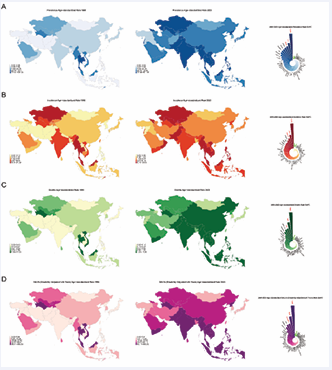
Figure 1: Spatial distribution and temporal trends of the HIV/AIDS disease burden in Asia (1990–2023). Age-standardized (per 100,000 population) prevalence rate (A), incidence rate (B), mortality rate (C), and DALY rate (D) of HIV/AIDS in Asia and their changes over time. Each indicator includes three panels: left, distribution in 1990; middle, distribution in 2023; right, estimated annual percentage change (EAPC) from 1990 to 2023. Color intensity represents the magnitude of disease burden. In EAPC panels, red denotes the three countries with the fastest increase and green denotes the three countries with the fastest decline.
From 1990 to 2023, ASPR increased overall (EAPC= 4.64%), with the fastest rises in Pakistan (35.15%), Nepal (23.15%), and Georgia (19.50%). ASIR declined overall (EAPC=–1.04%), with the largest increases in Pakistan (31.17%), Armenia (17.18%), and Bangladesh (13.19%), and the fastest declines in Singapore (-5.57%), Qatar (-5.54%), and Thailand (-3.73%). ASMR increased overall (EAPC= 4.05%), with the greatest increases in Pakistan (42.83%), Nepal (28.39%), and Laos (19.66%), and declines in Israel (-4.95%), Azerbaijan (-3.43%), and Qatar (-1.81%). ASDR similarly increased overall (EAPC=3.59%) (Tables 1-2).
Age and Sex Distribution of HIV/AIDS Disease Burden
Age-specific analyses revealed pronounced age and sex patterns. In absolute numbers, prevalent cases, deaths, and DALYs peaked in the 35–39 age group: males had approximately 431,123 prevalent cases, 11,549 deaths, and 658,932 DALYs; females had 251,069, 7,386, and 420,536, respectively. Incident cases peaked at age 20–24 in both sexes (males: 32,609; females: 16,192).
ASPR peaked at age 40–44 (males: 255.471 per 100,000; females: 155.826). ASIR peaked at age 20–24 (males: 18.083; females: 9.547). ASMR peaked at age 45 49 in males (7.332) and age 40–44 in females (4.761). ASDR peaked at age 40–44 in both sexes (males: 368.017; females: 246.617) (Figure 2A-D).
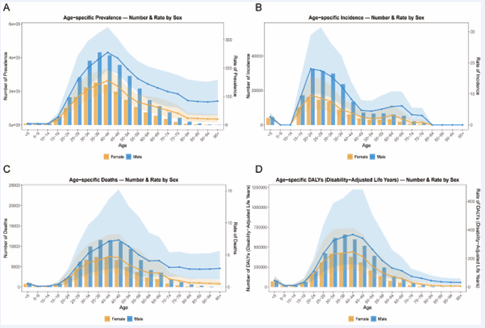
Figure 2: Age-specific distribution characteristics of the HIV/AIDS disease burden in Asia, by sex. (A) Age-specific prevalence rate. (B) Age specific incidence rate. (C) Age-specific mortality rate. (D) Age-specific DALY rate. Solid lines represent males, dashed lines represent females
Males bore a substantially higher burden than females across most age groups, with disparities most pronounced between ages 25 and 54, where male rates were 1.5- to 3-fold higher than female rates.
Joinpoint Regression Analysis
Joinpoint regression revealed distinct trends between the overall population and adults aged ≥65 years. In the overall population, ASPR showed a sustained upward trend with decelerating growth: rapid increases from 1990–1991 and 1992-1994 (APC= 62.09% and 31.68%), continued but slowing growth from 1995 2001 (APC=18.15% and 5.57%), a marginal decline from 2002–2012 (APC=−0.30%), and a modest renewed rise from 2013-2023 (APC=0.88%) (Figure 3A). ASIR showed an early increase followed by sustained decline: increases from 1990-1991 and 1992-1995 (APC=36.42% and 16.76%), decreases from 1996-2006 and 2007-2015 (APC=−3.91% and-2.75%), and stability from 2016-2023 (APC=−0.55%) (Figure 3B). ASMR rose sharply from 1990 2001 (APC=30.86% and 10.85%), decelerated from 2002 2005 (APC=2.54%), and entered sustained decline from 2006-2023 (APC=−4.13%) (Figure 3C). ASDR followed a similar trajectory, rising until 2003, stabilizing from 2004-2007 (APC=0.13%), and declining from 2007-2023 (APC=−4.33%) (Figure 3D).
In the≥65 years age group, ASPR rose persistently across the entire period: 1990-1995 (APC=24.30%), 1996-2005 (APC=14.13% and 6.67%), and 2006-2023 (APC=3.91% and 1.58%) (Figure 3E). ASIR increased from 1990-2004 (APC=25.58% and 3.33%), then declined in an accelerating pattern from 2005-2013 (APC=−4.43% and −11.07%) before moderating through 2023 (2014-2018: AP =−4.82%; 2019-2023: APC=−0.66%) (Figure 3F). Both ASMR and ASDR exhibited a rise–decline–rebound–decline pattern (Figures 3G,3H).
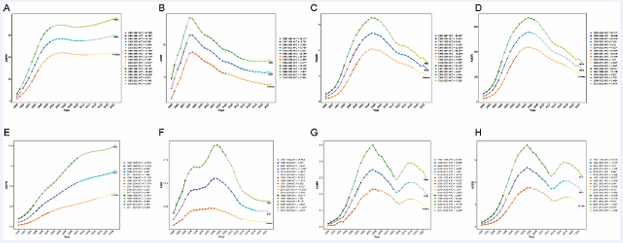
Figure 3: Joinpoint regression analysis of age-standardized HIV/AIDS rates in Asia, 1990–2023. Age-standardized (per 100,000 population) rates for the overall population and the elderly population (≥65 years): (A-D) overall population; (E-H) elderly population (≥65 years).
Age-Period-Cohort Analysis of HIV/AIDS
APC analysis revealed multidimensional changes. Age effects showed that prevalence increased continuously from approximately 6.5 per 100,000 at age 2.5 years to 117-124 per 100,000 at ages 32.5-37.5 years, remaining high in older ages (~220 at age 97.5). Incidence rose rapidly to a peak at age 22.5 (~40.1 per 100,000) then declined to near-zero. Mortality increased sharply after age 22.5, peaking at ages 32.5-42.5 (~7.4-7.7 per 100,000), then slightly declined. DALY rates peaked at age 32.5 (~448 per 100,000) then gradually declined (Figure 4A-D).
Period effects (reference: 2006.5, RR=1) showed persistent increases in prevalence (RR=1.405 in 2021.5), while incidence showed no significant trend. Mortality showed sustained decline (RR=0.410 in 1996.5 to 0.687 in 2021.5), with DALY rates following a similar pattern (Figure 4A-D).
Cohort effects indicated that early birth cohorts (1899s-1940s) had low HIV/AIDS risk; mid-century cohorts (1950s-1970s) experienced significantly elevated risk, peaking in the 1969-1974 cohort (mortality RR≈1.185 1.214); more recent cohorts (post-1980s) showed rapidly declining risk (Figure 4A-D).
Local drift analysis revealed positive growth in prevalence among middle-aged and older groups. Incidence showed negative growth in most age groups. Mortality and DALY rates showed significant negative growth in younger and young-adult groups (annual declines of~1%-4%) (Figure 4A-D).
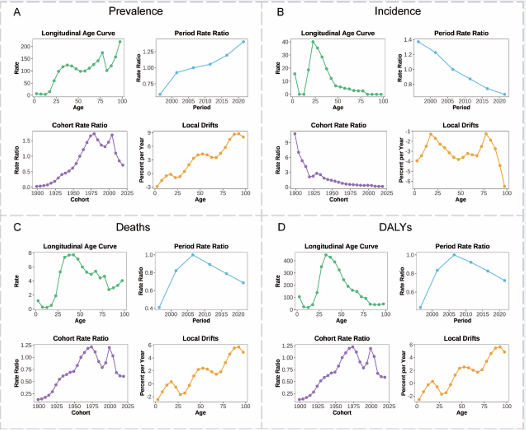
Figure 4: Age-period-cohort effect analysis of HIV/AIDS in Asia (1990–2023). (A-D) Age-period-cohort effects for HIV/AIDS prevalence, incidence, mortality, and DALYs, respectively. Upper left: age effect panel showing relative risk by age. Upper right: period effect panel with 2006.5 as the reference, showing relative risk at different time points. Lower left: cohort effect panel with the 1959 birth cohort as the reference, reflecting the cumulative effects of lifestyle and environmental exposures. Lower right: local drift panel showing the annual percentage change by age group, revealing dynamic trends in disease burden across different age groups.
Decomposition Analysis of HIV/AIDS Disease Burden
Das Gupta decomposition showed that changes in HIV/ AIDS burden from 1990 to 2023 were primarily driven by the epidemiological effect, with population growth and aging as secondary contributors.
For prevalence, the epidemiological effect accounted for 74.58% of the increase, followed by population growth (17.19%) and aging (8.24%). Subregionally, the epidemiological effect dominated across all four regions (Figure 5A-B). For incidence, the epidemiological effect contributed 59.05%, population growth 42.44%, and aging -1.5% (Figure 5C-D). For mortality and DALYs, the epidemiological effect contributed 70.76% and 73.02%, respectively (Figure 5E-H).
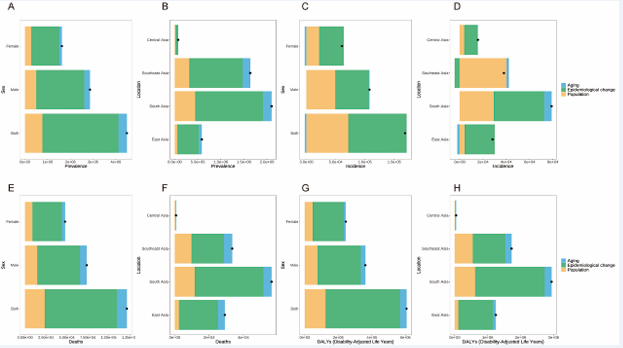
Figure 5: Decomposition analysis of changes in HIV/AIDS prevalence (A, B), incidence (C, D), mortality (E, F), and DALY (G, H) burden in Asia and its four subregions, 1990–2023. The four subregions are East Asia, Central Asia, South Asia, and Southeast Asia.
Frontier analysis of HIV/AIDS Disease Burden
DEA frontier analysis demonstrated a nonlinear inverse association between ASDR and SDI in Asia. The frontier curve declined steeply with increasing SDI, reflecting the strong mitigating effect of socioeconomic development (Figure 6A). In 2023, countries with medium SDI such as Thailand, Timor-Leste, Myanmar, Cambodia, and Vietnam had burdens far exceeding the frontier. High-SDI countries (e.g., Saudi Arabia, Brunei, UAE, Taiwan, Israel) had low burdens close to the frontier. Low-SDI countries (e.g., Afghanistan, Bangladesh, Yemen) had ASDR levels near the frontier (Figure 6B).
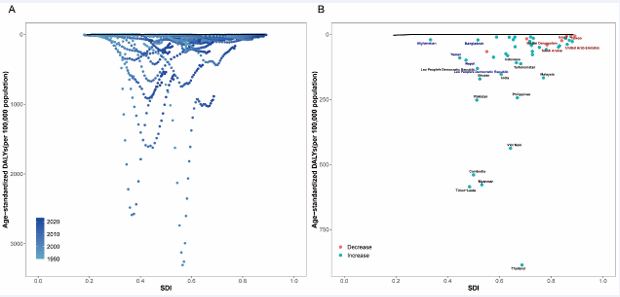
Figure 6: Association between the Socio-demographic Index (SDI) and age-standardized HIV/AIDS DALY rate, 1990–2023. (A) Scatter plot of SDI versus age-standardized HIV/AIDS DALY rate for 49 countries/territories, 1990–2023. The black curve represents the frontier production function, indicating the minimum DALY rate achievable at a given SDI level. Different colors represent different years. (B) Temporal trends in the age-standardized HIV/AIDS DALY rate for selected countries in 2023. The solid black curve represents the frontier production function; colored dashed lines represent country-specific DALY rate trends. Black labels indicate countries with the largest efficiency gap; blue labels indicate low SDI countries with the smallest efficiency gap; red labels indicate high-SDI countries with the largest efficiency gap.
Health Inequality Analysis
The SII shifted from positive to negative, declining from 10.80 in 1990 to -97.57 in 2023, indicating that absolute burden progressively concentrated away from high-SDI toward low-SDI regions (Figure 7A-B). The CI shifted from -0.477 in 1990 to 0.154 in 2023, reflecting redistribution of relative burden toward higher-SDI regions (Figure 7C D). Thus, while relative burden has shifted to higher-SDI regions, absolute disparity has widened substantially.
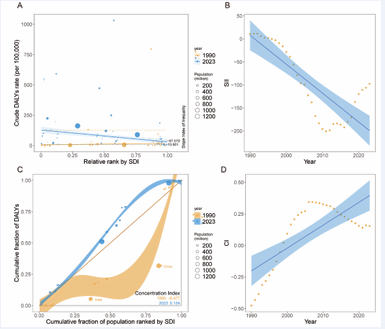
Figure 7: Health inequality analysis of HIV/AIDS DALY rates, 1990–2023. (A) Temporal trend of the Slope Index of Inequality (SII) for HIV/AIDS DALY rates, 1990–2023. The SII measures absolute inequality and the CI measures relative inequality in disease burden; larger absolute values indicate greater inequality. (B) Scatter plot of the SII for HIV/AIDS DALY rates, 1990–2023. (C) Inequality curve for HIV/AIDS DALY rates, with cumulative population share on the x-axis and cumulative DALY rate share on the y-axis. The dashed line represents perfect equality; greater deviation indicates greater inequality. (D) Scatter plot of the CI for HIV/AIDS DALY rates, 1990–2023.
Association between SDI and HIV/AIDS Burden in Asia
Spearman correlation analyses showed a significantly negative correlation between SDI and ASPR (Rs=−0.323, P=0.024). The negative correlation with ASIR did not reach significance (Rs=−0.281, P=0.050). Stronger negative correlations were observed for ASMR (Rs=−0.529, P<0.001) and ASDR (Rs=−0.521, P<0.001) (Figure 8A-D).
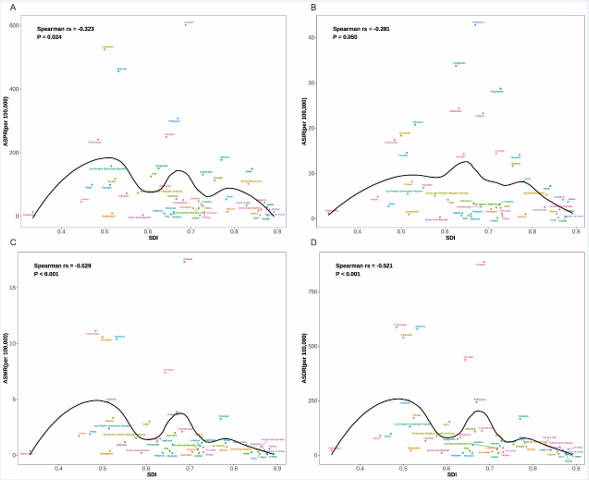
Figure 8: Association between SDI and age-standardized HIV/AIDS prevalence (A), incidence (B), mortality (C), and DALY (D) rates across Asian countries in 2023.
BAPC Model-Based Projections of HIV/AIDS Disease Burden
Under continuation of historical trends, BAPC projections indicate that from 2024 to 2040, ASPR will increase from 120.206 to 171.012 per 100,000. ASIR will decline from 5.519 to 3.189, ASMR from 2.444 to 0.800 (a 67.28% decrease), and ASDR from 129.435 to 45.519 (Figure 9A-D). In the ≥65 years age group, ASIR is projected to increase from 1.336 to 1.917 per 100,000 (+43.43%), and ASPR from 46.683 to 64.250. In contrast, ASMR is projected to decline from 1.306 to 0.380, and ASDR from 31.536 to 11.794 (Figure 9E-H).
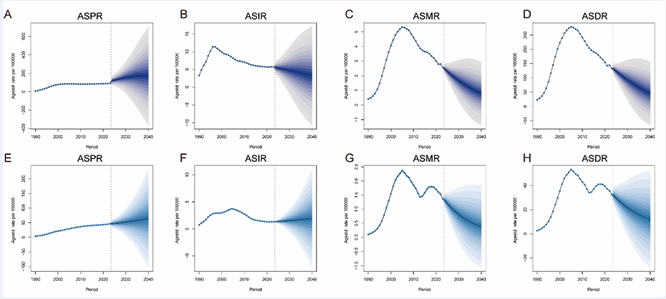
Figure 9: BAPC model-based projections of HIV/AIDS burden (prevalence, incidence, mortality, and DALYs) in the overall population and the elderly population (≥65 years) in Asia, 2024-2040. (A-D) Overall population; (E-H) elderly population (≥65 years).
DISCUSSION
This study provides a comprehensive, up-to-date assessment of the HIV/AIDS burden in Asia, revealing a region in the midst of a profound dual transition: a successful epidemiological transition towards lower mortality and chronic disease management, juxtaposed with an accelerating demographic transition towards an older population. Our core finding is that while Asia has made undeniable progress in controlling mortality, these successes are paradoxically driving a new set of challenges—a rising prevalence burden, a significant shift of disease burden towards older adults, and widening absolute health inequalities.
The sustained decline in ASMR and ASDR observed in our joinpoint analysis after 2005-2006 is a clear public health success, directly mirroring the period of large-scale ART rollout across Asia [11,12]. This finding aligns with UNAIDS reports showing that several Asian countries, including Thailand and Cambodia, achieved substantial ART coverage milestones by 2020 [8]. However, decomposition analysis pinpoints the “epidemiological effect” as the primary driver of rising prevalence. This paradox—falling mortality but rising prevalence—is the direct consequence of ART transforming HIV into a chronic disease [13]. The challenge, therefore, has shifted from preventing immediate death to managing a growing population of long-term survivors.
Our finding that the local drift for prevalence is positive in middle and older age groups, while negative for incidence, provides strong evidence that this is a survival driven accumulation of cases, not a failure of primary prevention alone. This contrasts with regions like sub Saharan Africa, where a decline in incidence plays a more dominant role in shaping prevalence trends [14]. A recent comparative study by GBD 2021 collaborators similarly noted that Asian epidemics are increasingly characterized by aging survivor populations, whereas African epidemics remain more driven by incident infections [1].
The most critical finding for future policy is the projected surge in burden among older adults (≥65 years). While overall ASIR is projected to decline, the model projects a relative increase of 43.4% in ASIR among older adults. As clarified in the Results, this is primarily a “denominator” and “reclassification” phenomenon—the aging of the large, mid-life cohort of PLHIV who acquired infection decades ago and are now surviving into older age due to ART [15]—though late-stage diagnoses among older individuals who remain at risk cannot be excluded [16]. A study from China, for example, found that the proportion of newly diagnosed HIV cases among individuals aged ≥50 years increased from 7.8% in 2010 to 24.5% in 2020 [17], supporting the importance of both mechanisms.
Our APC analysis showed that older cohorts (born pre-1970s) have higher mortality risk, and local drift shows positive prevalence growth in older groups. This demographic reality, combined with immunosenescence and comorbidity accumulation [4,5], means that older PLHIV will place unprecedented demands on healthcare systems not traditionally designed for them. For example, the co-management of HIV with cardiovascular disease, diabetes, and osteoporosis will become the norm[18]. Asian healthcare systems, many of which are still grappling with infectious disease control, must urgently prepare for this shift. We therefore recommend the immediate implementation of routine, annual geriatric screening protocols (e.g., for frailty, polypharmacy, cardiovascular risk) within all HIV clinics serving patients over age 50.
Our subregional and frontier analyses reveal stark heterogeneity, demanding differentiated strategies. Southeast Asia, as the frontier analysis shows, has a burden far exceeding expectations for its SDI level, suggesting systemic inefficiencies or gaps in intervention coverage for key populations [19]. This finding is consistent with a recent modeling study highlighting persistent HIV transmission among MSM in several Southeast Asian capitals [20]. Central Asia stands out with the highest ASIR, likely driven by ongoing transmission among PWID, where harm reduction services remain insufficient. A modeling analysis by Ward et al., estimated that switching from a criminalization to a public health approach for PWID in Central Asia could avert up to 40% of new infections—a finding that directly supports our policy recommendation.
The health inequality analysis provides a crucial, nuanced insight. While the relative burden (CI) has shifted towards higher-SDI regions (possibly due to better diagnosis and longer survival in those settings), the absolute burden (SII) has alarmingly concentrated in low-SDI countries. This divergence underscores that while high-SDI regions may have a higher “relative” burden due to diagnosis and survival, the human and health-system crisis in terms of absolute numbers of deaths and DALYs is intensifying in the poorest parts of Asia. Countries like Afghanistan, Yemen, and parts of South Asia are falling further behind. This pattern is often seen in later stages of an epidemic when effective treatment is available but not equitably distributed [21]. It underscores that ART access and chronic care capacity are not reaching the poorest populations. Therefore, international funding and technical assistance must pivot towards these low SDI settings to prevent them from becoming permanent reservoirs of high-burden, transmissible HIV.
Our findings both align with and extend beyond previous regional analyses. A 2019 GBD-based study on HIV in Asia [22], reported similar overall trends but did not specifically examine the aging transition or project to 2040. A UNAIDS regional report from 2022 highlighted progress in treatment coverage but lacked the quantitative decomposition and inequality analyses we provide. More recent country-specific studies have noted the aging trend in individual nations, but ours is the first to systematically quantify this phenomenon across all Asian subregions using harmonized methods and to project its future trajectory. This places our study in a unique position to inform regional policy.
Key strengths include: (1) the use of the most recent GBD 2023 data with expanded surveillance input from Asian countries; (2) a comprehensive suite of advanced analytical methods (APC, decomposition, frontier, BAPC) that allow multi-dimensional characterization; (3) specific focus on Asia’s dual transition, addressing a critical knowledge gap; (4) back-testing of BAPC projections and sensitivity analysis for COVID-19 to validate model performance.However, limitations must be acknowledged. First, GBD estimates for low-SDI countries rely on model based inference with potentially wide uncertainty intervals due to weak surveillance infrastructure. For example, estimates for Afghanistan and Yemen should be interpreted with particular caution. Second, the lack of GBD-stratified data on key populations (e.g MSM, PWID, female sex workers) limits our ability to model transmission dynamics directly and to assess intervention coverage by risk group; furthermore, GBD estimates for these populations carry substantial uncertainty. Third, our BAPC projections are based on historical trends and do not account for potential impacts of emerging curative strategies (e.g., broadly neutralizing antibodies, therapeutic vaccines), sudden policy changes, future pandemics beyond COVID-19, or the growing challenge of HIV drug resistance in Asia. Fourth, country-level aggregates may obscure significant intra country urban-rural disparities, as has been documented in large nations like India and China. Future research should aim for higher geographic resolution as subnational GBD data become available.
CONCLUSION
Asia stands at a critical crossroads in its HIV/AIDS response. The region has successfully reduced mortality, but this success has unveiled a new, more complex epidemic characterized by rising prevalence, rapid aging of the survivor population, and widening absolute health inequalities. Our projections indicate that the future burden will be increasingly defined by the chronic care needs of older PLHIV. Consequently, the public health paradigm must shift: from a sole focus on “ending AIDS as a public health threat” by 2030, to a life-course, integrated care model for the decades beyond.
This requires immediate action: (1) prioritizing integrated HIV-geriatric care models in high-burden, rapidly-aging settings like Southeast and East Asia, including routine screening for cardiovascular disease, diabetes, and osteoporosis in older PLHIV; (2) scaling up harm reduction (e.g., needle-syringe programs, opioid agonist therapy) and targeted testing for key populations in Central and South Asia, where transmission remains concentrated; and (3) reorienting international resources to close the widening absolute gap in low-SDI countries, with specific attention to Afghanistan, Yemen, and parts of Pakistan. Without this strategic pivot, the growing population of aging PLHIV in Asia will face a diminished quality of life and place an unsustainable burden on overstretched health systems.
Ethics Declaration
This study utilized de-identified data from the publicly available GBD database and did not require ethical approval. The reporting of this study adhered to the Guidelines for Accurate and Transparent Health Estimates Reporting (GATHER) statement.
Data Availability Statement
The data used were publicly available for this study. The website of the data is https://vizhub.healthdata.org/ gbd-results/.
Funding
This work was supported by grants from the following sources: Key Laboratory of Infectious Diseases and Liver Diseases (University Key Laboratory) [2024] FY006 and 2023 Major, Infectious Disease Prevention and Control- Comprehensive HIV/AIDS Prevention and Treatment Project (Qian Cai She [2022] No. 162) and Guizhou Provincial Key Laboratory for Digestive System Diseases (Qiannan Science and Technology Cooperation Platform zsys (2025)021).
ACKNOWLEDGMENTS
We thank the Institute for Health Metrics and Evaluation (IHME) for providing access to the Global Burden of Disease (GBD) 2023 database. The authors also acknowledge the contributions of all investigators and collaborators involved in the GBD study.
REFERENCES
- Global, regional, and national burden of HIV/AIDS, 1990-2021, and forecasts to 2050, for 204
- countries and territories: the Global Burden of Disease Study 2021. Lancet HIV. 2024; 11: e807-e822
- Deeks SG, Lewin SR, Havlir DV. The end of AIDS: HIV infection as a chronic disease. Lancet (London, England). 2013; 382: 1525-1533
- Antiretroviral Therapy Cohort Collaboration. Life expectancy of individuals on combination antiretroviral therapy in high-income countries: a collaborative analysis of 14 cohort studies. Lancet (London, England). 2008; 372: 293-299.
- Guaraldi G, Orlando G, Zona S, Menozzi M, Carli F, Garlassi E, et al. Premature age-related comorbidities among HIV-infected persons compared with the general population. Clin Infect Dis. 2011; 53: 1120-1126
- Smit M, Brinkman K, Geerlings S, Smit C, Thyagarajan K, Sighem A, et al. Future challenges for clinical care of an ageing population infected with HIV: a modelling study. Lancet Infect Dis. 2015; 15: 810-818
- Lundgren JD, Babiker AG, Gordin F, Emery S, Grund B, Sharma S, et al. Initiation of Antiretroviral Therapy in Early Asymptomatic HIV Infection. NEJM. 2015; 373: 795-807
- Beyrer C, Baral SD, van Griensven F, Goodreau SM, Chariyalertsak S, Wirtz AL, et al. Global epidemiology of HIV infection in men who have sex with men. Lancet (London, England). 2012; 380: 367-377
- World demographic trends. Population Division of the Department of International Economic and Social Affairs, United Nations Secretariat. World Health Stat Q. 1987; 40: 6-21
- Global, regional, and national incidence, prevalence, and mortality of HIV, 1980-2017, and forecasts to 2030, for 195 countries and territories: a systematic analysis for the Global Burden of Diseases, Injuries, and Risk Factors Study 2017. Lancet HIV. 2019; 6: e831-e859
- Shen L, Zong Y, Zhao J, Yang Y, Li L, Li N, et al. Characterizing the skeletal muscle immune microenvironment for sarcopenia: insights from transcriptome analysis and histological validation. Front Immunol. 2024; 15: 1414387
- Garland JM, Mayan H, Kantor R. Treatment of Advanced HIV in the Modern Era. Drugs. 2025; 85: 883-909.
- Trickey A, Sabin CA, Burkholder G, Crane H, d’Arminio Monforte A, Egger M, et al. Life expectancy after 2015 of adults with HIV on long-term antiretroviral therapy in Europe and North America: a collaborative analysis of cohort studies. Lancet HIV. 2023; 10: e295-e307.
- Blair CS, Cambou MC, Landovitz RJ. Update on HIV Chemoprevention. Annu Rev Med. 2025; 76: 43-56.
- Lima VD, Zhu J, Barrios R, Toy J, Joy JB, Williams BG, et al. Longitudinal evolution of the HIV effective reproduction number following sequential expansion of treatment as prevention and pre-exposure prophylaxis in British Columbia, Canada: a population-level programme evaluation. Lancet HIV. 2024; 11: e461-e469
- Stoner MCD, Westreich D, Ahern J, Edwards J, Gómez-Olivé FX, Tollman SM, et al. Modeling Combination Interventions to Prevent Human Immunodeficiency Virus in Adolescent Girls and Young Women in South Africa (HIV Prevention Trials Network 068). Clin Infect Dis. 2021; 73: e1911-e1918
- Stover J, Glaubius R, Teng Y, Kelly S, Brown T, Hallett TB, et al. Modeling the epidemiological impact of the UNAIDS 2025 targets to end AIDS as a public health threat by 2030. PLoS Med. 2021; 18: e1003831.
- Gupta RK, Jordan MR, Sultan BJ, Hill A, Davis DH, Gregson J, et al. Global trends in antiretroviral resistance in treatment-naive individuals with HIV after rollout of antiretroviral treatment in resource-limited settings: a global collaborative study and meta-regression analysis. Lancet. 2012; 380: 1250-1258.
- Mathers BM, Degenhardt L, Phillips B, Wiessing L, Hickman M, Strathdee SA, et al. Global epidemiology of injecting drug use and HIV among people who inject drugs: a systematic review. Lancet. 2008; 372: 1733-1745.
- Cheung DH, Waratworawan W, Clatts MC, Colby D, Le GM, Kongjareon Y, et al. Sexual and Psychosocial Risk Burdens Associated With Online Sex Seeking Among Young Men Who Have Sex With Men: Cross-Sectional Study. J Med Internet Res. 2025; 27: e59072.
- Zhao R, Fairley CK, Cook AR, Phanuphak N, He S, Tieosapjaroen W, et al. Optimising HIV pre-exposure prophylaxis and testing strategies in men who have sex with men in Australia, Thailand, and China: a modelling study and cost-effectiveness analysis. Lancet Glob Health. 2024; 12: e243-e256
- Shiels MS, Cole SR, Kirk GD, Poole C. A meta-analysis of the incidence of non-AIDS cancers in HIV-infected individuals. J Acquir Immune Defic Syndr. 2009; 52: 611-622.
- Suguimoto SP, Techasrivichien T, Musumari PM, El-saaidi C, Lukhele BW, Ono-Kihara M, et al. Changing patterns of HIV epidemic in 30 years in East Asia. Curr HIV/AIDS Rep. 2014; 11: 134-145.