Electroconvulsive Therapy and Heat Shock Gene Inactivation in Neurodegenerative Diseases
- 1. Centre of Excellence in Alzheimer’s disease Research and Care, Edith Cowan University, Australia
- 2. School of Psychiatry and Clinical Neurosciences, The University of Western Australia, Australia
- 3. McCusker Alzheimer’s Research Foundation, Hollywood Medical Centre, Australia
Keywords
Electroconvulsive therapy; Mental disorders; Screening tests; Heat shock gene; Neurodegenerative diseases; Suprachiasmatic nucleus; Sirtuin 1; Diabetes; Circadian rhythm
Citation
Martins IJ (2018) Electroconvulsive Therapy and Heat Shock Gene Inactivation in Neurodegenerative Diseases. Ann Neurodegener Dis 3(1): 1028.
EDITORIAL
The global diabetes epidemic [1] is associated with accelerated aging and relevant to neurodegnerative diseases such as multiple sclerosis, Parkinson’s disease and Alzheimer’s disease. The major mental illnesses in diabetics are schizophrenia, bipolar disorders and depression. These mental illnesses lead to changes in mood, memory, cognition and behaviour in these individuals with potential screening plasma tests for early detection of these conditions. These mental disorders may be related to sleep disorders with relevance to alterations in the sleep/ wake cycle [2,3]. In diabetes and neurodegenerative diseases the major defect in the brain is related to the suprachiasmatic nucleus (SCN) and its dysregulation is connected to core body temperature regulation, non alcoholic fatty liver disease and metabolic disease [4,5]. Electroconvulsive therapy (ECT) is performed in patients with diabetes mellitus and psychiatric disorders such as severe depression and relevant to the use of anti-psychotic/antidepressant drugs [6,7]. The use of electroconvulsive therapy (Figure 1) is an established means to improve function in a variety of psychiatric and neurologic conditions such as multiple sclerosis, Parkinson’s disease and Alzheimer’s disease [8-11]. The therapeutic benefit of ECT has been indicated in various studies and in Alzheimer’s disease its use in particular is involved in the prevention uncontrolled agitation and aggression [10,11]. ECT studies indicate brain temperature increases [12] with relevance to electroconvulsive therapy stimulation [13,14]. Concerns over heat stress relevant to ECT associated memory loss/brain damage [15,16] may be relevant to irreversible inactivation of the genesand brain heat shock geneSirtuin 1 (Sirt 1) expression [17-19]. Sirt 1 is a NAD(+) dependent class III histone deacetylase (HDAC) protein that targets transcription factors to adapt gene expression to metabolic activity, insulin resistance and inflammation [4,5]. Sirt 1 is involved in neurogenesis, gluconeogenesis in the liver, cholesterol metabolism, mitochondrial biogenesis and adipocyte senescence/energy metabolism. Sirt 1 is a heat shock gene [20,21] that is responsible for the circadian regulation of heat shock proteins (HSP) with HSP associated with amyloid beta aggregation critical to the survival of neurons and peripheral cells [21,22]. Sirt 1 is important to prevent mitochondrial apoptosis and epilepsy induced stroke [23].
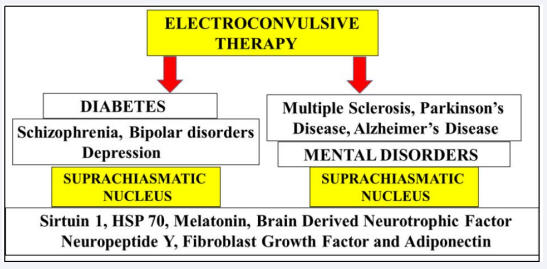
Figure 1: Electroconvulsive therapy stimulation (dose/frequency) should avoid heat stress and complete inactivation of the heat shock gene Sirtuin 1 and the suprachiasmatic nucleus relevant to mental disorders in diabetes and neurodegenerative diseases. Electroconvulsive therapy require assessment for SCN function with relevance to neuron death (mitochondrial apoptosis). ECT therapeutic technology should involve screening tests for Sirtuin 1 regulated proteins and hormones such as HSP 70, melatonin, brain derived neurotrophic factor, neuropeptide Y, fibroblast growth factor and adiponectin.
Sirt 1 is sensitive to temperature changes with elevated brain temperature associated with core body temperature disturbances [5]. Sirt 1 and the SCN [24] are closely connected with physiological temperatures relevant to central circadian control in the SCN [25] and related to mental illness in diabetes and neurodegenerative diseases [4]. SCN can synchronize circadian rhythms in other brain regions and peripheral tissuesbut ECT stimulation (dose/ frequency) should be carefully controlled [26,27] to avoid heat stress and complete SCN disruption (Figure 1) associated with heat therapy [28] in various neurologic conditions such as diabetes, multiple sclerosis, Parkinson’s disease and Alzheimer’s disease. Food quality can inactivate Sirt 1 with nutrigenomic diets essential for the maintenance and treatment of diabetes and neurologic conditions [29]. In the developing world diets that contain bacterial lipopolysaccharides (LPS), mycotoxinand xenobiotics repress Sirt 1. In the developed world unhealthy diets (without Sirt 1 activators) that contain excess calories inactivate Sirt 1 and the SCN with relevance to mental illnesses in diabetes and neurodegenerative diseases. The therapeutic benefit of ECT will depend on patients that are from the developing or developed world with relevance to diet, core body temperature disorders and synaptic plasticity defects [30,31]. ECT treatments in diabetic and psychiatric patients that disturb Sirt 1 regulation of the SCN (Figure 1) should involve blood tests that include plasma Sirt 1 regulated proteins and hormones such as HSP 70, melatonin, brain derived neurotrophic factor, neuropeptide Y, fibroblast growth factor and adiponectin [5,32-40].
CONCLUSION
ECT as an established technique and technology in a variety of psychiatric and neurologic conditions may require reassessment with relevance to memory loss and brain damage. The therapeutic benefit of ECT will depend on heat stress induction and inactivation of the heat shock gene Sirt 1 with relevance to mitochondrial apoptosis and neuron death. ECT and neurostimulation in diabetes and neurodegenerative diseases should allow intact SCN function and activation to avoid sleep/ wake disturbances, heat shock response dysregulation and induction of circadian abnormalities. ECT technology should be used with caution (dose/frequency) in psychiatric individuals with synaptic plasticity defects with relevance to unhealthy diets and core body temperature dysregulation. ECT application may now involve plasma tests for various Sirt 1 regulated protein hormones with relevance to SCN function and circadian signals.
ACKNOWLEDGEMENTS
This work was supported by grants from Edith Cowan University, the McCusker Alzheimer’s Research Foundation and the National Health and Medical Research Council.
REFERENCES
- Hu FB, Satija A, Manson JE. Curbing the Diabetes Pandemic: The Need for Global Policy Solutions. JAMA. 2015; 313: 2319-2320.
- Goder R, Hinrichsen I, Seeck-Hirschner M, Pfeiffer R, Weinhold L, Baier PC, et al. Sleep at baseline and after electroconvulsive therapy in patients with major depression. Psychiatry Res. 2016; 246: 683-687.
- Ospeck MC, Coffey B, Freeman D. Light-dark cycle memory in the mammalian suprachiasmatic nucleus. Biophys J. 2009; 97: 1513-1524.
- Martins IJ. Nutritional and Genotoxic Stress Contributes to Diabetes and Neurodegenerative Diseases such as Parkinson's and Alzheimer's Diseases. Frontiers in Clinical Drug Research -CNS and Neurological Disorders. 2015; 3: 158-192.
- Martins IJ. Regulation of Core Body Temperature and the Immune System Determines Species Longevity. Curr Updates Gerontol. 2017; 1: 6.
- Rasmussen KG, Ryan DA, Mueller PS. Blood glucose before and after ECT treatments in Type 2 diabetic patients. J ECT. 2006; 22: 124-126.
- Zolezzi M. Medication management during electroconvulsant therapy. Neuropsychiatr Dis Treat. 2016; 12: 931-939.
- Steen K, Narang P, Lippmann S. Electroconvulsive Therapy in Multiple Sclerosis. Innov Clin Neurosci. 2015; 12: 28-30.
- Narang P, Glowacki A, Lippmann S. Electroconvulsive Therapy Intervention for Parkinson's Disease. Innov Clin Neurosci. 2015; 12: 25-28.
- Sutor B, Rasmussen KG. Electroconvulsive therapy for agitation in Alzheimer disease: a case series. J ECT. 2008; 24: 239-241.
- van den Berg JF, Kruithof HC, Kok RM, Verwijk E, Spaans HP. Electroconvulsive Therapy for Agitation and Aggression in Dementia: A Systematic Review. Am J Geriatr Psychiatry. 2018; 26: 419-434.
- de Oliveira MM, Wen P, Ahfock T. Bio-heat transfer model of electroconvulsive therapy: Effect of biological properties on induced temperature variation. Conf Proc IEEE Eng Med Biol Soc. 2016; 2016: 3997-4000.
- Pirnia T, Joshi SH, Leaver AM,Vasavada M, Njau S, Woods RP, et al. Electroconvulsive therapy and structural neuroplasticity in neocortical, limbic and paralimbic cortex. Transl Psychiatry. 2016; 6: 832.
- Dukart J, Regen F, Kherif F, Colla M, Bajbouj M, Heuser I, et al. Electroconvulsive therapy-induced brain plasticity determines therapeutic outcome in mood disorders. Proc Natl Acad Sci USA. 2014; 111: 1156-1161.
- Donahue AB. Electroconvulsive therapy and memory loss: a personal journey. J ECT. 2000; 16: 133-143.
- MacQueen G, Parkin C, Marriott M, Bégin H, Hasey G. The long-term impact of treatment with electroconvulsive therapy on discrete memory systems in patients with bipolar disorder. J Psychiatry Neurosci. 2007; 32: 241-249.
- Pae CU, Mandelli L, Serretti A, Patkar AA, Kim JJ, Lee CU, et al. Heat-shock protein-70 genes and response to antidepressants in major depression. Prog Neuropsychopharmacol Biol Psychiatry. 2007; 31: 1006-1011.
- Lamont EW, Legault-Coutu D, Cermakian N, Boivin DB. The role of circadian clock genes in mental disorders. Dialogues Clin Neurosci. 2007; 9: 333-342.
- Voleti B, Tanis KQ, Newton SS, Duman RS. Analysis of target genes regulated by chronic electroconvulsive therapy reveals role for Fz6 in depression. Biol Psychiatry. 2012; 71: 51-58.
- Martins IJ. Heat shock gene Sirtuin 1 regulates post-prandial lipid metabolism with relevance to nutrition and appetite regulation in diabetes. Int J Diab Clin Diagn. 2016, 3: 20.
- Martins IJ. Type 3 diabetes with links to NAFLD and Other Chronic Diseasesin the Western World. Int J Diab Metab Disord. 2016; 1:1-5.
- Kennedy D, Jäger R, Mosser DD, Samali A. Regulation of apoptosis by heat shock proteins. IUBMB Life. 2014; 66: 327-338.
- Martins IJ. Food Quality and Advances in Pharmacological Management Prevent Mitochondrial Apoptosis and Epilepsy Induced Stroke. Res Reviews: Neurosci. 2018; 2: 7-9.
- Chang HC, Guarente L. SIRT1 mediates central circadian control in the SCN by a mechanism that decays with aging. Cell. 2013; 153: 1448-1460.
- Li JD, Hu WP, Zhou QY. The circadian output signals from the suprachiasmatic nuclei. Prog Brain Res. 2012; 199: 119-127.
- Andrade C1. Dose calculation with brief-pulse ECT demystified. Indian J Psychiatry. 2010; 52: 276-278.
- Gangadhar BN, Thirthalli J. Frequency of electroconvulsive therapy sessions in a course. J ECT. 2010; 26: 181-185.
- Martins IJ. Heat Therapy with Relevance to the Reversal of NAFLD and Diabetes. J Diabetes Metab Disord. 2017; 4: 18.
- Martins IJ. Food quality induces a miscible disease with relevance to Alzheimer’s disease and Neurological diseases. J Food Res. 2016; 5: 45-52.
- Martins IJ. Regulation of Body Temperature and NAFLD in Global Population. Asian Hospital and Healthcare Management. 2018.
- Martins IJ. Dietary Interventions Reverse Insulin and Synaptic Plasticity Defects Linking to Diabetes and Neurodegenerative Diseases. SL Nutr Metab. 2017; 1: 1-5.
- Quera Salva MA, Hartley S, Barbot F, Alvarez JC, Lofaso F, Guilleminault C. Circadian rhythms, melatonin and depression. Curr Pharm Des. 2011; 17: 1459-1470.
- Phillips C. Brain-Derived Neurotrophic Factor, Depression, and Physical Activity: Making the Neuroplastic Connection. Neural Plast. 2017; 2017: 7260130.
- Hu Y, Dong X, Chen J. Adiponectin and depression: A meta-analysis. Biomed Rep. 2015; 3: 38-42.
- Morales-Medina JC, Dumont Y, Quirion R. A possible role of neuropeptide Y in depression and stress. Brain Res. 2010; 1314: 194-205.
- Martins IJ. Anti-Aging Genes Improve Appetite Regulation and Reverse Cell Senescence and Apoptosis in Global Populations. Advances in Aging Res. 2016; 5: 9-26.
- Martins IJ. Evaluation of diagnostic tests in human health and disease. J Clin Path Lab Med. 2018; 2: 13-15.
- Martins IJ. Sirtuin, a Diagnostic Protein Marker and its Relevance to Chronic Disease and Therapeutic Drug Interventions. ECPT. 2018; 6: 209-215.
- Evans SJ, Choudary PV, Neal CR, Li JZ, Vawter MP, Tomita H, et al. Dysregulation of the fibroblast growth factor system in major depression. Proc Natl Acad Sci USA. 2004; 101: 15506-15511.
- Martins IJ. Appetite Control and Biotherapy in the Management of Autoimmune Induced Global Chronic Diseases. J ClinImmunol Res. 2018; 2: 1-4.