The Effect of Surface Incline on Running Biomechanics
- 1. Department of Computer Engineering and Computer Science, California State University, USA
- 2. Department of Mechanical and Aerospace Engineering, California State University, USA
Abstract
Research in running biomechanics has observed differences in muscle contributions of the stance leg to body mass acceleration while running at various speeds. However, a dynamic musculoskeletal model has not been used to examine how changes in surface incline impact these muscle contributions. This study takes 10 experienced runners and records motion, electromyography, and force data for both varying running speeds (intervals of 1 m/s, 1-5 m/s) and surface inclines (0°, 4°, 8°). Subjects ran on treadmill at prescribed speeds for 30 second intervals. These data were analyzed on the 3D dynamic model and muscle contributions were examined in OpenSim, musculoskeletal simulation software. It is expected that the quadriceps and hips flexors will provide additional muscle force contributions for running on increasing inclines, as opposed to flat-level running. Currently data from one subject has been gathered and partial motion analysis has been completed. Other relevant analyses, such as calculating muscle-induced accelerations and running the ANOVA method, have yet to be performed.
Keywords
Running , Biomechanics , Muscle function , Induced acceleration analysis
Citation
Nishimi K, Choi M, Park J, Demircan E (2016) The Effect of Surface Incline on Running Biomechanics. Ann Sports Med Res 3(6): 1080.
INTRODUCTION
Hamner’s running biomechanics study found different levels of activation of muscles in the leg while running at different velocities using three dimensional, muscle-driven simulations [1], and that running strategy does not change significantly across varying speeds [2]. However, investigating how changes in surface incline impact muscle contributions of the legs and the acceleration of the body using a dynamic musculoskeletal model has not been explored.
It was found that the calf muscles provided the most to forward acceleration during running while the quadriceps provided most to upward acceleration or to support [1,2]. This may change when an incline is introduced due to the change of the angle and frequency at which the runner’s feet impact the ground. Several biomechanical studies [3,4] have examined the effect of inclined walking and running on fatigue, oxygen consumption [5] and metabolic costs [6], mechanical power [7], and muscle activation [8], but did not use a musculoskeletal model for simulation. This study aims to develop and document a quantitative understanding of changes between flat-level and incline running by identifying individual muscle contributions to acceleration while running on an incline. To this end, there must be a standard understanding of the difference in running form and strategy between flat-level and incline running.
Musculoskeletal simulations in OpenSim allow for the analysis of muscle force production and dynamics. As the foot strikes the ground, an equal and opposite force is applied to the foot which accelerates the body’s center of mass (COM) forward, backward, and upward [1]. A body-mass acceleration can be found using a subject’s measured COM and the ground reaction forces (GRF) during running stride; individual muscle contributions to the acceleration can be analyzed with a process called Induced Acceleration Analysis (IAA) [5]. Due to the constraints of available equipment, force data will be collected using plantar pressure insoles, which record the vertical force applied by the foot, rather than using force plates. Therefore, the GRF must be found by using an estimation of the center of pressure, which was accomplished by using markers around the foot and the force measured by the insoles [1].
This study will compare the biomechanics and kinetics of long distance runners running at various inclines and speeds on a treadmill. Data collected will allow researchers to compare muscle contributions to body-mass acceleration, hopefully with incline running contrasting flat-ground running. As surface incline increases, muscle activation should shift upward in the leg and originate from the hip flexors, gluteus, and quadriceps, rather than the calf muscles. Furthermore, ankle, knee, and hip flexion should increase in comparison to flat running. It is expected that as velocity increases, the overall muscle activation and GRF should increase in order to allow for an increase in acceleration.
MATERIALS AND METHODS
This research will examine 10 male subjects with experience in long distance running. Subjects should be currently fit and be currently running at least 50 km/week, with an average age, height, and mass of 23 +- 5 years, 1.77 +- 0.4m, 65 +- 10 kg respectively. Females are not included due to the differences in body geometry and the complexities of scaling a model in the simulation software. Subjects will run at 30 second intervals, increasing in speed by 1 m/s each interval, beginning at 1 m/s and stopping with 5 m/s. After a period of rest, the treadmill will be raised to a 4 degree incline and the same intervals will be repeated, and then again at an 8 degree incline. Subjects will run for approximately 7 minutes and 30 seconds, and it is expected to take approximately 1 and a half hours per subject.
Marker trajectories and ground reaction forces and moments were collected as each subject ran on a treadmill at different speeds. We placed 85 reflective markers on each subject, with 20 (10 on each foot) placed around the feet for GRF estimation, and collected a static calibration trial. Marker positions were measured at 120 Hz using 8 Vicon MX40b cameras. Marker positions and ground reaction forces were low pass filtered at 15 Hz with a zero-phase 4th order Butterworth filter and critically damped filter [9], respectively. The GRF was recorded using Tekscan F-scan hardware and software at a sample rate of 500 Hz. EMG signals were recorded using a Delsys Trigno Wireless system with surface electrodes placed on 8 muscles in the right leg: Soleus, Gastrocnemius, Tibialis Anterior, Biceps Femoris, Vastus medialis, Vastus Lateralis, Rectus Femoris, and Gluteus Medius. The raw EMG signal from each muscle was corrected for offset, rectified, and low-pass filtered at 10 Hz with a zero-phase 2nd order Butterworth filter [11]. The processed EMG signal from each muscle was normalized by the maximum voltage recorded across all trials for each subject (Figure 1).
Data collected was output and analyzed using simulation software called OpenSim [10], in which the accelerations and kinetics can be examined closer. Specifically, the motion capture data allows a subject-specific, scaled musculoskeletal model to be developed in OpenSim that will later be manipulated using the EMG and GRF data. The model used in this study is available online at simtk.org, and was created by Hamner et al. [1]. The model consists of 12 segments with 29 degrees of freedom, is driven by 92 musculo tendon actuators in the lower extremities and torso, and employs torque actuation for arm movement. Through the use of inverse kinematics by taking motion capture data and translating it to a model, this incline running will be examined for differences with: the flat running in hip, knee, and ankle joint angles, muscle contributions to forward accelerations, and changes in accelerations across different running speeds. Additionally, a one-way repeated measures analysis of variance
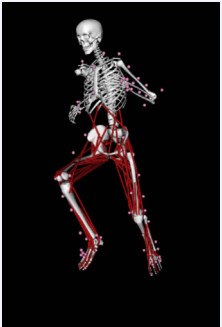
Figure 1: Model in OpenSim which is composed of 12 segments and 29 degrees of freedom. The model is scaled to the subject and is in the middle of running stride at 5 m/s and an 8 degree incline. The pink spheres represent the marker locations used to create the motion.
will be used to provide further insight into the effect of surface incline on GRF, joint angles, and movements. The data from the model produced will be shared with the online OpenSim community to allow other researchers to examine and further develop the model.
RESULTS AND DISCUSSION
Currently, the data and preliminary results have been collected for one subject. Additionally, inverse kinematics has been run and the motion capture data was translated to a motion file for the musculoskeletal model. GRF and IAA have yet to be analyzed.
Through examinations of the motions, a significant change in joint angles has been found. This can be seen in Figure (2), which gives a comparison of the right hip flexion through 30 seconds of running for flat running versus 8 degree inclined running. It is observed that hip flexion increases with an increased surface incline. This same pattern can be observed for pelvis rotation. However, there are no significant changes to the angles of the knee joint. This may show that the primary difference between motion of flat running and inclined running lies in the activity of the hip, rather than the lower leg. Though this supports the hypothesis, data from additional subjects must be collected to understand the difference in the load between the calf, whose activation controls the ankle, and the upper thigh and hip.
The EMG data showed that while maintaining running speed, changes in incline resulted in varying changes of muscle activity. In the lower leg, at a speed of 5 m/s, there were insignificant changes in muscle activity of the calf (soleus, gastrocnemius) between inclines while the tibialis anterior showed an increase
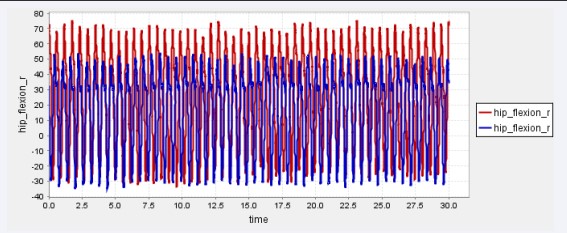
Figure 2: The angle of the right hip flexion throughout the simulation. The red plot represents the motion of the higher incline (8 degrees) and the blue represents the motion of the flat incline (0 degrees). This shows that the hip flexes to a greater range of motion during inclined running than flat running.
in activity at higher surface inclines. In the upper leg, there was a sharp decrease in the activity at the higher surface inclines, with the exception of the rectus femoris and gluteus medius, which reside in the backside of the leg. This decrease in muscle activity may be due to a decrease in impact with the surface, as the muscles of the thigh are largely responsible for braking, [1] which is less prominent at an incline. An equally sharp increase was found in the rectus femoris and gluteus medius, which may be due to a decreased proportion of the acceleration in the lower leg.
CONCLUSION
With the data and partial analysis of one subject’s data, it is not possible to arrive at salient conclusions. However, the preliminary results seem to support the idea that muscle activation should shift from the lower leg to the upper leg. Although changes in the proportion of muscle activation between flat and inclined running in the lower leg are insignificant, there are major changes in the upper leg where some muscles have a reduction in activity while others have an increase. The increase in activity of the rectus femoris and gluteus medius between flat and inclined running with regard to the insignificant change in the activity of the lower leg may indicate that those muscles are responsible for a larger proportion of the forward acceleration at an incline than at a flat surface. While the soleus and gastrocnemius are a very high percentage of the contribution to forward acceleration during flat running [1], their contribution may be decreased when an incline is introduced.
ACKNOWLEDGEMENTS
We would like to acknowledge Dr. James Becker and his students at the Movement Science Laboratory for the use of their facility and assistance in data collection.