Heat Transport in Novel Nanostructured Materials and their Thermoelectric Applications
- 1. Department of Chemical Engineering, New Mexico State University, Las Cruces, New Mexico 88003, USA
- 2. Sandia National Laboratories, Albuquerque, New Mexico 87185, USA
ABSTRACT
The novel heat transport properties observed in nanostructured materials are promoting revolutionary breakthroughs from highly thermal conductive carbonbased materials to highly-electrical conductive thermal insulators. This article is focused on the thermal transport characteristics of nanostructured materials and their potential uses in thermoelectric applications. We show that nanostructuring could turn common semiconductor materials into thermal insulators while keeping their electronic properties. These two characteristics are responsible for a large increase in thermoelectric efficiency (ZT). Highly efficient thermoelectric nanostructured materials are now considered a viable option in applications such as harvesting wasted heat to produce electricity and transistor cooling. We also discussed the recent advancement for the use of nanostructured thermoelectrics in fields such as solar power generation, and future applications of band engineered nanowires and thermoelectric biosensors.
KEYWORDS
Thermoelectric, Nanostructured materials, Nanowires, Thermal conductivity, Germanium, Solar power generation, Biosensors, Engineering.
CITATION
Quintana HA, Song E, Wang GT, Martinez JA (2013) Heat Transport in Novel Nanostructured Materials and their Thermoelectric Applications. Chem Eng Process Tech 1: 1008.
INTRODUCTION
During the last few years, the research community has developed nanostructured materials with novel optical [1], heat transport [2,3], and electronic [4] properties that have been employed for sensing [5], renewable energy [6], and chemical reaction [7] applications. In this report, we will focus on the heat transport characteristics of nanostructured materials, and how these properties could contribute to new developments in the field of chemical engineering. We also discuss a few new research fields for thermoelectric nanostructure materials.
In solid materials, heat is transported by the momentum transfer of interatomic vibrations to nearby atoms (lattice transport) and/or by mobile electric charges (electrons or holes). Therefore, the thermal conductivity (K) is represented by a simple linear contribution of the lattice thermal conductivity (KL ) and the electronic thermal conductivity (Ke ) or in mathematical form K = KL + Ke . The study of lattice heat transport is greatly simplified when it is represented by a hypothetical particle called phonon. KL is function of the acoustic phonon scattering processes such as phonon-phonon scattering, phonon-electric carrier scattering, and phonon-impurity scattering. All the phonon scattering mechanisms will dictate the phonon mean free path. The thermal conductivity of nanostructured materials can be smaller than their bulk counterpart due to the effective scattering of acoustic phonons with mean free paths longer than the characteristic dimensions of the nanostructured material. This scattering process is known as phonon-boundary scattering. While phonons can be scattered in nanostructured materials, electric carriers transport could remain unaffected because their mean free path is several orders of magnitude smaller than phonons. Assuming the Wiedemann-Franz law (Ke = L σ T, with L: Lorenz number; σ: electrical conductivity; T: absolute temperature), Ke will be affected by nanostructuring if σ changes due to carriers scattering. For example, the thermal conductivity of single-crystal heavily doped p-type Silicon-Germanium alloy nanowires of about 250 nm in diameter was reported close to 1 W/m-K which is 3 times smaller than its bulk counterpart with similar electrical conductivity [2].
Amorphous solid materials have one of the smallest thermal conductivities because phonons are scattered by the short order arrangement of atoms in the materials. Amorphous materials are also known as “phonon glasses”. Theoretical framework based on phonon transport in amorphous materials provides a lower limit for the thermal conductivity [8]. However, nanostructuring could reduce the thermal conductivity of crystalline materials to values comparable to amorphous non-electrically conductive materials such as SiO2 [2,9]. The thermal conductivity of nanostructured materials can be experimentally measured by a number of approaches [2,3,10,11]. Basically, these approaches are based on generating a known heat-flux which develops into a temperature gradient across the sample, so K can be obtained by solving the Fourier heat conduction equation. For example in Figure 1,

Figure 1: (A) Ge nanowire suspended between the gold leads of the thermoelectric characterization platform. An AC source is applied between the leads, and the resulting voltage drop is measured. (B) Thermal conductivity at room temperature for some nanostructure materials compared to bulk materials. Nanostructuring is capable to produce materials with K spanning the entire range of conductivities. X-axis is in log scale. K extracted from: (1) Balqandin et al. 2012; (2) HOchbaum et al. 2008; (3) Martinez et al. 2011.
the heat flux is produced by a large electric current (Joule heating), and the heat leaks away from the middle of the suspended nanowire to the metal contacts due to a temperature gradient [9].
Thermoelectrics are considered those materials that have low thermal conductivity with a large electrical conductivity. Low dimensional materials are high efficient thermoelectrics because they can become thermal insulators with high electrical conductivities. Thermal insulation is widely present in chemical plants (e. g. pipes, furnaces, etc.), so thermoelectric materials could replace current insulations to harvest that thermal energy and transform it into electricity [12].
If the heat transport is carried out by acoustic ballistic phonons, boundary scattering is not expected to play a major role. The thermal conductivity of a single atomic layer of graphene was found to be between 4000 and 5000 W/m-K at room temperature which is a factor of 5 larger than the thermal conductivity of graphite [11]. Even though graphene has a large σ (large Ke ), acoustic ballistics phonons dominate the heat transport. Due to the low degree of scattering of lowenergy phonons in 2-dimensional graphene, K actually increases compared to bulk graphite [11]. The thermal conductivity of graphene is several orders of magnitude larger than most metals (e. g. copper, stainless steel, etc.), so it could replace metals in some heat exchange applications for corrosive fluids. Figure 1 provides a comparison among the thermal conductivities of some key materials and nanostructured materials.
Solar thermoelectric generators
One of the novel uses of thermoelectric nanostructured materials is in the field of solar thermoelectric generators (STEGs). STEGs are devices that convert the heat from sunlight into electrical energy. STEG allows a more efficient use of the solar energy because it captures a wide solar spectrum which is not possible for photovoltaic cells [13,14]. A STEG is made up of several elements: thermoelectric materials, heat absorption element, metal interconnects, and substrates (Figure 2).

Figure 2: Representation of a solar thermoelectric generator with its main components. I represents the direction of the DC current.
Such devices use the traditional semiconductor p and n-type semiconductor junctions with high thermoelectric efficiency materials such as SiGe alloy [14] and Bi2 Te3 [15]. However, the efficiency of STEG units is about 1% which is low compared to the 11% for siliconbased photovoltaic cells [15,16]. New thermoelectric materials and harvesting techniques have been developed to overcome efficiency barriers, increase absorbed solar energy, and reduce radiation losses [13,15]. Current developments are also focused on materials that can provide higher operating temperatures and higher thermoelectric efficiencies with efficiencies close to 4.6%[16,17].
The thermoelectric energy efficiency can be quantify by the dimensionless thermoelectric figure of merit (ZT= S2 σT/K, where S, σ, T and K are the Seebeck coefficient, electrical conductivity, absolute temperature, and thermal conductivity respectively) [12]. Materials with large σ and low K (electron-crystal, phonon-glass materials) are desirable to obtain a high ZT, so nanostructured materials are perhaps the best option for high efficient STEG. Another important parameter to take into consideration is the thermoelectric power (S2 σ) which strongly dependent on the σ (S is inversely proportional to the σ). Nanostructuring could affect S2 σ due to the influence of surface state effect [9], or quantum confinement [18]. Sample preparation and crystalline quality are also factors that contribute to the good quality of thermoelectric materials. For example, our group has studied the thermoelectric characteristics of n-type Bi2 Te3 nanowire bundles (nanowire diameter approx. 70 nm). We found that S2 σ is about 6.2 10-4 W/m-K2 at 300 K (Figure 3)

Figure 3: Power factor as function of T for n-type Bi2Te3 nanowire bundle.
which is a factor of 10 larger than the value reported for n-type Bi2 Te3 single nanowires [19] and a factor of 3 smaller than nanocrystalline Bi2 Te3 [20] (all these power factors were measured at similar σ).
More expansion on heat absorption elements has also led STEG in another direction. When the term solar is used automatically a heliostat absorber comes to mind. Instead of using a mirror like reflective surface (heliostat) or a trough (parabola shaped mirror), hybrid solar cells are being used for STEG. These organic polymers combined with inorganic materials create a system that can take advantage of the IR part of the solar spectrum [12]. The efficiency of STEG is strongly influenced by the amount of solar radiation is absorbed. Hybrid solar absorbers such as polymernanocomposites, and nanostructured inorganic materials [21] could be explored as one of the approaches to improve the overall efficiency.
Band-engineered nanowires for high efficient thermoelectrics
The use of semiconductor nanowires for thermoelectric power generation and solid state cooling has gained momentum in recent years due to the increase of ZT compared to bulk due to a significant decrease in K from acoustic-phonon boundary scattering. For example, some common thermoelectric nanowires such as Bi2 Te3 [22], and SiGe alloy [2] have a larger ZT value compared to bulk materials. A greater improvement in ZT could be achieved if increases could be made to the Seebeck coefficient (ZT is proportional to S2 ), but increases in S are generally offset by reductions in σ which could result in a degradation of the thermoelectric power factor [S2 σ]. Undoped band-engineered core-shell semiconductor nanowires exhibit the spontaneous generation of electric carriers at the core-shell interface producing a conduction channel with high mobility carriers [23,24]. The lack of impurity scattering in the conduction channel results in an increase of both S and σ [25]. The core-shell nanostructuring also contributes to low thermal conductivity of Bi2 Te2 S-Bi2 S3 and Bi2 Te3 -Bi2 S3 nanowires [26], Ge-Si nanowires, [27,28] and PbTe-PbSe [29] due to the scattering of phonons across the core-shell interface [27,30]. Therefore, an improved ZT is expected for band-engineered core-shell nanowires. Figure 4

Figure:4 AlGaN-GaN nanowire suspended between the contact leads of a thermoelectric characterization platform before thermal contact annealing. Inset: schematic representation of cross section of the nanowire. The electorn-conduction channel is located on the GaN side of the core-shell interface.
shows a single AlGaN-GaN shell-core nanowire placed on a thermoelectric characterization platform. We found that the thermal conductivities for AlGaN-GaN nanowires fall in between 5 W/m-K and 6 W/m-K or a factor of 4 smaller than K for GaN nanowires of comparable diameter [31].
One of the distinctive applications of thermoelectric materials is to provide cooling without moving components, so thermoelectric cooling is relevant for those cases where space limitations and mechanical disturbances could be an issue. The working principle of thermoelectric cooling is basically the reverse of thermoelectric power generation. If ZT > 4 can be achieved, thermoelectric cooling will become more efficient than traditional gas compression-expansion cooling approach [32]. Such high ZT has not been reached yet, and recent research efforts have been focused in increasing ZT for common semiconductor nanowires to values where thermoelectric cooling can become cost effective. For example, ZT as high as 0.5 for Silicon nanowires [3,10] and 0.7 for core-shell Germanium nanowires [9] have been observed. Increasing ZT beyond those thermoelectric-efficiency values with undoped core-shell nanowires is still an on-going effort by few research groups.
Thermoelectric nanowire sensors
Rapid and highly sensitive detection of chemical and biological species is critical in many fields such as medical treatment, monitoring of toxic agents, and safety. The use of nanostructured materials for those applications has led to the development of a series of impressive sensor technologies. The large impact of nanosensors can be understood by the broad number of applications ranging from the detection of transmembrane pore-forming proteins by silicon nanowires, [5] to chemical sensing by ZnO nanoribbons [33], to the sensing of biomolecules by silver triangular nanoparticles [34]. Some of the reasons for such interest are: the large density of sensing devices in a small area with different functionalities given their small dimensions [35,36]; the mass transfer rate of target species from solution to the surface of the nanosensor is not a limiting process (contrary to their bulk counterpart) [5]; and the ability to detect small concentration of target species. For example, silicon field effect transistor nanowire sensors have been able to detect target species to the picograms/ml level [37].
Generally, nanosensors are divided into 2 groups: the electrical and optical based sensing approaches. For the electrical based nanosensors, the sensing approach includes measuring electrical changes of nanostructured materials due to chemical, biochemical, or cell activity events. For optical based nanosensors, the sensing event will trigger an optical response, which could be either a change of the fluorescence intensity (also known as fluorescent tagged approach), or a change of a material’s property (e. g. refractive index) known as label free approach [38]. Despite these considerable advantages, optical methods present limitations such as photobleaching, interaction of non-target species in solution with the fluorescent probes,and inability to be used in turbid solutions. On the other hand, electrical based sensors overcome those limitations, but they also present a series of disadvantages such as electro interference with the sensing media, and electrochemical reaction of nontarget species in solution.
A third approach that incorporates the benefits of electrical based sensors, but without net electric current through the sensing element is currently under development by our group based on the thermoelectric principle. Thermoelectric sensors are present in a number of aquatic animals. For example, the extraordinary ability to sense temperature changes and small electric fields of pray by sharks is carried out by a thermoelectric gel in the “ampullae of Lorenzini”[39]. Thermoelectric sensor response would be based on changes of carrier density due to surface binding events (Figure 5),
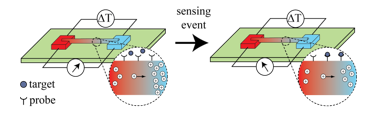
Figure : 5 Working Principle for the proposed thermoelectric nanosensor. Due to sensing events, the majority charge carrier (assuming holes) density changes affecting the thermoelectric voltage. DT=temperature difference.
so small diameter nanowires with large mobilities are expected to improve signal to noise ratio.
CONCLUSIONS
hoice for thermoelectric applications mostly due to the reduction of the thermal conductivity without a negative influence on the electronic properties. Even though of the large improvements of the thermoelectric efficiency by nanostructuring, ZT values are still not high enough for a wide spread use of thermoelectrics. However, a large number of applications could presently benefit from nanostructured thermoelectrics (e. g. in-situ cooling of high power transistors). Engineers in collaboration with materials scientists would make possible to expand the horizon of applications for thermoelectric nanostructured materials.
ACKNOWLEDGMENT
The authors would like to thank Philip Kalisman for the Bi2 Te3 nanowire specimens. This work has been funded by the National Aeronautics and Space Administration (NASA) Grant: GR0004096 (H. A. Q. , J. A. M. ), and Start-up funding through the New Mexico State University (E. S. , J. A. M. ). This work was performed at the Center for Integrated Nanotechnologies, a U. S. Department of Energy, and Office of Basic Energy Sciences user facility at Sandia National Laboratories (Contract DE-AC04- 94AL85000). The AlGaN/GaN nanowire work was supported by the U.S. Department of Energy, Office of Basic Energy Sciences, Materials Sciences, and Engineering Division. Sandia National Laboratories is a multi-program laboratory managed and operated by Sandia Corporation, a wholly owned subsidiary of Lockheed Martin Corporation, for the U.S. Department of Energy’s National Nuclear Security Administration under contract DEAC04-94AL85000.
REFERENCES
- Seo MA, Dayeh SA, Upadhya PC, Martinez JA, Swartzentruber BS, Picraux ST, et al. Understanding ultrafast carrier dynamics in single quasi-one-dimensional Si nanowires. Applied Physics Letters. 2012; 100: 071104.
- Martinez JA, Provencio PP, Picraux ST, Sullivan JP, Swartzentruber BS. Enhanced thermoelectric figure of merit in SiGe alloy nanowires by boundary and hole-phonon scattering. Journal of Applied Physics. 2011. 110: 074317.
- Hochbaum AI, Chen R, Delgado RD, Liang W, Garnett EC, Najarian M, et al. Enhanced thermoelectric performance of rough silicon nanowires. 2008; Nature.451: 163-167.
- Kholmanov IN, Magnuson CW, Aliev AE, Li H, Zhang B, Suk JW, et al. Improved electrical conductivity of graphene films integrated with metal nanowires. 2012; Nano Lett.12: 5679-5683.
- Martinez JA, Misra N, Wang Y, Stroeve P, Grigoropoulos CP, Noy A. Highly efficient biocompatible single silicon nanowire electrodes with functional biological pore channels. 2009; Nano Lett.9: 1121-1126.
- Zhang D, Xie F, Lin P, Choy WC. Al-TiOâ‚‚ composite-modified single-layer graphene as an efficient transparent cathode for organic solar cells. 2013; ACS Nano.7: 1740-1747.
- Nielsen TK, Bösenberg U, Gosalawit R, Dornheim M, Cerenius Y, Besenbacher F, et al. A reversible nanoconfined chemical reaction. 2010; ACS Nano.4: 3903-3908.
- Cahill DG, Pohl RO. Lattice-Vibrations and Heat-Transport in Crystals and Glasses. Annual Review of Physical Chemistry. 1988; 39: 93-121.
- Martinez JA, Cho JH, Liu XH, Luk TS, Huang JY, Picraux ST, et al. Contribution of radial dopant concentration to the thermoelectric properties of core-shell nanowires. Applied Physics Letters. 2013; 102: 103101.
- Boukai AI, Bunimovich Y, Tahir-Kheli J, Yu JK, Goddard WA 3rd, Heath JR. Silicon nanowires as efficient thermoelectric materials. 2008; Nature.451: 168-171.
- Balandin AA, Nika DL. Phononics in low-dimensional materials. Materials Today. 2012; 15: 266-275.
- Tritt TM. Thermoelectric Phenomena, Materials, and Applications. Annual Review of Materials Research. 2011; 41: 433-448.
- Kraemer D, Poudel B, Feng HP, Caylor JC, Yu B, Yan X, et al. High-performance flat-panel solar thermoelectric generators with high thermal concentration. 2011; Nat Mater.10: 532-538.
- Fuschillo N, Gibson R. Germanium-silicon, lead telluride, and bismuth telluride alloy solar thermoelectric generators for venus and mercury probes. Advanced Energy Conversion. 1967; 7: 43-52.
- Amatya R, Ram RJ. Solar Thermoelectric Generator for Micropower Applications. Journal of Electronic Materials. 2010; 39: 1735-1740.
- Kraemer D, Poudel B, Feng HP, Caylor JC, Yu B, Yan X, et al. High-performance flat-panel solar thermoelectric generators with high thermal concentration. 2011; Nat Mater.10: 532-538.
- Baranowski LL, Snyder GJ, Toberer E.S. Concentrated solar thermoelectric generators. Energy & Environmental Science. 2012; 5: 9055-9067.
- Cornett JE, Rabin O. Thermoelectric figure of merit calculations for semiconducting nanowires. Applied Physics Letters. 2011; 98: 182104.
- Zhou JH, Jin CG, Seol JH, Li XG, Shi L. Thermoelectric properties of individual electrodeposited bismuth telluride nanowires. Applied Physics Letters. 2005; 87: 133109.
- Takashiri M, Takiishi M, Tanaka S, Miyazaki K, Tsukamoto H. Thermoelectric properties of n-type nanocrystalline bismuth-telluride-based thin films deposited by flash evaporation. Journal of Applied Physics. 2007; 101: 074301.
- Jeong S, Garnett EC, Wang S, Yu Z, Fan S, Brongersma ML, et al. Hybrid silicon nanocone-polymer solar cells. 2012; Nano Lett.12: 2971-2976.
- Yoo B, Xiao F, Bozhilov KN, Herman J, Ryan MA, Myung NV. Electrodeposition of thermoelectric superlattice nanowires. Advanced Materials. 2007; 19: 296-299.
- Wong BM, Léonard F, Li Q, Wang GT. Nanoscale effects on heterojunction electron gases in GaN/AlGaN core/shell nanowires. 2011; Nano Lett.11: 3074-3079.
- Li Y, Xiang J, Qian F, Gradecak S, Wu Y, Yan H, et al. Dopant-free GaN/AlN/AlGaN radial nanowire heterostructures as high electron mobility transistors. 2006; Nano Lett.6: 1468-1473.
- Pichanusakorn P, Kuang YJ, Patel CJ, Tu CW, Bandaru PR. The influence of dopant type and carrier concentration on the effective mass and Seebeck coefficient of GaN(x)As(1-x) thin films. Applied Physics Letters. 2011; 99: 072114.
- Purkayastha A, Yan QY, Gandhi DD, Li HF, Pattanaik G, Borca-Tasciuc T, et al. Sequential organic-inorganic templating and thermoelectric properties of high-aspect-ratio single-crystal lead telluride nanorods. Chemistry of Materials. 2008; 20: 4791-4793.
- Hu M, Zhang XL, Giapis KP, Poulikakos D. Thermal conductivity reduction in core-shell nanowires. Physical Review B. 2011; 84: 085442.
- Wingert MC, Chen ZC, Dechaumphai E, Moon J, Kim JH, Xiang J, et al. Thermal conductivity of ge and ge-si core-shell nanowires in the phonon confinement regime. 2011; Nano Lett.11: 5507-5513.
- Scheele M, Oeschler N, Veremchuk I, Peters SO, Littig A, Kornowski A, et al. Thermoelectric properties of lead chalcogenide core-shell nanostructures. 2011; ACS Nano.5: 8541-8551.
- Kang J, Roh JW, Shim W, Ham J, Noh JS, Lee W. Reduction of lattice thermal conductivity in single Bi-Te core/shell nanowires with rough interface. 2011; Adv Mater.23: 3414-3419.
- Harris CT, Martinez JA, Shaner EA, Huang JY, Swartzentruber BS, Sullivan JP, et al. Fabrication of a nanostructure thermal property measurement platform. 2011; Nanotechnology.22: 275308.
- DiSalvo FJ. Thermoelectric cooling and power generation 1999; Science.285: 703-706.
- Fan ZY, Wang DW, Chang PC, Tseng WY, Lu JG. ZnO nanowire field-effect transistor and oxygen sensing property. Applied Physics Letters. 2004; 85: 5923-5925.
- McFarland AD, Van Duyne RP. Single silver nanoparticles as real-time optical sensors with zeptomole sensitivity. Nano Letters. 2003; 3: 1057-1062.
- Cui Y, Wei Q, Park H, Lieber CM. Nanowire nanosensors for highly sensitive and selective detection of biological and chemical species. 2001; Science.293: 1289-1292.
- Misra N, Martinez JA, Huang SCJ, Wang YM, Stroeve P, Grigoropoulos CP, et al. Bioelectronic silicon nanowire devices using functional membrane proteins. Proceedings of the National Academy of Sciences of the United States of America. 2009; 106: 13780-13784.
- Zheng G, Patolsky F, Cui Y, Wang WU, Lieber CM. Multiplexed electrical detection of cancer markers with nanowire sensor arrays. 2005; Nat Biotechnol.23: 1294-1301.
- Fan X, White IM, Shopova SI, Zhu H, Suter JD, Sun Y. Sensitive optical biosensors for unlabeled targets: a review. 2008; Anal Chim Acta.620: 8-26.
- Brown BR. Neurophysiology: Sensing temperature without ion channels. Nature. 2008; 454: 246-246.