Enhancement of Cold Tolerance Promotes Resistance to Aluminum Stress
- 1. Department of Life and Environmental Sciences, University of Tsukuba, Japan
Abstract
Aluminum (Al) toxicity is one of the major factors that limit crop productivityin acid soils. Soil acidification enhances the release of Al3+, which enters into root tip and prevents root growth. The improvement of Al resistance is important for increasing crop productivity. In this study, we determined that Al levels were decreased during cold acclimation. According to neutron activation analysis, the levels of 24Na, 38Cl, 42K, 49Ca, and 56Mn were temporally decreased, and the levels were restored during cold acclimation. In contrast, 28Al levels were decreased despite acclimation to cold stress. Furthermore, enhancement of cold tolerance by overexpression of ICE1 in Arabidopsis and tomatoes improved Al resistance. These results suggest a relationship between cold tolerance and Al resistance.
Citation
Yamamoto T, Okuda H, Nozawa R, Furukawa J, Miura K (2015) Enhancement of Cold Tolerance Promotes Resistance to Aluminum Stress. Int J Plant Biol Res 3(2): 1032.
INTRODUCTION
Environmental stresses such as cold, drought, and salinity restrict plant growth and crop yield. Thus, plants are required to adapt to such stresses for survival. Cold stress is one of the key factors that influences plant development and limits the geographical distribution of cold-sensitive plant species. Plants have evolved a mechanism called cold acclimation to enhance tolerance to freezing stress [1]. The molecular mechanismsinvolved in cold acclimation have been extensively investigated, and several molecules have been identifiedthat are important for cold tolerance [2].
Among several cold-signaling pathways, the ICE1-CBF/ DREB1-dependent cold-signaling pathway appears to be the most important pathway for the control of cold-regulated genes and cold tolerance [3]. ICE1, a MYC-type basic helix-loop-helix (bHLH) transcription factor that binds to the MYC-recognition cis-elements (CANNTG) in the promoter of CBF3/DREB1A, is a positive regulator of cold signaling [4]. According to microarray data, ICE1 regulates approximately 40% of cold-regulated (COR) genes and 46% of cold-regulated transcription factor genes [5]. ICE1 is likely to be an important regulator that controls CBF3/ DREB1A and many COR genes. Overexpression of ICE1 improves tolerance to cold stress in Arabidopsis [4, 6], tomatoes [7, 8], and cucumber [9].
Aluminum (Al) is the most abundant metal in the earth’s crust and constitutes approximately 8% by weight [10]. Because many plant species are sensitive to micromolar concentrations of Al ions, and low pH enhances the solubilization of Al, Al ion is toxic to plants and is a major factor in theinhibition of plant growth and crop production in acid soils [11]. Soil acidification occurs naturally when basic cations such as calcium, magnesium, and potassium are leached from soils. It is also accelerated by nitrogenous fertilizer and acid rain. More than 30% of the world’s land is affected by acid soils, meaning approximately half of the potential arable lands is affected [12]. Al inhibits root growth and uptake of water and nutrients, resulting in the retardation of plant growth and the loss of crop production [11]. The root apex is the most sensitive zone, especially the distal transition zone, to Al stress [13,14]. In this zone, a region 1-3 mm behind the root tip, a transition occurs from cell division to cell elongation. The expression of SbMATE, which encodes for an Al-activated root citrate transporter for the extrusion of toxic compounds in sorghum [15], was specifically observed in the epidermal and outer cortical cell layers of the distal transition zone[14]. Al toxicitycauses damage to the membrane due to negative charges and the irreversible binding to Al, together with rigidification of the cell wall due to displacement of Ca2+ with Al3+ [16]. And a quick burst of mitochondrial ROS was also triggered by treatment with Al in Arabidopsis [17].
Al-resistant plants have evolved mechanisms for their detoxification. For example, plants useorganic acidsto expel Al from the root apex or detoxifyAl by chelating it with organic acids [18]. Exudation of organic acid anions, such as citrate, oxalate, and malate, enhances Al tolerance by forming stable complexes with Al [19]. These organic acid anions also function in chelating Al in the cytosol. Thus, overexpression of citrate synthase in tobacco, canola, and alfalfaand an increase in malate synthesis in tobacco and alfalfa enhanced Al tolerance [20-24]. Phosphorus is also reported to alleviate Al toxicity in Citrus by increasing immobilization of Al in roots [25]. MATE (multidrug and toxic compound extrusion), responsible for citrate exudation, was activated by Al in the Al-resistance barley cultivar [26]. Genes for antioxidant defense mechanisms, such as superoxide dismutase (SOD) andperoxidase, were upregulated by Al treatment in Arabidopsis [27]. Overexpression of the mitochondrial SOD gene conferred Brassica napus resistance to Al [28]. Here, we introduce a new molecular strategy to increase Al resistance. According to the neutron activation analysis, several elements were transiently decreased after cold shock, but the levels were mostly restored during cold acclimation. However, the levels of Al decreased despite the fact thatthe plants acclimated to the cold stress. Furthermore, the resistance to Al stress was enhanced in ICE1-overexpressing Arabidopsis or tomato plants, which showed cold tolerance [8,29]. These results suggest a relationship between cold tolerance and Al resistance.
MATERIALS AND METHODS
Plant Culture and Treatments
Wild-type and AtICE1-overexpressing Arabidopsis thaliana
plants used were in the Col-0 background [6, 29]. Seeds were surface-sterilized and germinated on basal media containing a halfMurashige and Skoog (MS) mineral salts, 1% sucrose, and 0.8% agar with pH 4.5. Petri dishes were vertically positioned and maintained for 3 days. Then, the seedlings were transferred onto the media containing 50 μM or 100 μM AlCl3 and grown for an additional 6 days. Root growth was measured as previously described [41].
The tomato (Solanum lycopersicum) cultivar Micro-Tom and the SlICE1-overexpressing tomatoes [7,8] were used for the treatment of aluminum stresses. These tomatoes were grown for 3 weeks on rockwool with 1/10 Hoagland’s solution. Then, 1/10 Hoagland’s solution with 0, 50, or 100 μM AlCl3 was provided and tomatoes were grown for an additional 3 weeks. The weight of each tomato shoot was subsequently measured.
Measurement of Elemental Profiles
Wild-type Arabidopsis (ecotype Col-0) plants were grown at 23°C for 3 weeks and were incubated at 4°C for the indicated days. The relative amount of selected elements contained in each sample was measured by neutron activation analysis performed at JRR-3 located at the Japan Atomic Energy Agency. The samples were dried at 70°C for 2 days and then doubly sealed in a polyethylene vinyl bag. After irradiation for 10 seconds for 24Na, 28Al, 38Cl, 42K, 49Ca and56Mn in the research reactor with a thermal neutron flux of 6.0 x 10¹³ n cm-2 s-1, gamma-rays emitted from samples were measured by a Ge(Li) detector. The gamma-rays used to determine 24Na, 28Al, 38Cl, 42K, 49Ca and56Mn were 1.369, 1.779, 2.168, 1.525, 3.084 and 1.810 MeV, respectively.
Measurement of H2O2 Concentration and Peroxidase Activity
Tomato plants were grown for 2 weeks on rockwool with 1/5 Hoagland’s solution. Then, the plants were incubated with 1/5 Hoagland’s solution with or without 50 μM AlCl3 for 3 weeks. Leaf samples were harvested with 4 replicates for each treatment. The concentration of H2O2 in the tissue was determined by the
following method as described [30] with slightly modification.
Briefly, 0.1 g of leaf tissue was grinded in liquid nitrogen and 1 mL of cold acetone and 0.5 mL of cold water was added. 0.1 mL of 5% (w/v) titanium sulfate solved with 25% H2SO4 and 0.2 mL of ammonium hydroxide solution was added to precipitate the peroxide-titanium complex. The precipitate was collected by centrifugation at 21,500xg for 10 min. After washing with cold acetone, the precipitate was dissolved with 1.6 mL of 1M H2SO4. The absorbance at 420 nm was measured with a spectrophotometer (DU800, Beckman, USA). A standard curve was prepared with the several concentration of H2O2 solution.
Measurement of peroxidase activity was performed by the following procedure (http://www.sigmaaldrich.com/technical- documents/protocols/biology/enzymatic-assay-of-peroxidase. html). Briefly, after grinding 0.1 g of tomato leaves, 1 mL of 100 mM phosphate buffer (pH 6.8) was added. After centrifugation at 21,500xg for 15 min, supernatant was added to reaction mixture. One minute after reaction, sulfuric acid was added to stop reaction. The enzyme unit was calculated according to the procedure.
RNA isolation and quantitative RT-PCR analysis
Total RNA was isolated from tomato leaves. cDNA synthesis, real-time PCR, and comparative CT analyses were performed as described [31] with gene-specific primers for UBI3 [8], SlPOD1(5’-ATTGTCCACGTAGTGGAGGTGATTCC-3’ and 5’-TCCTCCACTAAATAGTGCTTGATCAG-3’).
RESULTS AND DISCUSSION
Decrease of Al content during cold acclimation
To investigate what types of minerals are altered during cold acclimation, the relative amount of several elements was measured twice by neutron activation analysis and representative one was shown in Table 1. According to these data, the concentration of 24Na, 38Cl, 42K, 49Ca, and 56Mn showeda decrease on day 1 followed by the levels of these elements increasingon day 3. This temporal decrease may be due to a cold stress response, and the restoration of these elements is likely correlated with cold acclimation. Alternatively, 28Al showed a specific profile during cold treatment. The level of 28Al decreased even though cold acclimation occurred. These results suggest that cold acclimation decreases the Al concentration.
Overexpression of ICE1 increased Al resistance
According to the results (Table 1), it is assumed that enhancement of cold tolerance increases Al resistance. Thus, ICE1 overexpressing Arabidopsis [6] and tomato plants [8] were subjected to Al stress. The root growth of wild-type seedlings was inhibited by approximately 50% when the seedlings were treated with 100 μM AlCl3 for 6 days, but onlyapproximately 20% of the root growth of AtICE1-overexpressing seedlings was inhibited (Figure 1). No significant growth change was observed in AtICE1 overexpressing seedlings treated with 50μM AlCl3 , compared to AtICE1-overexpressing seedlings without aluminum treatment (Figure 1C). According to the microarray data (http://bar.utoronto. ca/), MATE (At1g51340) and several MATE-like genes were upregulated in roots by treatment with cold stress (Figure 1D).MATE encodes multidrug and toxic compound extrusion, which is Al-induced citrate transporter [32]. The expression of MATE facilitated the Al-activated efflux of citrate and enhanced tolerance to Al stress [32-35]. Up-regulation of these genes by cold stress may be involved in decrease in Al content. Expression of SOS1, which encodes Na+ transporter mediating Na+ efflux [36], was not changed after cold treatment, but HKT1, which is involved in uptake of Na+ [37], was down-regulated by cold stress (Figure 1D). Decrease in influx and unchanged efflux may not affect content of Na. SlICE1-overexpressing tomato plants also showed Al resistance (Figure 1E-H). Three-week-old tomato plants were treated with 0, 50, or 100 μM AlCl3 for 3 weeks. Following the Al treatment with 100 μM AlCl3 , the leaves of wild-type plants appeared yellow (Figure 1G), and growth retardation was observed (Figure 1H). Alternatively, transgenic tomato plants had healthy leaves even though they were treated with 100 μM AlCl3 . The fresh weight of shoots in the transgenic plants was not altered with or without AlCl3 treatment (Figure 1H). Together,
Table 1: Elemental profiles during cold treatment in Aradisopsis measured by neutron activation analysis.
|
these results suggest that an increase in cold tolerance by overexpression of ICE1 enhanced the resistance to Al stress.
Overexpression of SlICE1 decreases accumulation of H2 O2 and enhances peroxidase activity
Generally, cold stress decreases the rate of metabolism, leading to the delay of energy dissipation and the introduction of oxidative damage [2]. To acclimate to cold stress, the synthesis of cryoprotective molecules is enhanced in plants. These compounds function in stabilizingthe membrane, protecting from dehydration, and scavenging reactive oxygen species (ROS). The level of H2 O2 was also increased after treatment of aluminum stress in wild-type tomato leaves (Figure 2A). On the other hand, the level of H2 O2 in SlICE1-overexpressing tomato leaves was not altered with or without aluminum stress (Figure 2A). Because the antioxidant activity in SlICE1-overexpressing plants is increased [7], the level of H2 O2 was lower than that in wild type (Figure 2A). The activity of antioxidant enzymes, including superoxide dismutase, catalase, glutathione peroxidase, and ascorbate peroxidase, and the accumulation of non-enzymatic antioxidants, such as ascorbic acid, glutathione, and carotenoids, are enhanced by abiotic stresses[38]. Overexpression of SlICE1 enhances antioxidant activity and increases the accumulation of antioxidants, including ascorbic acid, β-carotene, and lycopene [7]. In addition, overexpression of SlICE1 also enhanced peroxidase activity without aluminum stress (Figure 2B). The activity was increased after treatment of aluminum in wild type, but the level was not altered in SlICE1-overexpressing plants (Figure 2B). The increase in antioxidant activity and peroxidase activity may inhibit accumulation of ROS under aluminum stress. The mRNA expression of the aluminum-inducible gene SlPOD1 (peroxidase, Solyc10g076240) was up-regulated by aluminum stress in wild-type tomato leaves and the level of gene was higher in SlICE1-overexpressing plants without aluminum treatment (Figure 2C). Proteomics revealed that the gene product was up regulated by aluminum [39]. The mRNA expression of SlPOD1 (Figure 2C) and peroxidase activity (Figure 2B) were similar, suggesting that peroxidase is one of factors to ROS. Al stress causes an increase in the production of ROS (Figure 2A), causing peroxidation of membrane lipids. Detoxification of Al-induced ROS through antioxidant defense mechanisms, such as chelation by organic acid anions and amino acids, is one way to prevent Al-induced damage in cells and tissues [40,41]. High antioxidant status confers Al resistance to plants [42,43]. Taken together, the enhancement of antioxidant activity by cold stress may decrease Al levels.Overexpression of ICE1 enhances the accumulation of antioxidant compounds, most likely leading to Al resistance.
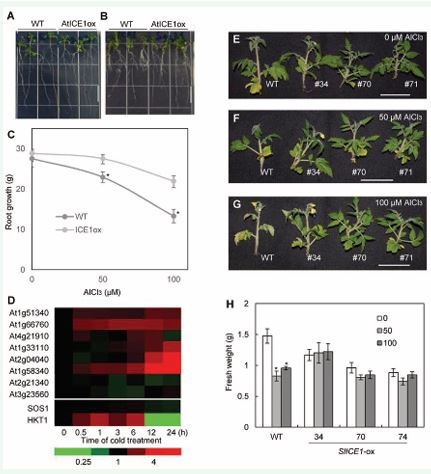
Figure 1 ICE1 overexpression enhances tolerance to aluminum stress. Wild-type and AtICE1-overexpressed seedlings were grown on MS plates in the absence (A) or the presence (B) of 100 μM AlCl3 . (C) Root growth of wild-type and AtICE1 overexpression seedlings grown on media with or without Al3+. Data are the mean ± SE (n = 12). The asterisk shows a significant difference in root growth between wild-type and AtICE-overexpressed seedlings at P < 0.05 by Student’s t-test.(D) Gene expression of MATE (At1g51340), MATE-like, SOS1 (At2g01980), and HKT1 (At4g10310) genes. Data was obtained from the microarray data (http://bar.utoronto.ca/). (E-G) Wild-type and SlICE1-overexpressing tomato plants were grown with Hoagland’s solution without (E), with 50 μMAlCl3 (F), or with 100 μM AlCl3 (G). (H) The fresh weight of shoots was measured. Data are the mean ± SE (n = 12). The asterisk shows a significant effect of Al at P < 0.05 by Student’s t-test.
CONCLUSIONS
Cold acclimation showedthedecrease Al levels (Table 1). Furthermore, overexpression of ICE1 enhanced Al resistance in Arabidopsis (Figure 1) and tomato plants (Figure 2). These results suggest that enhancement of cold tolerance is correlated with an improvement in Al resistance. Because Al resistance results fromincreasing antioxidant activity, and antioxidant activity is enhanced by cold stress, antioxidant activity may be involved in the enhancement of Al resistance in ICE1-overexpressing Arabidopsis and tomatoes.
ACKNOWLEDGMENTS
We thank Ms. Aya Hiyama for technical support. This work was supportedbyGrant-in-Aid for Young Scientists (B, 26840087) from MEXT and Cooperative Research Grant of the Plant Transgenic Design Initiative, Gene Research Center, University of Tsukuba.
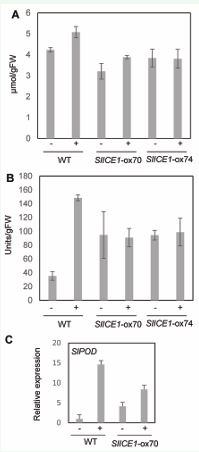
Figure 2 Overexpression of SlICE1 exhibits lower H2 O2 accumulation after treatment of aluminum stress (A) and higher peroxidase activity without aluminum treatment (B). Wild-type and SlICE1 over expressing tomato plants were grown for 3 weeks with Hoagland’s solution with 0 (-) or 50 (+) μM AlCl3 . The concentration of H2 O2 (A) and the peroxidase activity (B) in leaf tissues was measured. Data are means ± SE (n = 4). (C) Total RNA was extracted from tomato leaves with 0 (-) or 50 (+) μM AlCl3 . Relative mRNA levels of SlRAF(rapid alkalization factor 1; Solyc09g074890.1.1) and SlXTH9 (xyloglucan endotransglucosylase /hydrolase 9; Solyc11g066270.1.1) were determined by quantitative RT-PCR analyses. Data are means ± SD (n = 3)
REFERENCES
- Thomashow MF. Plant Cold Acclimation: Freezing Tolerance Genes and Regulatory Mechanisms. Annu Rev Plant Physiol Plant Mol Biol. 1999; 50: 571-599.
- Miura K, Furumoto T. Cold signaling and cold response in plants. Int J Mol Sci. 2013; 14: 5312-5337.
- Lissarre M, Ohta M, Sato A, Miura K. Cold-responsive gene regulation during cold acclimation in plants. Plant Signal Behav. 2010; 5: 948- 952.
- Chinnusamy V, Ohta M, Kanrar S, Lee BH, Hong X, Agarwal M, et al. ICE1: a regulator of cold-induced transcriptome and freezing tolerance in Arabidopsis. Genes Dev. 2003; 17: 1043-1054.
- Lee BH, Henderson DA, Zhu JK. The Arabidopsis cold-responsive transcriptome and its regulation by ICE1. Plant Cell. 2005; 17: 3155- 3175.
- Miura K, Jin JB, Lee J, Yoo CY, Stirm V, Miura T, et al. SIZ1-mediated sumoylation of ICE1 controls CBF3/DREB1A expression and freezing tolerance in Arabidopsis. Plant Cell. 2007; 19: 1403-1414.
- Miura K, Sato A, Shiba H, Kang SW, Kamada H , Ezura H. Accumulation of antioxidants and antioxidant activity in tomato, Solanum lycopersicum, are enhanced by the transcription factor SlICE1. Plant Biotechnol. 2012; 29: 261-269.
- Miura K, Shiba H, Ohta M, Kang SW, Sato A, Yuasa T, et al. SlICE1 encoding a MYC-type transcription factor controls cold tolerance in tomato, Solanum lycopersicum. Plant Biotechnol. 2012; 29: 253-260.
- Liu L, Duan L, Zhang J, Zhang Z, Mi G , Ren H. Cucumber (Cucumis sativus L.) over-expressing cold-induced transcriptome regulator ICE1 exhibits changed morphological characters and enhances chilling tolerance. Sci Hort 2010; 124: 29-33.
- Driscoll CT, Schecher WD. The chemistry of aluminum in the environment. Environ Geochem Health. 1990; 12: 28-49.
- Kochian LV. Cellular Mechanisms of Aluminum Toxicity and Resistance in Plants. Annu Rev Plant Physiol Plant Mol Biol. 1995; 46: 237-260.
- Macdonald TL, Martin RB. Aluminum ion in biological systems. Trends Biochem Sci. 1988; 13: 15-19.
- Sivaguru M, Baluska F, Volkmann D, Felle HH, Horst WJ. Impacts of aluminum on the cytoskeleton of the maize root apex. short-term effects on the distal part of the transition zone Plant Physiol. 1999; 119: 1073-1082.
- Sivaguru M, Liu J, Kochian LV. Targeted expression of SbMATE in the root distal transition zone is responsible for sorghum aluminum resistance. Plant J. 2013; 76: 297-307.
- Magalhaes JV, Liu J, Guimaraes CT, Lana UG, Alves VM, Wang YH, et al. A gene in the multidrug and toxic compound extrusion (MATE) family confers aluminum tolerance in sorghum. Nat Genet. 2007; 39: 1156- 1161.
- Jones DL, Blancaflor EB, Kochian LV, Gilroy S. Spatial coordination of aluminium uptake, production of reactive oxygen species, callose production and wall rigidification in maize roots. Plant Cell Environ. 2006; 29: 1309-1318.
- Li Z, Xing D. Mechanistic study of mitochondria-dependent programmed cell death induced by aluminium phytotoxicity using fluorescence techniques. J Exp Bot. 2011; 62: 331-343.
- Inostroza-Blancheteau C, Rengel Z, Alberdi M, de la Luz Mora M, Aquea F, Arce-Johnson P, Reyes-Díaz M. Molecular and physiological strategies to increase aluminum resistance in plants. Mol Biol Rep. 2012; 39: 2069-2079.
- Ma JF, Ryan PR, Delhaize E. Aluminium tolerance in plants and the complexing role of organic acids. Trends Plant Sci. 2001; 6: 273-278.
- de la Fuente JM, Ramírez-Rodríguez V, Cabrera-Ponce JL, Herrera- Estrella L. Aluminum tolerance in transgenic plants by alteration of citrate synthesis. Science. 1997; 276: 1566-1568.
- Anoop VM, Basu U, Mccammon MT, Mcalister-Henn L, Taylor GJ.Modulation of citrate metabolism alters aluminum tolerance in yeast and transgenic canola overexpressing a mitochondrial citrate synthase. Plant Physiol. 2003; 132: 2205-2217.
- Barone P1, Rosellini D, Lafayette P, Bouton J, Veronesi F, Parrott W,. Bacterial citrate synthase expression and soil aluminum tolerance in transgenic alfalfa. Plant Cell Rep. 2008; 27: 893-901.
- Tesfaye M, Temple SJ, Allan DL, Vance CP, Samac DA. Overexpression of malate dehydrogenase in transgenic alfalfa enhances organic acid synthesis and confers tolerance to aluminum. Plant Physiol. 2001; 127: 1836-1844.
- Wang Q-F, Zhao Y, Yi Q, Li K-Z, Yu Y-X , Chen L-M. Overexpression of malate dehydrogenase in transgenic tobacco leaves: enhanced malate synthesis and augmented Al-resistance. Acta Physiol Plant. 2010; 32: 1209-1220.
- Yang LT, Jiang HX, Tang N, Chen LS. Mechanisms of aluminum- tolerance in two species of citrus: secretion of organic acid anions and immobilization of aluminum by phosphorus in roots. Plant Sci. 2011; 180: 521-530.
- Furukawa J, Yamaji N, Wang H, Mitani N, Murata Y, Sato K, Katsuhara M. An aluminum-activated citrate transporter in barley. Plant Cell Physiol. 2007; 48: 1081-1091.
- Richards KD, Schott EJ, Sharma YK, Davis KR, Gardner RC. Aluminum induces oxidative stress genes in Arabidopsis thaliana. Plant Physiol 1998; 116: 409-418.
- Basu U, Good AG, Taylor GJ. Transgenic Brassica napus plants overexpressing aluminium-induced mitochondrial manganese superoxide dismutase cDNA are resistant to aluminium. Plant Cell Environ. 2001; 24: 1278-1269.
- Miura K, Ohta M, Nakazawa M, Ono M, Hasegawa PM. ICE1 Ser403 is necessary for protein stabilization and regulation of cold signaling and tolerance. Plant J. 2011; 67: 269-279.
- Jiang J, Lu Y, Li J, Li L, He X, Shao H, et al. Effect of seed treatment by cold plasma on the resistance of tomato to Ralstonia solanacearum (Bacterial Wilt). PLoS One. 2014; 9: e97753.
- Miura K, Okamoto H, Okuma E, Shiba H, Kamada H, Hasegawa PM, et al. SIZ1 deficiency causes reduced stomatal aperture and enhanced drought tolerance via controlling salicylic acid-induced accumulation of reactive oxygen species in Arabidopsis. Plant J. 2013; 49: 79-90.
- Furukawa J, Yamaji N, Wang H, Mitani N, Murata Y, Sato K, et al. Analuminum-activated citrate transporter in barley. Plant Cell Physiol. 2007; 48: 1081-1091.
- Zhou G, Delhaize E, Zhou M, Ryan PR. The barley MATE gene, HvAACT1, increases citrate efflux and Al(3+) tolerance when expressed in wheat and barley. Ann Bot. 2013; 112: 603-612.
- Wu X, Li R, Shi J, Wang J, Sun Q, Zhang H, et al. Brassica oleracea MATE encodes a citrate transporter and enhances aluminum tolerance in Arabidopsis thaliana. Plant Cell Physiol. 2014; 55: 1426-1436.
- Shi H1, Ishitani M, Kim C, Zhu JK. The Arabidopsis thaliana salt tolerance gene SOS1 encodes a putative Na+/H+ antiporter. Proc Natl Acad Sci U S A. 2000; 97: 6896-6901.
- Uozumi N, Kim EJ, Rubio F, Yamaguchi T, Muto S, Tsuboi A, et al. The Arabidopsis HKT1 gene homolog mediates inward Na(+) currents in xenopus laevis oocytes and Na(+) uptake in Saccharomyces cerevisiae. Plant Physiol. 2000; 122: 1249-1259.
- Chen TH, Murata N. Enhancement of tolerance of abiotic stress by metabolic engineering of betaines and other compatible solutes. Curr Opin Plant Biol. 2002; 5: 250-257.
- Okekeogbu I, Ye Z, Sangireddy SR, Li H, Bhatti S, Hui D, et al. Effect of aluminum treatment on proteomes of radicles of seeds derived from Al-treated tomato plants. Proteomes. 2014; 2: 169-190.
- Basu U, Good AG, Aung T, Slaski JJ, Basu A, Briggs KG , et al. A 23-kDa, root exudate polypeptide co-segregates with aluminum resistance in Triticumae stivum. Physiol Plant. 1999; 106: 53-61.
- Devi SR, Yamamoto Y, Matsumoto H. An intracellular mechanism of aluminum tolerance associated with high antioxidant status in cultured tobacco cells. J Inorg Biochem. 2003; 97: 59-68.
- Guo TR, Zhang GP, Zhang YH. Physiological changes in barley plants under combined toxicity of aluminum, copper and cadmium. Colloids Surf B Biointerfaces. 2007; 57: 182-188.
- Lee YP, Kim SH, Bang JW, Lee HS, Kwak SS, Kwon SY. Enhanced tolerance to oxidative stress in transgenic tobacco plants expressing three antioxidant enzymes in chloroplasts. Plant Cell Rep. 2007; 26: 591-598.
- Miura K, Sato A, Ohta M, Furukawa J. Increased tolerance to salt stress in the phosphate-accumulating Arabidopsis mutants siz1 and pho2. Planta. 2011; 234: 1191-1199.