Hyper-IgE syndrome: Two Egyptian case reports
- 1. Medical Military Hospital, Egypt
- 2. Cairo University, Egypt
Abstract
Hyper-IgE syndromes (HIES) are a heterogeneous group of inborn errors of immunity. The underlying cause of HIES is dominant mutations in various signal transduction and activators of transcription genes with the most common type is mutation in the STAT3 gene located on chromosome 17 followed by mutation in DOCK8 gene. The disease is very rare with prevalence less than 1 per million population. Elevated IgE level is the cardinal feature of the disease. Clinical features include recurrent eczema, frequent bacterial infections, and mucocutaneous candidiasis. Treatment is usually symptomatic including prophylactic antibiotics. Bone marrow transplantation & stem cell therapy can be used for recalcitrant cases. Recently, biologics have emerged as an additional option for treating HIES with treatment refractory atopic dermatitis. Dupilumab, a human monoclonal antibody that blocks the shared receptor subunit of IL-4 and IL-13, mitigates the signs and symptoms of atopic dermatitis. Few case reports have demonstrated the substantial improvements of atopic dermatitis following the injection of dupilumab in HIES. Here, we present two cases of different age groups whom atopic dermatitis was treated successfully using dupilumab, an IL-4 / IL-13 antagonist.
Keywords
• HIES
• Dupilumab
• Inborn errors of immunity
• STAT3 gene
• DOCK8 gene
Citation
Hegazy MS, Nada H (2026) Hyper-IgE syndrome: Two Egyptian case reports. JSM Allergy Asthma 7(1): 1031.
INTRODUCTION
Hyper-IgE syndromes (HIES) are a heterogeneous group of inborn errors of immunity. The underlying cause of HIES is dominant mutations in various signal transduction and activators of transcription genes with the most common type is mutation in the STAT3 gene located on chromosome 17 followed by mutation in DOCK8 gene [1]. The disease is very rare with prevalence less than 1 per million population. Elevated IgE level is the cardinal feature of the disease. Clinical features include recurrent eczema, frequent bacterial infections, and mucocutaneous candidiasis. Skin rash usually appears in the first week of life, recurrent pneumonia and cold abscess with staphylococcus aureus are common. The patient can present with non-healing skin eruptions. Characteristic facial features that typically appear in early adolescence or late childhood include asymmetry, a prominent forehead, deep-set eyes, a broad nasal bridge, a wide fleshy nasal tip, rough facial skin, an increased inter-alar distance, prognathism and a high-arched palate. Birth defects observed in individuals with HIES include craniosynostosis (permanent premature closure of skull sutures), Arnold Chiari type 1 malformation (displacement of the cerebellar *Corresponding author Hanan Nada, Cairo University, Giza, Egypt. Submitted: 26 January 2026 Accepted: 13 February 2026 Published: 14 February 2026 Copyright © 2026 Hegazy MS, et al. ISSN: 2573-1254 OPEN ACCESS Keywords • HIES • Dupilumab • Inborn errors of immunity • STAT3 gene • DOCK8 gene tonsils into the spinal canal), joint hyperextensibility, scoliosis, osteopenia, decreased bone density, frequent fractures, tooth retention and arterial aneurysm (coronary, aortic ….) [2].
Diagnosis of HIES is typically based on clinical features, high total IgE concentration exceeding 1000 IU/ml and eosinophilia that are observed in over 90% of patients. STAT3 Gene Sequencing test and detection of DOCK8 mutation can be used to confirm the diagnosis. Th17 cells testing can be used for a probable HIES. Chest X-rays or computed tomography (CT) scans to detect the presence of pneumatoceles and to assess bone density can be requested. The disease is often complicated by non-Hodgkin’s lymphoma, myocardial infarction, lacunar infarcts, hypertension, systemic lupus erythematosus, and glomerular nephritis [1,2].
A scoring system is used for a probable STAT3 mutation. The patient got 10 points for the IgE level, 8 for the number of abscesses, 3 for the eosinophil count, 5 for the congenital anomalies, 4 for the congenital rash, 2 for the eczema and 1 for the wide nose. In total, the patient got 33. We can also add one point for the confirmed pneumonia. Diagnosis can be problematic as there is no clear criteria and symptoms are quite diverse similar to our case. However, most clinicians diagnose HIES with its clinical features, and the scoring system is used to evaluate for STAT3 probability. We could not identify the mutations due to the unavailable genetic testing for HIES in our laboratories and the financial disadvantage, which affected many other cases and have delayed diagnosis and treatment [3].
Treatment is usually symptomatic. Prophylactic antibiotics against staphylococcus can be used but reoccurrence is common. Bone marrow transplantation & stem cell therapy can be used for recalcitrant cases (1 & 2).
Recently, biologics have emerged as an additional option for treating HIES with treatment refractory atopic dermatitis. Dupilumab, a human monoclonal antibody that blocks the shared receptor subunit of IL-4 and IL-13, mitigates the signs and symptoms of atopic dermatitis. Few case reports have demonstrated the substantial improvements of atopic dermatitis following the injection of dupilumab in HIES [4].
Here, we present two cases of different age groups whom atopic dermatitis were treated successfully using dupilumab, an IL-4 / IL-13 antagonist.
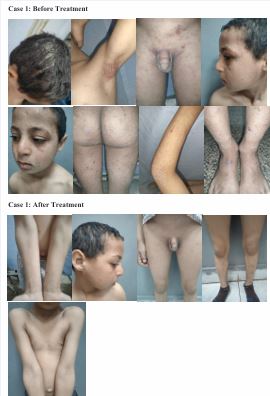
Case 1: Before Treatment & After Treatment.
CASE 1
A 7-year-old boy –was not born to consanguineous marriage and his mother denies the use any drugs or exposure to radiation during pregnancy- came complaining of recurrent abscess on different areas of his body including the scalp and ears that was cultures & found to be caused by a Staphylococcus aureus infection. The patient belonged to an under-resourced area with limited access to healthcare and lacked parent’s awareness that contributed to delay in diagnosis. The patients received only symptomatic treatment for many years and underwent incision & drainage many times for his recurrent abscesses. There was also history of repeated hospitalization for recurrent fever, chest and urinary tract infections. The child was depressed and refused to go to school from his bad skin looking.
Then, the patient came to us where the differential diagnoses of HIES, chronic granulomatous diseases, combined immunodeficiency syndrome and HIV were issued. Complete work up had been started where HIV testing, nitro blue tertazolium tests were negative. Complete blood count was normal except for mild eosinophilia. IgE level were 5600 IU/ml. Upon physical examination, there were multiple abscesses, oozing & crustations on the scalp and ears, areas of post inflammatory hyperpigmentation, eczematized lesions on the face, groin and buttocks.
We started to give him antibiotics and supportive treatment until infection subsided then subcutaneous injection with dupilumab has been initiated in a dose of 400 mg at first week ( 2 syringes of 200 mg each ),then 200 mg every two weeks for 6 months ( as the child’s body weight was 37 kg).
The patient progressed very well with complete subsidence of all eczematized lesions as well as infections. The child resumed his normal activities and return back to his school. His appetite became better and gained few kilograms. The patient continued receiving dupilumab 200 mg every 2 weeks for another six months then we started gradual spacing of the dose every 4 weeks with maintained good response. The patient is still under regular follow up and care.
CASE 2
A 21-year-old female came with swollen vulva & pubic area. She had consanguineous parents. The patient also had itchy eczematous and crusted lesions on the trunk, scalp & around and inside the ears since she was 2 years old.
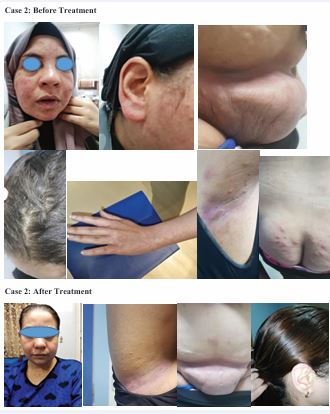
Case 2: Before Treatment & After Treatment.
There were also multiple abscesses of different sizes and different distribution all over the trunk and extremities.
She was diagnosed once as multiple cold abscesses or atopic dermatitis. She received conservative treatment in the form of antibiotics and drainage with culture showed Staphylococcus aureus but the condition became worse. Recurrent fever, skin and chest infections occurred that sometimes nesseciated hospitalization. At the age of 13 years old, the patient developed erythematous plaques at her left forearm and lower abdomen that was biopsied and diagnosed as nonspecific dermatitis. She started to receive multiple courses of systemic steroids, cyclosporine and mycophenolate mofetil without satisfactory response and sometimes adverse reactions had occurred.
Later on, the condition was complicated with recurrent vulval moniliasis with discharge. She received several courses of systemic & topical antifungal without satisfactory response. Due to repeated infections of the genital area, the area became swollen and the swelling became persistently non-pitting. This was explained by recurrent lymphangitis that leads to lymphatic obstruction. The patient underwent surgical intervention in a trial to improve the swollen vulva & pubic area twice but the condition became worse.
The patient became withdrawn and suffered from depression & isolation. She stopped her regular activities with repeated absenteeism from school.
Upon examination, the patient had distinctive coarse facies features that become universal by 16 years of age, including asymmetrical faces, hemi atrophy, prominent foreheads, broad nasal bridges, mild prognathism and deep-set eyes.
The differential diagnosis of this case was either atopic dermatitis or HIES. CBC showed leukocytosis with absolute eosinophilia. Her IgE level was 11,423 IU/ ml. Based on clinical picture and laboratory finding, the diagnosis was settled as HIES.
We started broad spectrum antibiotic with fluconazole 150 mg weekly in addition to supportive measures until the infection was controlled. Then, Dupilumab therapy was initiated in a dose of 600 mg as initial dose at the first week, then 300 mg every two weeks for one year. The patient responded very well with clearance of all eczematized lesions. The erythematous papules, lichenified plaques, and xerosis significantly improved. The EASI score decreased from 60 to 9.3, and the numerical rating scale score from 9 to 2. The serum IgE level decreased from 11,423 IU/mL to 4,261 IU/mL (normal range, \100 IU/mL), and the absolute eosinophil count from 1105/L to 257/L (normal range, 50 350/L). The patient did not experience any infections of the skin or respiratory tract.
The only remaining thing that annoyed the patient was the distorted mons pubis that was difficult to be managed according to the plastic surgeon except by a sophisticated operation to improve the lymphatic drainage of the area. Anyhow, the patient was satisfied by the gained response and she started to resume her normal life and schooling.
The patient is still regularly followed up with maintaining the same good response with dupilumab 300 mg every month (along 20 months duration) without any noticeable adverse events.
DISCUSSION
HIES consists of multiple overlapping primary immunodeficiency conditions, each of which has its distinct features. The most common defects are a deficiency of STAT3, and a deficiency of dedicator of cytokinesis 8 (DOCK8) [1,2].
Two pathways of eczema formation in HIES have been described. The first pathway involves STAT3 and ZNF431 and impairs IFN-g production and IL-10 signal transduction, leading to an unbalanced IL-4 state. The second pathway involves DOCK8 and WASP, which reduces T-cell receptor signaling and causes T regulatory cell dysfunction. Management of severe atopic dermatitis presenting in the context of elevated immunoglobulin E (IgE) levels and recurrent bacterial skin infections is challenging. Dupilumab is a monoclonal antibody against IL-4 and IL-13 and may represent a successful treatment in such cases [4].
In spite of paucity of case reports about the efficacy of dupilumab in the treatment of atopic symptoms & signs in HIES; yet we decided to try it in our two patients whose cases were chronic, recalcitrant, refractory to symptomatic treatment and affects the quality of life of the affected patients.
Over the treatment period, our patients were gradually relieved from the pruritus and other atopic symptoms. All skin lesions improved markedly. Dupilumab was well tolerated without serious adverse events. Both patients resumed their daily activities with improvement of QoL. Dupilumab may not only work on the skin inflammation but also on the inflammation of systemic organs of hyper IgE–related disorders, such as asthma. This has been mentioned in previous case report [5].
The efficacy of dupilumab in pediatric patients with severe eczema presenting in the setting of elevated immunoglobulin E (IgE) levels and recurrent bacterial skin infections is not well-understood. Here we present a case of a child with elevated IgE levels in whom dupilumab treatment led to remarkable control of his eczema and recurrent skin infections. Similar cases has been published before [6].
In conclusion, HIES is a rare disease that is understudied and underdiagnosed. The good response of our patients to dupilumab treatment; provide a new potential and hope for the treatment of such rare disabling disease.
We recommend the use of dupilumab on a large-scale patient to document it beneficial role as a therapeutic modality for HIES. This study provides an insight into HIES for physicians and encourages future work on the matter.
REFERENCES
- Tirth D, Fatema Ali Asgar T, Umme Salma R, Rizwanullah H. Hyper Immuneglobulin E syndrome: a case report. Ann Med Surg. 2024; 86: 1205-1209
- Awad R, Kakaje A. Hyper IgE syndrome (Job syndrome) in Syria: a case report. Oxf Med Case Reports. 2020; 2020: omaa106.
- Woellner C, Gertz EM, Schäffer AA, Lagos M, Perro M, Glocker EO, et al. Mutations in STAT3 and diagnostic guidelines for hyper-IgE syndrome. J Allergy Clin Immunol. 2010; 125: 424-432.
- Su CJ, Tseng HC. Treatment efficacy of dupilumab in a hyper- immunoglobulin E syndrome patient with severe atopic dermatitis. JAAD Case Rep. 2021; 11: 60-62.
- Lu CW, Lee WI, Chung WH. Dupilumab for STAT3-Hyper-IgE Syndrome with Refractory Intestinal Complication. Pediatrics. 2021; 148: e2021050351.
- Joshi TP, Anvari S, Gupta MR, Davis CM, Hajjar J. Case Report: Dupilumab Successfully Controls Severe Eczema in a Child with Elevated IgE Levels and Recurrent Skin Infections. Front Pediatr. 2021; 9: 646997.