A Topological Surface Network Model of the Brain Suggests that there is No Law of Excluded Middle in the Brain’s Logic
- 1. Centre for Research in Adaptive Nanostructures and Nano devices, School of Physics, Trinity College Dublin, Ireland
Abstract
In his book “The Computer and the Brain” von Neumann observed that the brain works efficiently using low arithmetical precision and very few logical steps. From this he made the remarkable conjecture that the brain’s internal logical system was non-standard. In this paper we prove von Neumann’s conjecture by considering a topological surface spin network brain model. Two theoretical arguments are presented. Both of which lead to testable predictions that suggest that the internal logical system of the brain is not standard as its logic does not obey the classical logical law of excluded middle of classical logic, which states that a logical proposition must be either true or false. We also show how the brain might function as a quantum computer when retrieving memories. This result explains how the brain can function efficiently with low arithmetical precision and few logical steps as a quantum computer requires very few steps to solve a problem. Observational support for the arguments and the reason for the existence of a quantum memory structure are discussed. The basic properties of the model used are explained. Thus we prove that the surface chosen for the model exactly captures the topological connectivity of the brain, sketch how that the model can produce all observed brain excitations using its global features and show that it has a natural way to store the information carried by signals as memory in a quantum spin structure.
Keywords
• Connectome
• Topology
• Riemann surface
• Riemann theta function characteristics
• Quantum memory
• Brain logic
• Quantum computer
Citation
Sen S (2026) A Topological Surface Network Model of the Brain Suggests that there is No Law of Excluded Middle in the Brain’s Logic. Comput Sci Eng 5(1): 1016.
INTRODUCTION
In this paper we prove von Neumann’s conjecture [1], that the internal logical system of the brain is nonstandard using results established in a recently published topological surface spin network brain model [2]. The internal logical system of the brain in the model is proved to not satisfy the law of excluded middle of classical logic and is thus nonstandard. The law of excluded middle of logic states that any logical proposition must be either true or false. We also show how this departure from classical logic allows it to work efficiently using a small number of logical steps and low arithmetic precision.
In his book, “The Computer and the Brain” von Neumann [1], suggested that the internal logic of the brain may not follow the rules of classical logic. He pointed out that just as language is a historical accident, as there is no logical necessity for the existence of a specific language such as Greek or Sanskrit, it is reasonable to assume that logics and mathematics are historical, accidental forms of expression. They may have essential variants. von Neumann was led to this conjecture by observating that the brain functions efficiently using shallow arithmetical and logical depth. Von Neumann was an outstanding mathematician of great insight who contributed more than any mathematician of his time to diverse areas of pure and applied sciences and made major contributions to many fields. Von Neumann’s started thinking about the brain after reading the work of Pitt’s and McCulloch [3], and he used some of the ideas of Pitt and McCulloch when he built the first digital computer. His clearly stated surprising conjecture about the brain’s logical system is worth investigating.
Arithmetic depth reflects the accuracy of the arithmetic operations that are carried out required to make predictions while logical depth reflects the number of logical steps required to come to a conclusion. From these observations von Neumann concludes that” Thus logics and mathematics in the central nervous system, when viewed as languages, must structurally be essentially different from those languages to which our common experiences refer. “The results of this paper validate von Neumann’s conjecture.
Other authors have suggested that the logical system of the brain may de part from classical logic [4,5]. These suggestions reflect the general belief that biological systems operate on the basis of seeking meaning in the information they receive rather than requiring overall logical consistency.
Alternative logical systems do exist. There is, for example, the four valued Buddhist logical system and the seven valued logical system of Jain philosophy [6-8]. The ancient Indian logical systems rejected the law of excluded middle simply because the Indian philosophers felt that no empirical statement could hold for all time and under all conditions. Thus the statement that an apple is red is true at a give instant of time and in a given environment. If viewed using blue light the apple will appear to be black. If we leave the apple for a month it will no longer be red. There is growing interest in non-standard logical systems in Artificial Intelligence [9], in neural networks [10], and in addressing foundational questions of quantum mechanics [11]. In these approaches departures from classical logic are externally introduced.
The internal logical system of the brain is not known. It cannot be found by studying the way the brain can learn and use abstract mathematics or use different system of logic. It can only be investigated by studying the combination rule of brain signals and the way they interact with and access memory. Such a study of signals and memory is only possible in a mathematical model of the brain. Unfortunately standard brain models cannot help. In these models input signals are not autonomously generated but are introduced through different types of “firing functions” and there is no attempt to study the constant interaction of signals with memories simply because the precise structures in which memories stored are not known [12-15]. Also the way signals carry information is not theoretically determined but has to be found by studying properties of signals [16]. Thus there is no theoretical method of studying the combination rule for signals. The only rule available is that when multiple signals enter a brain cell output signals emerge only if the combined voltages of the input signals cross a threshold. Similarly although there is growing evidence that memories are stored in the pathways between special brain cells, the way this is done is still under investigation [15], so that a theoretical study of memory storage is not possible. We thus need a non-standard brain model with the requires properties.
We note that all the functions of the brain are responses to input information carrying signals where the information carried is encoded in the brain’s own self-generated code.
The nature of incoming information received is identified by the brain by consulting memory. This means that the way to determine the brain’s logical system is by studying the combination rules of signals and their interaction with memory.
We study these two brain features. We begin by formulating the law of excluded middle in terms of the combination rules of brain signals. Consider two brain signals. One carries a proposition P and the other carries its converse CP. Using combination rules of signals that we will explain we then combine these two signals. The law of excluded middle is then the statement:
If the law of excluded middle holds it implies that a signal carrying a proposition and its converse, at the same time, cannot exist.
Our next step is to explain the basic features of the topological surface spin network brain model which we use for our analysis. From now on we will refer to it as the brain model.
BRAIN MODEL
The topological surface network model of the brain used is a realistic model because in two ways. It is realistic because, as we will now prove it exactly captures the topological connectivity properties of the brain and its surface is taken to have the electrical properties of the brain membrane so that they contain spin half electrons and protons. It is realistic in another sense as it can produce all brain-like excitations, suggest how memories may be stored and retrieved. We will sketch how these features emerge from a study of the model. We now prove that the surface of the surface network is chosen to exactly captures the topo logical connectivity of any brain connectome and then note that, unexpectedly it also has a precise mathematical representation [2]. A connectome captures the connectivity of the biological brain by a linear graph where each brain cell (neuron) is represented by a point and nerve fibers, axons, connecting them as lines. If we replace the points by surface regions and the lines by tubes we will have a surface representation of a connectome. The neurons of the brain are now located at the junction regions of the Riemann surface. The surface thus constructed is a compact surface that can be visualized as a membrane cover of the brain’s individual nerve cells. In this picture the neurons are junction regions and axons are the tubes. We further require this membrane to have surface spin-half particles to captures a property of the biological brain membrane.
A theorem of topology called the topological classification theorem of sur faces, enormously simplifies our model [17]. This theorem states that any com pact surface, no matter how complex, is topologically equivalent to an orderly collection of doughnuts joined together as shown in Figure 1. If we assume that the surface is smooth then such a surface with surface spin-half particles has a mathematical description as a Riemann surface with a spin structure. Thus the model introduced has classical topological properties because of its complex connectivity. Surface spin-half particles introduce an additional topological property to the surface called a spin structure and they also introduce a quantum feature to the model as spin-half particles obey the laws of quantum physics. The topological feature of surface spin-half particles comes from the fact that they have magnetic properties so that that they can link together to form distinct topological patterns. These are spin structures [18,19]. Spin-half particles also introduce a quantum feature to the model as they obey the laws of quantum physics [20].
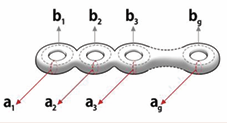
Figure 1: Riemann Surface with marked coordinates (ai ,bi).
MATHEMATICAL FACTS
Before we can sketch how brain signals are generated, how memory structure are created and how the combination rules for signals and properties of memory structures studied in the surface network model we need to define properties of the Riemann surface and explain why we need to introduce a function associated with it called the Riemann Theta function.
Riemann Surface
A Riemann surface has two properties. It has complex connectivity and it is smooth. Mathematically it is a geometric way to represent a polynomial equation in two complex variables [21]. This result was proved by Riemann. The topological connectivity properties of a Riemann surface are described by introducing loop coordinates round the surface of the g connected doughnuts as shown in Figure 1. There is a set of 2g of natural topological closed loop coordinates (ai , bi ) as shown. The ai loops go round the tubes while the bi loops go round the central hole of the ith doughnut as shown in the figure. These loops reflect the multiple periodic nature of Σg . The sets of closed loops (ai , bi ) (Figure 1) are said to be orthogonal.
The variables of a Riemann surface are its sur face points z. They are complex numbers. The smoothness of Σg is captured by g mathematical objects called one-forms ωi (z) dz, i =1,···,g. The existence of these g one-forms was proved by Riemann [22]. A one-form is an object that can be integrated. Its smoothness is captured by the smoothness of the coefficients ωi (z), where z is a point on Σg .
Thus Σg , as a mathematical Riemann surface, is described by the choice of its 2g topological coordinates (ai ,bi ) that describe closed loops, (Figure 1), and its smoothness is described by a specific set of g smooth one-forms and its variables are its surface points z. We still have to explain how to describe its spin structure. We will define it in an indirect but precise way after we define the Riemann Theta function associated with the surface.
The Riemann Theta function and Spin Structures
We next define the Riemann Theta function Θg [22,23]. Why is this function required? It is required to represent responses of the Riemann surface to sur face distorting input signals. Let us clarify this remark. Suppose we want to study oscillations of a circular wire. It is a geometric object and can be described in terms of its radius r and an angle θ. To study its oscillations we introduce trigonometric functions, (r sin(θ),r cos(θ). The variables of these functions are related to the variables of the circle and the functions satisfy a non-linear constraint that establishes that it is related to the circle. The constraint is (r cos(θ))2+(r sin(θ))2 =r2. The Riemann Theta function plays a similar role. It describes responses of the surface. As was the case for the trigonometric functions the parameters and variables are related to those of its associated Riemann surface and, as for the trigonometric functions, the Theta function is required to satisfy a non-linear identity called the Fay trisecant identity so that it does represent the Riemann surface. We first define the parameters and variables of the Theta function and then define the function.
We start with the parameters. An important set of parameters of Θg are in a symmetric matrix ?ij , with positive imaginary values, called the period matrix ?ij of the Theta function. It is defined by integrating the one forms ω(z)j dz over the closed loop bi . We thus have the expression, ?ij = ωj(z)dz, i,j = 1; g. It is a set of  complex numbers. The period matrix of a genus g Riemannsurface has complex parameters.
The second set of parameters of Θg are a set of positive or negative integers that can range between (±∞). The integers can be interpreted as winding numbers that come from integrating one forms ωj (z)dz over closed the ai loops.
These integrals  ω j (z)dz =δij , where δij is the Kronecker delta function. The integral represent integrating the jth one form once round the ith loop ai shown in Figure 1. Thus they produce positive or negative integer values as they “wind” round the ai loops of the Riemann surface in the clockwise or anticlockwise directions. We next turn to define the variables of the theta function.
The Riemann Θg function has g complex variables zi that are all generated from the one complex variable z of Σg . They are defined by 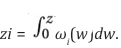 In other words, the variables, zi are generated by integrating the ith one form between a fixed point 0 on Σg to a variable point z on its surface. The Θg can be regarded as a smooth function in a space of g complex variables. The variables zi of the space have periodicity properties which they inherit from the periodicity of the variable z of Σg as it winds round the 2g closed loops (ai , bi ) of Σg . This space of g complex variables with periodicity conditions is called the Jacobian, J (Σg ) associated with Σg . The theta function, Θg is a locally smooth function on J (Σg ). A theorem, called the Jacobi inversion theorem [23], tells us that the Jacobian J (Σg ) provides an alternative description of a Riemann surface [23].
Finally Θg has 2g discrete variables called theta characteristics or simply characteristics, (αi ,βi ), i = 1,2,...g, that describe the spin structure of Σg , in a precise way. Topologically distinct spin structures of Σg correspond to different choices of characteristic values [18,19].We will make this link clear shortly. Each characteristic αi or βi can take one of two values, namely zero or half.
We now write down the defining expression for the Riemann theta function 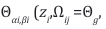 it is,

Notice the characteristics, (αi ,βi ) are related to the loops (ai ,bi ) of Σg . Thus the αi characteristics are associated with the ai loops and the βi characteristics with the bi loops of Σg . This observation allows us to give characteristic a geometric interpretation. A traversal round the ai loop adds  to zi while one round the bi loop adds to ni variables of the theta function [19]. We interpreted the integer numbers ni as the windings number of a one form round the ai loops then the fraction can be interpreted as the winding of a “half form” that changes sign after a 2π rotation can be associated with a spin-half particle [18]. It is known that a quantum spin-half particle does changes sign under 2π rotation [20].Thus by relating spin-half particles to “half-forms” a geometric interpretation can be given that links characteristics associated with integrals over ai loops of Σg to the integral of “half-forms” over ai loops that represent spin-half particles on Σg . We next note an important property of the Theta function. We note that we can write Theta as,
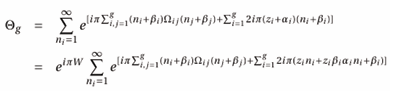
where  It is an integer. It is the spin topology number of Σg reflected in the Theta function. It defines the spin structure of the Riemann surface. Thus the two topological integer numbers that capture the connectivity g and spin structure W are now defined. Both of them are explicitly present in the Theta function. A given set of characteristics is said to be even or odd depending on whether eiπW =±1.
Pinch deformation input signals
We next describe how signals are generated in the network by global means by local topology changing input signals called pinch deformations. These input signals can generate a wide variety of brain-like excitations. We will explain how this happens.
Pinch deformations input signals reduce the circumference of ai loops and as a result change the topology of the surface as shown in Figure 2. As this process reveals junction regions of the Riemann surface pinch deformations reveal the neurons underlying the Riemann surface.
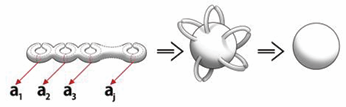
Figure 2: Pinch Deformation reduce topology of subunit to that of a sphere.
† The figure shows how a pinch de formation changes the topology of a subunit to that the surface of a sphere. † It is known that a pinch deformation of a biological axon does indeed produce signals [24].
The sphere represents a collection of neurons. Mathematically pinch deformations of a Riemann surface deform the zi variables of the Theta function to become z i →Vi x+Wi t where (Vi ,Wi) represent the Riemann surface deformation parameters and (x,t) variables represent two directions on an axon tube, space and time variables. The details of this happens are given in the cited papers [25,26]. We will comment on this result later. Here we simply note that the distortion parameters (Vi ,Wi) are depend on the Riemann surface. They represent the model’s self generated information code.
Signal Generation
Unexpectedly brain signals are generated in the model by exploiting the surface network’s topological properties. Let us explain the process. A subunit that generates a signal with topology numbers (k,w), representing its genus and spin, is deformed by k pinch deformation input signals as shown in Figure 1 to a topo logical sphere with (k = 0,w = 0) topology numbers. We interpret this sphere as a collection of neurons. These pinch deformations produce k one dimensional non-dissipative voltage pulse that carry with them a spin topology phase eiπw and these excitations can be represented by explicit analytic expressions in terms of Theta function which are solutions of the non-linear Schroedinger differential equation [2]. Depending on the nature of the deformation parameter values all observed brain signals can be generated by pinch deformation input signals [25,26].
Let us explain how this happens. A number of mathematical discoveries underpin the result. The first discovery [27,23] was to find the non-linear identity, 10 the Fay trisecant identity, that a Riemann Theta function must satisfy if it is to represent a Riemann surface [23]. This was done by Mumford.
The next result was that the brain excitations must carry spin topology phases with odd values of the spin topology number w. This is because the Fay identity only holds when Theta functions have odd integer values for W. The next unexpected discovery was made by Mumford [23]. He found that under pinch deformations, two things happen: the variables of the Theta function are deformed, as the variables of Theta are related to those of the Riemann surface, and the Fay identity gets deformed to becomes a non-linear differential equation. Finally Arbarello [28], showed that the non-linear differential equation produced by pinch deformations is the one dimensional Schroedinger equation only if the Riemann surface is described by the real hyper elliptic equation defined by the equation. We are interested in solutions of the non-linear Schrodinger equation as they can describe all observed brain excitations. The hyper elliptic equation is defined by the equation,

where y,z are complex but xi are either real or they occur as complex conjugate pairs, that is, if  is a complex zero of the equation then
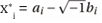 is also a zero. ‡
Key properties of signals
We list the key properties of brain signals we need for our discussion of brain logic. All brain signals are generated by reducing the topology numbers of a subunit from (k,w) to (0,0). This means that the signals must carry away this topological information. The number k shows up as k pulses and the number w shows up as the phase factor eiπw that multiplies the expression describing the excitation. We pointed out that the Theta function naturally has this phase. The next important feature of signals is that different information carrying signals can have the same spin topology phase factor. This statement is clear from
‡The Riemann surface associated with this equation can be constructed by showing how starting from the equation the ωi (z)dzi = 1·,g and the 2g loop coordinates (ai ,bi ) can be determined from the equation. They are defined by  and the 2g cycles represent choices of branch cuts that make the square root function well defined on the complex plane [25]. the expression for k pulse solution we now write down [26],
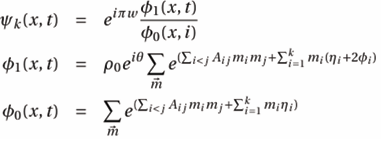
where mi summed over. Each mi can be either zero or one. The subunit has genus k and spin topology number 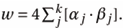 Different signals with the same eiπw are possible. They will have different pinch deformation parameter values for (Ai j , ηi , φi ,) and. The term ηi = (Vi x + W i t ). The k pulse excitation is produced by a subunit of genus k in response to k input pinch input signals. Thus two different signals with the same spin topology number must produce the same number of pulses and these pulses reflect the number of neurons firing in the subunit.
We next turn to explain how quantum memory structures are created by propagating signals [2], and prove that quantum memory states are topologically entangled.
MEMORY STATES ARE EXTENDED QUANTUM STATES
Memory structures are created by the magnetic fields generated by moving charged pulse signals [29], acting on and aligning the surface spin-half particles present. A quantum calculation shows that these weak transient magnetic field can result in the formation of a stable helical structure of aligned spins on the surface of pathways traversed by the pulse [2]. It is an extended quantum memory structure. It is quantum because spin half particles obey the laws of quantum theory and it is a memory structures as it records the nature of the transient magnetic field produced by the voltage pulse signal as the magnetic field completely determines the original voltage pulse signal [30]. The stability of the structure was carefully investigated and proved to hold at body temperature provided certain conditions are satisfied [2]. The key determinant of stability was that the path contains loops. But a loop of paths means multiple neurons must be involved in the structure as neurons are junction regions and a path loop requires at least two junction regions to form. Thus the model predicts that a stable memory structure must involve a collection of neurons connected together by paths that form closed loops. But this predicted structure is precisely the structure of observed memory engrams [15].
An unexpected property of the magnetic memory structure is that it does not have any macroscopic magnetism. This is because in a helical structure of aligned spins neighbouring spin-half particles are related by 2π angle rotations and spins related by 2π rotations have opposite orientation. It is a quantum property of spin half particles [20]. The quantum structure calculation also shows that each memory structure has a memory specific excitation frequency [2].
We next prove that the quantum memory structures are topologically entangled. This is a technical argument but we include the proof as it is an important result and does not require prior knowledge of topology.
Memory structures are topologically entangled
Entanglement in topology means that points or collection of points in a given space cannot be separated. Let us explain what this means. Topology studies properties of a space that do not change under continuous deformations this means its basic building blocks must unchanged under such deformations. A region of space such as a points inside a disc in two dimensions have this property. Under continuous deformation the shape of the disc will change but the collection of points inside do not change. The interior points in a disc define an open set. Using open sets of discs we can separate two points on a two dimensional surface. We simply introduce two discs so that each disc contain one of the two points and make sure that the discs chosen do not intersect. This is possible. It means the two points are not entangled: they can be separated by discs. Spaces where points or collection of points can be separated in this way are called Hausdorff spaces [17]. We now show that the space of memories does not have this property. Memories are helical structures of aligned spin half particles on a Riemann surface. They are extended quantum states that have a one-dimensional helical shape. Such a shape can be described by the algebraic equation Mi = xi (zi )2 + yi (zi )2 = R2, 0 < zi < Li where (Xi (zi ),yi (zi )) are points on the surface of the Riemann surface Σg and zi describes the length of the memory which can range over closed loops of the Riemann surface. The total brain memory structure M is the superposition of all quantum memory states Mi . We define a topology for this space of memories using the fact that each memory is a helical structures embedded in a Riemann surface. We then prove that these memories are topologically entangled.
Recall a topology of a space X with null space φ is a choice of open sets in X that have the property of the union of these open sets is an open set, the finite intersection of open sets is open and X and φ are regarded as open sets. Our space of memories M are closed sets in Σg . A natural way of constructing open sets from them is by considering the complements of these closed sets. Thus the open set associated with Mi is Σg −Mi . These open sets were introduced by Zariski [31], and provide the space of memories a topology. But now open sets of any two memories always intersect as they both contain Σg with just a curve removed from it. This means the space of memories cannot be separated. A Hausdorff separable space [17], is one in which any two points of the space can be placed in open sets that do not intersect. A spaces with Zariski topology is non-Hausdorff. Memories are topologically entangled. Thus the surface network predicts that coherent quantum memory states that are topologically entangled should exist in the brain. Indeed the model speculates that these structures are formed by helically aligned proton spins located in myelin sheaths of axons. Indirect evidence for this is discussed in Sen [2].
With these results in place we are now ready to start our study of how brain signals combine. We key result is a combination rules for the spin topology phase factors carried by signals discovered by Frobenius. Frobenius found that spin topology phases obey combination rules, when W is an odd integer. Let us explain his rules.
Combination rules for spin phase factors
Frobenius [32,33], studied the combination rule of of spin topology numbers associated with sets of characteristics of a Riemann theta function where each set of characteristics was assigned a spin topology phase factor eiπW. From these he selects those with the property eiπW = −1 and shows that a set of these can be chosen, which he called the fundamental set, in terms of which all other characteristics can be is expressed. Many different choices for the fundamental set are possible [32]. We do not need to consider these sets. We only need Frobenius’s rules for combining the spin topology numbers of two arbitrary odd characteristics. They are [33],

where wi , wj are two sets of odd characteristics (α1 ,α2 ·,αg ,β1 ,β2 ,·,βg )n, n = i, j, and the labels, i, j represent the spin topology numbers of each set, and e(w) = eiπW ,with  the associated spin topology number, with (−1)W. Thus when two different spin topology number with odd characteristics are combined they produce an odd spin topology number but when they are the same they combine to give W = 0. We write, W = i + j +1, where i, j are odd numbers, and when wi = wj the spin topology number becomes W =0. When wi = wj it means the two sets of characteristics are the same and that both signals are generated by subunits containing the same number of neurons. As any two subunits with the same value of W have the same genus.
THE LOGICAL RULES OF THE BRAIN
We are now ready to investigate the brain’s internal logical system. We will use two separate approaches. The first approach is based on the combination of signals. The second has to do with the quantum nature of the memory structures. Both approaches lead to testable predictions.
The internal logic of the brain is unknown. But it is reflected in the way brain signals combine and interact with memory since the brain functions to tally depend on using the information it receives from entering signals. There is no external logical rules that are imposed on the way this is done. The rules the brain follows have emerged as a result of evolution. Input signals are first encoded by the brain using its own unknown self-generated code, they are processed and result leads to responses in a person that could be emotional or/and motor. The processing depends on the interactions between signals and with memory. Such a study is only possible in a brain model.
The law of excluded middle for signals.
The idea is that brain signals can carry information containing propositions. If one signal carries proposition P and another its converse and if the law of excluded is valid then combining these two propositions to form a signal that contains both propositions should not be possible. The combination rules for spin topology phases tell us that if the two signals carry different spin topology numbers then when they combine a spin topology number that is odd is produced and an associated viable signal is produced. But if the two contrary information carrying signals have the same spin topology number then when they combine they produce a spin topology number W =0 and no signal is produced as all signals must carry a spin topology phase with W an odd integer. We now recall the law of excluded middle and its formulation in terms of the combination rules of brain signals stated in the introduction. We have:
The law of excluded middle is the statement of logic that a proposition P of logic is either true or false. We now formulate the law in terms of the combination rules of signals, as:
If the law of excluded middle holds it implies that a signal carrying a proposition and its converse, at the same time, cannot exist.
We have just shown that for the law of excluded middle to hold the signal carrying proposition P and one that carries the converse proposition must have the same spin topology number and as discussed must be generated by identical subunits. This means both signals are produced by exciting the same number of neurons as a multivoltage signal of g pulses is created by exciting g neurons present in a signal generating subunit.
Thus the question whether the brain’s internal logic does or does not satisfy the law of excluded middle can now be experimentally determined by studying if the size of excitations created by a propositions and its converse are the same or not.
Observationally it is found that a proposition and its converse produce signal excitations of different sizes [34]. This is found by means of multivariate pattern analysis (MVPA) that can distinguish between brain activities for a proposition and its converse. It found that while both types of concepts are processed in overlapping brain regions, their representations are not identical, particularly when influenced by negation. Thus it follows that the law of excluded middle is absent in the brain’s logical system if the theoretical results of combining signals of the TBM are valid. We end with a quote from the conclusion section of the paper:
“The overall picture emerging from this set of results is largely compatible with the view that sentential negation polarity operates by modulating the neural activation patterns coding for concepts, to an extent that is sufficient to make the processing of affirmative and negative sentences with either an abstract or concrete content distinguishable by means of MVPA. We suggest that the negation polarity modulation occurs in distributed representational semantic networks, through the functional mediation of syntactic and cognitive control systems [34]”. Thus negative propositions can be observationally distinguished from positive propositions. They do not use the same number of neurons. Hence the law of excluded middle is not valid for the brain’s internal logic system.
The law of excluded middle for memory states
We now give a second argument that suggests that also leads to the same conclusion. In the TBM memory structures are superposition of extended quantum states of helically aligned quantum spin-half surface particles. We sketched how they can be created by the magnetic field generated by moving voltage pulse signals acting on and aligning surface spin-half particles to create a non transient records of the information carried by signals. Since spin-half particles obey the laws of quantum theory this structure is a extended helical quantum structure. The conditions for this structure to be stable at body temperatures have been investigated [2].
In quantum theory the law of excluded middle does not hold as wave functions that are superposition of states can carry contrary propositions. An ex ample will clarify this point. Consider the quantum memory state of faces that a person recognizes. In this state all faces, as quantum states, are present. This means the state contains the face A and the face not Ain it and thus it does not satisfy the law of excluded middle. For this idea to be acceptable evidence for the existence of a extended quantum structure in the brain is required. Recent experimental results suggests the existence of an extended quantum structures in the brain [35,36]. Kerkens and his collaborators found that proton spins in bulk water in the brain have quantum coherent structures. We quote:
“Recent proposals in quantum gravity [37,38], have suggested that unknown systems can mediate entanglement between two known quantum systems, if the mediator itself is non-classical...Our findings suggest that we may have witnessed entanglement mediated by.... brain functions that operate non-classically.. which would mean that consciousness is non-classical”.
Our comment is that the scale of quantum coherence required for quantum gravity to be effective is not supported by observations [39], and the possibility of gravity induced quantum effects is speculative because currently there is no accepted theory of quantum gravity. Penrose [40], has explained why constructing such a theory is not possible using standard methods of quantum field theory. We suggest that Kerkens’s [35], observation of quantum coherence can be understood from the suggested quantum brain memory structure.
Kerskens found that proton spins in bulk water were in an entangled quantum state. They get entangled because both of them interact with the proton spins of the extended memory structure by spin-spin interactions. Symbolically if (p1 ,p2 ) are two bulk water proton spins in quantum states (|p1 ,y1 > , |p2 ,y2 >) and |M >=  ; Nj is the superposition of K memory states with x j a(j) the location of an aligned proton spins in the jth myelin sheath. Then the spin entanglement term is given by

The entanglement is due to both of the bulk water proton spins interacting with all the spins of the extended quantum memory state. However this entanglement expression is time dependent as the proton spin magnetic moments of both bulk water and memory structure proton shave oscillatory time dependences. This means a time average over these cycles will give a zero value for the entanglement. The only way a non-zero entanglement value is possible is if all the time dependences are the same.
We now explain that the memory structure proton spins have a heartbeat induced frequency which is always present. This means that if the bulk water protons are tuned to this frequency then the entanglement will be non-zero and will be observed as a coherence oscillation of buk water proton spins synchronized to the heartbeat frequency.
The synchronized proton spin oscillations observed with heart beat cycles can also be understood from the entanglement of bulk water proton spins. It has been established that heartbeat-induced blood pressure changes directly affect neuronal activity in the brain through mechano-sensitive ion channels like Piezo2, [41], that convert mechanical pressure in to electrical signals that have voltages of a few mV. Thus heartbeats generate oscillating voltage signals which can excite the memory structure as it has excitation frequencies in the range (1−20+)2Hz [2].These memory spin oscillations induced by hear beat, that are always present, will in turn lead to synchronized proton spins oscillations of the same frequency due to their spin-spin coupling to the memory structure. Al though these results are promising the existence of the quantum memory structure still remains conjectural. A direct proof that proton spins align to form a quantum memory structure is missing.
Does the brain function as a quantum computer?
We now explain how the process of memory recall in the model is similar to the way a quantum computer works [2]. We recall the argument. In the TBM memories are encoded in the superposition of extended quantum structure of aligned quantum spin-half particles. We pointed out earlier that memories have a memory specific excitation frequencies that overlap with those of EEG waveform, and that the EEG frequencies were determined by the brain excitations that co-produce them. EEG waveforms are associated to special surface oscillations on neurons [2], not as dipole loop currents on dendrites [42].
Let us put these pieces of information together and see how the process of memory retrieval works like a quantum computer. Consider the process of identifying a person A’s face. It is a two step process. An incoming mix of signals with the face details of A is received by the eye, leading to the generation of brain signal, these signals in turn generate a specific mix of EEG waveforms [2], associated with the incoming face pattern signals. The mix of EEG frequencies generated thus acts as a bar code for the collection of signals and excites the memory of face A from the quantum memory state of stored faces by a frequency resonance mechanism. There is observational support that EEG waves accessing memory states as soon as a signal enters the brain [43]. The process described is similar to the working of a quantum computer.
In a quantum computer a superposition of states contains all possible outcomes. To extract information a probe wave function is introduced that projects out and find out if a required result is present or not in the system. For the brain the space of memories is the quantum state of all possibilities and the EEG waveform mix generated by incoming signals is the probe wave function.
The suggested method of memory recall also explains how the brain can function efficiently with shallow arithmetic and logical depths. A quantum computer needs a small number of logical steps to carry out its function as it uses massive amount of parallel processing. Consequently great arithmetical precision is not required. But this exactly what von-Neumann conjectured. He had the insight to link departure from classical logic to the shallow logical and arithmetical depth observed in the functioning of the brain. In this paper we have shown that the topological surface model suggests that the internal logic system is non-standard as it does not obey the law of excluded middle of classical logic and this includes the suggested quantum memory structure which, as shown, allows the brain to function efficiently with shallow arithmetic and logical depth.
CONCLUSIONS
The surface network model we used has two special features. First its surface is a topological surface representation of any brain connectome. We proved this result. It means that the topological connectivity structure of the brains of all creatures whether a fly or a frog or a human can be represented by a Riemann surface with spin structure. The difference between their brains is in the value of the genus of the Riemann surface. Hence all such creatures should produce similar excitations and have similar EEG wave forms [2]. The second unexpected feature of the model is that the processes of signal production, of memory storage in a quantum structure of aligned spin-half particles. Usually spin-half particles play no role in signal production or in storing memories in the way suggested by the mode. Our proof of von Neumann’s conjecture was only possible because of the topological features of the model where we found that a spin topological phase was carried by all signals with well-defined combination rules, and these spin-half particles linked together to form a quantum memory structure with each memory having a characteristic excitation frequency that allowed it to function as a quantum computer for information retrieval with the help of EEG waveforms. The observational challenge is to find if the brain has the predicted quantum spin memory structure spin-half particles. We conjecture that they are proton spins in the myelin sheaths of axons of the central nervous system [2].
Author Contributions
Siddhartha Sen carried out the formal analysis and wrote the paper. The article is a theoretical work and no data was generated.
Ethics: No ethical issues are involved in this work.
Use of AI: No AI tools were used.
Funding
The work did not receive any specific grant from funding agencies in the private, public, commercial or not for-profit domain.
Methodology and Resources
The methodology used is publicly available. Resources used are published papers.
Acknowledgement
I would like to thank my late friend Mike Coey FRS for encouragement and many discussions and Maurizio Pezolli for reading and helpful comments.
REFERENCES
- von Neumann J. The Computer and the Brain. Yale University Press. 1957.
- Sen S. A topological method of generating action potentials and electroencephalography oscillations in a surface network. R Soc Open Sci. 2025; 12: 241977.
- McCulloch W, Pitts W. A logical calculus of the ideas immanent in nervous activity. Bull Math Biolphysics. 1943; 5: 115-133.
- Peirce C. On a New List of Categories. Proc Am Academy Arts Sci.1868; 7: 287-298.
- Kull K. Semiosis stems from logical incompatibility in organic nature: Why biophysics does not see meaning, while biosemiotics does. Prog Biophys Mol Biol. 2015; 119: 616-621.
- Mahalanobis PC. The India-Jaina Dialectic of Syadvad in Relation to Probability. Dialectica. 1954; 8: 95-111.
- Haldane JBS. The Syavadar System of Predictions. Sankhaya. 1957; 18: 195-200.
- Motilal BK. Buddhist Logic and Epistemologies. Studies in Buddhist Analysis of Inferences and Language. 1986; 7.
- Jain D. Knowledge Engineering with Markov Logic Networks: A Review. 2011.
- Gupta MM, Rao DH. On the principles of fuzzy neural networks. Fuzzy Sets and Systems. 1994; 61: 1-8.
- Ghose P. A contextual Seven Valued Logic (Saptabhanginaya) for Quantum systems. 2025.
- MacGregor R. Neural and Brain Modelling. Academic Press. 1987.
- Deschie N, Ignacio Gossn J, Tewarie P, Schelter B, Daffertshofer A. On the Validity of Neural Mass Models. Front Comp Neurosci. 2021; 14: 581040.
- Abbot LF, Dayan P. Theoretical Neuroscience. MIT Press Cambridge. 2005.
- O’Sullivan FM, Ryan TJ. If Engrams Are the Answer, What Is the Question? Adv Neurobiol. 2024; 38: 273-302.
- Bialek W, Rieke F, de Ruyter van Steveninck RR, Warland D. Reading a neural code. Science. 1991; 252: 1854-1857.
- Munkres JR. Introduction to Topology, Chapter 12, Prentice Hall, International Edition. 2014.
- Atiyah MF. Riemann surfaces and spin structures. Ann Scientifiques de l’Ecole Normale Superieure. 1971; 4: 47-62.
- Mumford D. Theta characteristics of an algebraic curve. Ann Scientifique del’Ecole Normale Superieure. 1971; 4: 181-192.
- Landau LD, Lifshitz EM. Quantum Mechanics: Non-Relativistic Theory. Course of Theoretical Physics. 1981; 3.
- Teleman C. Riemann Surfaces. 2003.
- Riemann B. Collected Papers. Kendrick Press. 1892.
- Mumford D. Tata Lectures on Theta I. 1987; 28.
- Faisal AA, White JA, Laughlin SB. Ion-channel noise places limits on the miniaturization of the brain’s wiring. Curr Biol. 2005; 15: 1143-1149.
- Kalla C. Fay’s Identity in the theory of Integrable Systems. 2011.
- Previato E. Hyperelliptic Quasi-Periodic and Soliton Solutions of the nonlinear Schrodinger Equation. Duke math J. 1985; 52: 329-377.
- Fay JD. Theta functions on Riemann surfaces. Lectures Notes in mathematics. 1973; 352.
- Arbarello E. Sketches of KDV. Contemporary Mathematics. 2001; 312: 9-70.
- Jackson JD. Classical Electrodynamics. Wiley. 1962.
- Barry JF, Turner MJ, Schloss JM, Glenn DR, Song Y, Lukin MD, et al. Optical magnetic detection of single-neuron action potentials using quantum defects in diamond. Proc Natl Acad Sci U S A. 2016; 113: 14133-14138.
- Griffith P, Harris J. Principles of Algebraic Geometry. Wiley. 1978.
- Farakas G. Theta Characteristics and their moduli. 2012.
- Guardia J. Jacobian nullwerte and algebraic equations. J Algebra. 2002; 253; 112-132.
- Ghio M, Haegert K, Vaghi MM, Tettamanti M. Sentential negation of abstract and concrete conceptual categories: a brain decoding multivariate pattern analysis study. Philos Trans R Soc Lond B Biol Sci. 2018; 373: 20170124.
- Kerskens CM, Perez DL. Experimental indication of non-classical brain functions. J Phys Com. 2022; 6: 1005001.
- López Pérez D, Bokde ALW, Kerskens CM. Complexity analysis of heartbeat-related signals in brain MRI time series as a potential biomarker for ageing and cognitive performance. Eur Phys J Spec Top. 2023; 232: 123-133.
- Bose S, Mazumdar A, Morley GW, Ulbricht H, Toroš M, Paternostro M, et al. A Spin Entanglement Witness for Quantum Gravity. Phys Rev Lett. 2017; 119: 240401.
- Marletto C, Vedral V. Gravitationally Induced Entanglement between Two Massive Particles is Sufficient Evidence of Quantum Effects in Gravity. Phys Rev Lett. 2017; 119: 240402.
- Sahu S, Ghosh S, Ghosh B, Aswani K, Hirata K, Fujita D, et al. Atomic water channel controlling remarkable proper-ties of a single brain microtubule: correlating single protein to its supramolecular assembly. Biosens Bioelectron. 2013; 47: 141-148.
- Penrose R. Shadows of the Mind: A search for the missing science of consciousness. Oxford University Press. 1994.
- Jammal Salameh L, Bitzenhofer SH, Hanganu-Opatz IL, Dutschmann M, Egger V. Blood pressure pulsations modulate central neuronal activity via mechanosensitive ion channels. Science. 2024; 383: eadk8511.
- Lopes da Silva F. Neural mechanisms underlying brain waves: from neural membranes to networks. Electroencephalogr Clin Neurophysiol. 1991; 79: 81-93.
- Sherman MA, Lee S, Law R, Haegens S, Thorn CA, Hämäläinen MS, et al. Neural mechanisms of transient neocortical beta rhythms: Converging evidence from humans, computational modeling, monkeys, and mice. Proc Natl Acad Sci USA. 2016; 113: E4885-E4894.