Loading

JSM Dental Surgery

Bone Spreading and Standardized Dilation of Horizontally Resorbed Bone: Technical Considerations

Review Article | Open Access | Volume 2 | Issue 4

  • 1. Department of Dental Materials and Prosthodontics, State University of São Paulo (UNESP) São José dos Campos, Brazil
+ Show More - Show Less
Corresponding Authors
Renato Sussumu Nishioka, Department of Dental Materials and Prosthodontics, State University of São Paulo (UNESP) São José dos Campos, Av. Francisco José Longo 777, São Dimas, São José dos Campos, São Paulo- Brazil, Cep:12245-000
Abstract

Bone spreading technique (BST) or crest dilatation technique is horizontal augmentation with minimal trauma for simultaneous implant placement. BST is an alternative Summer’s osteotome both clinical use as well as the armamentarium. The foremost advantage of BST is a substantially less invasive method; the buccal wall expands after the medular bone is compressed against the cortical bone. The lateral dilation and compaction of medular bone improved primary stability. The vital difference is that the BST used in this case report avoided discomfort of the patient, thus eliminating the need for malleting.

Keywords

• Ridge expansion

• Deficient alveolar bone width

• Bone spreading, Dental implan

Citation

de Melo Nishioka GN, Andreatta Filho OD, Souza FA, Nishioka RS (2017) Bone Spreading and Standardized Dilation of Horizontally Resorbed Bone: Technical Considerations. JSM Dent Surg 2(4): 1024.

INTRODUCTION

Alveolar resorption following trauma, extraction or infection have often resulted in a ridge form with deficient width or/and height dental implants placement. However, after loss of teeth in the anterior or posterior maxilla, the alveolar ridge decreases by bone atrophy. When patients present with inadequate alveolar ridges, it could jeopardize the application of implant dentistry. If bone volume is inadequate, several surgical techniques may be used to reconstruct the deficient ridge for implant placement. The advanced resorption of alveolar bone in the maxillary region is often a problem for the placement of implants. Bone volume must be available at the position needed to place a fixture.One of the major problems encountered after the tooth extraction is the hard and soft tissue loss. Reduction of the buccal alveolar bone caused by bone resorption in partially edentulous maxilla is a frequent problem [1,2]. Implants need an adequate volume of bone to stabilize the fixture. In partially edentulous patients often maxilla atrophy requires to be augmented. Numerous augmentation techniques [3-8], have been reported in dental literature to facilitate implant placement in atrophic ridge using blocks grafts, which require several steps before prosthetic restoration. In an effort to shorten the length of treatment, avoid an additional surgical appointment, challenge to the patient a decrease patient morbidity. A technique which would both lessen the trauma to patient and conserve the maximum amount of alveolar bone at precise site of anticipated implant placement would offer clinical benefits. Spreaders of increasing diameters are gently introduced sequentially to expand the implant site. With each insertion of a larger diameter spreader the bone is pushed laterally. The implant should be slightly larger in diameter than the site created by the largest diameter spreader. BTS is an alternative Summer’s osteotome [9-13], both clinical use as well as the armamentarium.

The limitations of drilling into an atrophic ridge in the maxilla constitute a challenging clinical situation. Zarb & Schmitt [1], indicated that the minimum required dimensions of bone include a ridge width of 5mm, based on clinical experience. In the past few years, much effort has been placed in developing a surgical technique to overcome this problem of bone resorption. To fulfill both the functional and esthetic requirements for implant placement in the residual alveolar bone, a plan may implant the placement of an implant in concert with ridge expansion procedures.

Several techniques have been reported for the placement of dental implants in an effort to shorten the length of treatment, avoid a second surgical appointment, reduce additional surgical sites, reduce the challenge to the patient and decrease patient morbidity. Ridge augmentation procedures available for implant placement include bone grafting and bone guided regeneration. The advantages and disadvantages of local bone grafts from the mandible have been described [2-9]. A technique which would both lessen the trauma to the patient and conserve the maximum amount of alveolar bone at the site of an anticipated implant placement would offer clinical benefits.

The Bone Spreader Technique (BST) involves horizontal augmentation with minimal trauma for simultaneous implant placement and is an alternative to summer’s osteotome [10- 13]. BST utilizes a “screw-type” configuration of expansion and condensing burs and screw spreaders in increasing diameters for lateral bone expansion and condensing for placement of an endosseous dental implant. This technique uses a series of six screw spreaders with increasing diameters, which are gently introduced to expand the osteotomy site. With the insertion of a larger screw spreader, the bone is pushed laterally. A control system allows for substance-saving compression of the medular bone to a sufficient horizontal dimension [14,15]. The implant should be slightly larger in diameter than the site created by the last screw spreader. The objective of this technique is to conserve all of the bone in the surgical site and to selectively displace the bone laterally. Trauma and invasiveness are reduced with instrumentation through the ridge crest [16-20]. This paper describes a technique for widening the maxillary cortical bone to improve the placement of implant.

PATIENT SELECTION

Before treatment, all patients were screened for preexisting dental problems, and systemic health. Existing intraoral infections including those of endodontic and periodontal origins were treated before implant placement. An overall treatment plan was formulated in conjunction with the treating restorative dentists. Periapical and panoramic radiographs were taken of all patients. Diagnostic casts, diagnostic wax-ups and surgical templates were also used. The selection criteria were: inadequate bone width or bone type IV.

SURGICAL TECHNIQUES

A 52-years-old man presented for replacement of a missing premolar in the maxilla. The incisive had been extracted 7 years ago. Clinical exam revealed significant buccal bone loss in the premolar maxilla, although adequate ridge height was present for implant placement. The patient requested that we avoid any bone-grafting procedure.

A complete examination of oral hard and soft tissues was carried out for each patient. Preoperative standardized periapical and panoramic radiographs showed a sever atrophy of the maxilla on one or both sides. In selected cases a CT-scan was utilized as pre operative and final investigation. Diagnostic cast, diagnostic wax-up and surgical acrylic template wasfabricated. The opposite jaw had to have a sufficient number of remaining teeth to give good occlusion. The CT-scan was produced with this acrylic template in place to analyses the sites for implant placement. A surgical acrylic template was used to indicate the optimal direction of the implant (Figure 1).

A surgical acrylic template was used to indicate the optimal direction  of the implant.

Figure 1: A surgical acrylic template was used to indicate the optimal direction of the implant.

The patient was given written information regarding the risks of that kind of surgery and their written informed consent was obtained.

The patient was premedicated with 2.0g de amoxicillin 1 hour prior to surgery and 500mg, 4 times a day for 7 days. Prior to surgery, patients were asked to rinse with chlorhexidinedigluconate .12% for 1 minute. Surgical procedures were performed under local anesthesia. After administering 2% mepivacain, this technique begins with a crestal incision. The criteria were inadequate bone width.

A buccal full-thickness flap was reflected to expose the alveolar ridge (Figure 2).
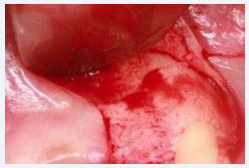
A buccal full-thickness flap was reflected to expose the alveolar ridge.

Figure 2: A buccal full-thickness flap was reflected to expose the alveolar ridge.

The proposed implant site was cleared marked with an initial bur (1.8 mm in diameter) was used at 18,000 rpm under copious irrigation with sterile saline, removing the cortical plate. The initial bur prevented the pilot bur from slipping. The pilot bur was penetrated to reach the desired height. BST utilizes a “screw-type” configuration of expansion and condensing burs and screw spreaders in increasing diameters for lateral bone expansion and condensing for placement of an endosseous dental implant. Meisinger, USA, LLC). Order of diameter of the instruments must be respected. In maximum diameters of 2.7mm, 2.9mm, 3.1mm, 3.3mm, 3.5mm and 4.0mm at 13mm depth (Figure 3,4).
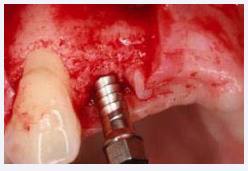
The successive deployment of series Spreaders and conensing no.
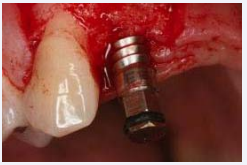
Figure 3: The successive deployment of series Spreaders and conensing no.

The successive deployment of series of six spreaders and condensing  no 4.

Figure 4: The successive deployment of series of six spreaders and condensing no 4.

The diameter increases as maximum length is reached. With the help of the appropriate spreader carrier, the spreader is gently screwed in the bone cavity and if necessary a ratchet is used, the spreader may be screwed in cautiously. This allows a slow and gradual expansion of the bone. By having wide the implant cavity in this manner it is now possible to place the suitable implant. Furthermore the clearly increased bone rigidity, achieved by bone condensation, results in optimized primary stability irrespective of the subsequent implant brand to be used. A self-tapping implants of 3.75mm diameter and 13mm height (Intraoss, Saõ Paulo, Brazil) was to be placed, it was placed at 35 Ncm at 20 rpm. Titanium cover screw was placed (Figure 5).

Titanium cover screw was placed.

Figure 5: Titanium cover screw was placed.

Finally, the flaps were sutured in their original place. A .12% chlorhexidinedigluconate oral rinse was prescribed for 1 minute twice a day for 2 week as chemical plaque control. Nonsteroidal anti-inflammatory agents were prescribed for post surgical analgesia. There was no occurrence of hematoma. Most patients can return to their normal life the day following surgery.

Patient was not allowed to use any removable prosthesis until after the sutures were removed 10 days postoperatively. The patient maintained excellent oral hygiene. Implants were allowed to heal for a minimum of 6 months before assessing their osseointegration at second-stage surgery and subsequently placing a restoration (Figure 6).

Final prosthetic restoration.

Figure 6: Final prosthetic restoration.

Another CT-scan was utilized as pos operative to compare the investigation (Figure 7).
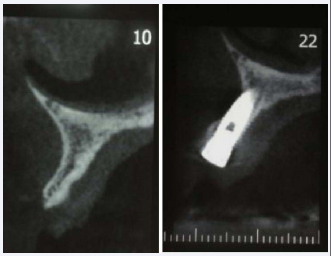
Comparative CT scan.

Figure 7: Comparative CT scan.

CONCLUSION

BST for ridge horizontal augmentation with immediate implant placement has been shown to be predictable and successful in treating the maxilla with deficient alveolar bone width. BST is superior to drilling technique for application in soft maxillary bone. The BST offers a number of advantages over both the Summer’s osteotome. The BST has proven to be highly advantageous for the comfort of patients, increasing their acceptance and overall satisfaction. This surgery technique is a predictable procedure when patient selection and surgical technique are appropriate.


REFERENCES

1. Misch CM, Misch CE. The repair of localized severe ridge defects for implant placement using mandibular bone grafts. Implant Dent. 1995; 4: 261-267.

2. Collins TA. On lay bone grafting in combination with Branemark implants. Oral Maxillo fac Surg Clin North Am. 1991; 3: 893-902.

3. Bernhart T, Weber R, Mailath G, Ulm C, Dörtbudak O, Watzek G. Use of crestal bone for augmentation of ridges prior to of extremely knife-edge alveolar ridges prior to implant placement: report of 3 cases. Int J Oral Maxillofac Implants. 1999; 14: 424-427.

4. Jensen J, Sindet-Pedersen S. Autogenous mandibular bone grafts and osseointegrated implants for reconstruction of the severely atrophied maxilla: A preliminary report. J Oral Maxillofac Surg. 1991; 49: 1277- 1287.

5. Misch CM, Misch CE. The repair of localized severe ridge defects for implant placement using mandibular bone grafts. Implant Dent. 1995; 4: 261-267.

6. Misch CM. Comparison of intraoral donor sites for onlay grafting prior to implant placement. Int J Oral Maxillofac Implants. 1997; 12: 767- 776. 

7. Montazem A, Valauri DV, St-Hilaire H, Buchbinder D. The mandibular symphysis as a donor site in maxillofacial bone grafting: a quantitative anatomic study. Int J Oral Maxillofac Implants. 2000; 58: 1368-1371.

8. Triplett RG, Schow S. Autologous bone grafts endosseous implants: Complementary techniques. J Oral Maxillofac Surg. 1996; 54: 486-494.

9. Shulman LB. Surgical considerations in implant dentistry. J Dent Educ. 1988; 52: 712-720.

10. Summers RB. The osteotome technique: Part 2-The ridge expansion osteotomy (REO) Compendium. 1994; 15: 422-436.

11. Summers RB. The osteotome technique: Part 3-Less invasive methods of elevating the sinus floor. Compendium. 1994; 15: 698-708.

12. Summers RB. The osteotome technique: Part 4-The future site development Compend Contin Educ Dent. 1995; 11: 1090-1025.

13. Davarpanah M, Martinez H, Tecucianu JF, Hage G, Lazzara R. The modified osteotome technique. Int J Periodontics Restorative Dent. 2001; 21: 559-607.

14. Elian N, Jalbout Z, Ehrlich B, Classi A, Cho SC, Al-Kahtani F, et al. A two-stage full-arch ridge expansion technique: review of the literature and clinical guidelines. Impl Dent. 2008; 17: 16-23.

15. Sethi A, Kaus T. Maxillary ridge expansion with simultaneous implant placement: 5-year results of an ongoing clinical study. Int J Oral Maxillofac Implants. 2000; 15: 491-499.

16. Nishioka RS, Kojima AN. Screw spreading: technical considerations and case report. Int J Periodont Restorat Dentist. 2011; 2: 141-147.

17. Nishioka RS, Souza FA. Bone spreader technique: a preliminar 3-year study. J Oral Implantol. 2009; 35: 289-294.

18. Nishioka RS, Paixão JC. Bone spreading technique – a case report. Minerva Stomatologica Chirurgia. 2009; 2: 121-124.

19. Nishioka RS. Bone Spreading Technique. Dentistry today. 2010; 19: 38-40.

20. Nishioka RS, Souza FA. Bone spreading and standardized dilation of horizontally resorbed bone: technical considerations. Implant Dent. 2009; 2: 119-126.

de Melo Nishioka GN, Andreatta Filho OD, Souza FA, Nishioka RS (2017) Bone Spreading and Standardized Dilation of Horizontally Resorbed Bone: Technical Considerations. JSM Dent Surg 2(4): 1024

Received : 16 Feb 2017
Accepted : 15 Jul 2017
Published : 15 Jul 2017
Journals
Annals of Otolaryngology and Rhinology
ISSN : 2379-948X
Launched : 2014
JSM Schizophrenia
Launched : 2016
Journal of Nausea
Launched : 2020
JSM Internal Medicine
Launched : 2016
JSM Hepatitis
Launched : 2016
JSM Oro Facial Surgeries
ISSN : 2578-3211
Launched : 2016
Journal of Human Nutrition and Food Science
ISSN : 2333-6706
Launched : 2013
JSM Regenerative Medicine and Bioengineering
ISSN : 2379-0490
Launched : 2013
JSM Spine
ISSN : 2578-3181
Launched : 2016
Archives of Palliative Care
ISSN : 2573-1165
Launched : 2016
JSM Nutritional Disorders
ISSN : 2578-3203
Launched : 2017
Annals of Neurodegenerative Disorders
ISSN : 2476-2032
Launched : 2016
Journal of Fever
ISSN : 2641-7782
Launched : 2017
JSM Bone Marrow Research
ISSN : 2578-3351
Launched : 2016
JSM Mathematics and Statistics
ISSN : 2578-3173
Launched : 2014
Journal of Autoimmunity and Research
ISSN : 2573-1173
Launched : 2014
JSM Arthritis
ISSN : 2475-9155
Launched : 2016
JSM Head and Neck Cancer-Cases and Reviews
ISSN : 2573-1610
Launched : 2016
JSM General Surgery Cases and Images
ISSN : 2573-1564
Launched : 2016
JSM Anatomy and Physiology
ISSN : 2573-1262
Launched : 2016
Annals of Emergency Surgery
ISSN : 2573-1017
Launched : 2016
Annals of Mens Health and Wellness
ISSN : 2641-7707
Launched : 2017
Journal of Preventive Medicine and Health Care
ISSN : 2576-0084
Launched : 2018
Journal of Chronic Diseases and Management
ISSN : 2573-1300
Launched : 2016
Annals of Vaccines and Immunization
ISSN : 2378-9379
Launched : 2014
JSM Heart Surgery Cases and Images
ISSN : 2578-3157
Launched : 2016
Annals of Reproductive Medicine and Treatment
ISSN : 2573-1092
Launched : 2016
JSM Brain Science
ISSN : 2573-1289
Launched : 2016
JSM Biomarkers
ISSN : 2578-3815
Launched : 2014
JSM Biology
ISSN : 2475-9392
Launched : 2016
Archives of Stem Cell and Research
ISSN : 2578-3580
Launched : 2014
Annals of Clinical and Medical Microbiology
ISSN : 2578-3629
Launched : 2014
JSM Pediatric Surgery
ISSN : 2578-3149
Launched : 2017
Journal of Memory Disorder and Rehabilitation
ISSN : 2578-319X
Launched : 2016
JSM Tropical Medicine and Research
ISSN : 2578-3165
Launched : 2016
JSM Head and Face Medicine
ISSN : 2578-3793
Launched : 2016
JSM Cardiothoracic Surgery
ISSN : 2573-1297
Launched : 2016
JSM Bone and Joint Diseases
ISSN : 2578-3351
Launched : 2017
JSM Bioavailability and Bioequivalence
ISSN : 2641-7812
Launched : 2017
JSM Atherosclerosis
ISSN : 2573-1270
Launched : 2016
Journal of Genitourinary Disorders
ISSN : 2641-7790
Launched : 2017
Journal of Fractures and Sprains
ISSN : 2578-3831
Launched : 2016
Journal of Autism and Epilepsy
ISSN : 2641-7774
Launched : 2016
Annals of Marine Biology and Research
ISSN : 2573-105X
Launched : 2014
JSM Health Education & Primary Health Care
ISSN : 2578-3777
Launched : 2016
JSM Communication Disorders
ISSN : 2578-3807
Launched : 2016
Annals of Musculoskeletal Disorders
ISSN : 2578-3599
Launched : 2016
Annals of Virology and Research
ISSN : 2573-1122
Launched : 2014
JSM Renal Medicine
ISSN : 2573-1637
Launched : 2016
Journal of Muscle Health
ISSN : 2578-3823
Launched : 2016
JSM Genetics and Genomics
ISSN : 2334-1823
Launched : 2013
JSM Anxiety and Depression
ISSN : 2475-9139
Launched : 2016
Clinical Journal of Heart Diseases
ISSN : 2641-7766
Launched : 2016
Annals of Medicinal Chemistry and Research
ISSN : 2378-9336
Launched : 2014
JSM Pain and Management
ISSN : 2578-3378
Launched : 2016
JSM Women's Health
ISSN : 2578-3696
Launched : 2016
Clinical Research in HIV or AIDS
ISSN : 2374-0094
Launched : 2013
Journal of Endocrinology, Diabetes and Obesity
ISSN : 2333-6692
Launched : 2013
Journal of Substance Abuse and Alcoholism
ISSN : 2373-9363
Launched : 2013
JSM Neurosurgery and Spine
ISSN : 2373-9479
Launched : 2013
Journal of Liver and Clinical Research
ISSN : 2379-0830
Launched : 2014
Journal of Drug Design and Research
ISSN : 2379-089X
Launched : 2014
JSM Clinical Oncology and Research
ISSN : 2373-938X
Launched : 2013
JSM Bioinformatics, Genomics and Proteomics
ISSN : 2576-1102
Launched : 2014
JSM Chemistry
ISSN : 2334-1831
Launched : 2013
Journal of Trauma and Care
ISSN : 2573-1246
Launched : 2014
JSM Surgical Oncology and Research
ISSN : 2578-3688
Launched : 2016
Annals of Food Processing and Preservation
ISSN : 2573-1033
Launched : 2016
Journal of Radiology and Radiation Therapy
ISSN : 2333-7095
Launched : 2013
JSM Physical Medicine and Rehabilitation
ISSN : 2578-3572
Launched : 2016
Annals of Clinical Pathology
ISSN : 2373-9282
Launched : 2013
Annals of Cardiovascular Diseases
ISSN : 2641-7731
Launched : 2016
Journal of Behavior
ISSN : 2576-0076
Launched : 2016
Annals of Clinical and Experimental Metabolism
ISSN : 2572-2492
Launched : 2016
Clinical Research in Infectious Diseases
ISSN : 2379-0636
Launched : 2013
JSM Microbiology
ISSN : 2333-6455
Launched : 2013
Journal of Urology and Research
ISSN : 2379-951X
Launched : 2014
Journal of Family Medicine and Community Health
ISSN : 2379-0547
Launched : 2013
Annals of Pregnancy and Care
ISSN : 2578-336X
Launched : 2017
JSM Cell and Developmental Biology
ISSN : 2379-061X
Launched : 2013
Annals of Aquaculture and Research
ISSN : 2379-0881
Launched : 2014
Clinical Research in Pulmonology
ISSN : 2333-6625
Launched : 2013
Journal of Immunology and Clinical Research
ISSN : 2333-6714
Launched : 2013
Annals of Forensic Research and Analysis
ISSN : 2378-9476
Launched : 2014
JSM Biochemistry and Molecular Biology
ISSN : 2333-7109
Launched : 2013
Annals of Breast Cancer Research
ISSN : 2641-7685
Launched : 2016
Annals of Gerontology and Geriatric Research
ISSN : 2378-9409
Launched : 2014
Journal of Sleep Medicine and Disorders
ISSN : 2379-0822
Launched : 2014
JSM Burns and Trauma
ISSN : 2475-9406
Launched : 2016
Chemical Engineering and Process Techniques
ISSN : 2333-6633
Launched : 2013
Annals of Clinical Cytology and Pathology
ISSN : 2475-9430
Launched : 2014
JSM Allergy and Asthma
ISSN : 2573-1254
Launched : 2016
Journal of Neurological Disorders and Stroke
ISSN : 2334-2307
Launched : 2013
Annals of Sports Medicine and Research
ISSN : 2379-0571
Launched : 2014
JSM Sexual Medicine
ISSN : 2578-3718
Launched : 2016
Annals of Vascular Medicine and Research
ISSN : 2378-9344
Launched : 2014
JSM Biotechnology and Biomedical Engineering
ISSN : 2333-7117
Launched : 2013
Journal of Hematology and Transfusion
ISSN : 2333-6684
Launched : 2013
JSM Environmental Science and Ecology
ISSN : 2333-7141
Launched : 2013
Journal of Cardiology and Clinical Research
ISSN : 2333-6676
Launched : 2013
JSM Nanotechnology and Nanomedicine
ISSN : 2334-1815
Launched : 2013
Journal of Ear, Nose and Throat Disorders
ISSN : 2475-9473
Launched : 2016
JSM Ophthalmology
ISSN : 2333-6447
Launched : 2013
Journal of Pharmacology and Clinical Toxicology
ISSN : 2333-7079
Launched : 2013
Annals of Psychiatry and Mental Health
ISSN : 2374-0124
Launched : 2013
Medical Journal of Obstetrics and Gynecology
ISSN : 2333-6439
Launched : 2013
Annals of Pediatrics and Child Health
ISSN : 2373-9312
Launched : 2013
JSM Clinical Pharmaceutics
ISSN : 2379-9498
Launched : 2014
JSM Foot and Ankle
ISSN : 2475-9112
Launched : 2016
JSM Alzheimer's Disease and Related Dementia
ISSN : 2378-9565
Launched : 2014
Journal of Addiction Medicine and Therapy
ISSN : 2333-665X
Launched : 2013
Journal of Veterinary Medicine and Research
ISSN : 2378-931X
Launched : 2013
Annals of Public Health and Research
ISSN : 2378-9328
Launched : 2014
Annals of Orthopedics and Rheumatology
ISSN : 2373-9290
Launched : 2013
Journal of Clinical Nephrology and Research
ISSN : 2379-0652
Launched : 2014
Annals of Community Medicine and Practice
ISSN : 2475-9465
Launched : 2014
Annals of Biometrics and Biostatistics
ISSN : 2374-0116
Launched : 2013
JSM Clinical Case Reports
ISSN : 2373-9819
Launched : 2013
Journal of Cancer Biology and Research
ISSN : 2373-9436
Launched : 2013
Journal of Surgery and Transplantation Science
ISSN : 2379-0911
Launched : 2013
Journal of Dermatology and Clinical Research
ISSN : 2373-9371
Launched : 2013
JSM Gastroenterology and Hepatology
ISSN : 2373-9487
Launched : 2013
Annals of Nursing and Practice
ISSN : 2379-9501
Launched : 2014
JSM Dentistry
ISSN : 2333-7133
Launched : 2013
Author Information X