α-Mangostin: A Multi-Target Candidate for Cervical Cancer
- 1. Department of Gynecology, Binzhou Medical University, China
- 2. Department of Gynecology, Binzhou Medical University, Binzhou Medical University Hospital, China
Abstract
Background: Cervical cancer poses a significant global health challenge for women, with conventional treatments such as surgery, radiotherapy, and chemotherapy often accompanied by side effects and drug resistance.
Objective: This review aims to explore the potential of α-mangostin in cervical cancer treatment, focusing on its anticancer properties.
Methods: We conducted a structured literature search of PubMed, Scopus, Web of Science Core Collection, ScienceDirect, and Google Scholar up to December 2025 using combinations of terms related to α-mangostin and cervical cancer/HPV. Peer-reviewed original studies and relevant reviews were screened for relevance, and findings were synthesized qualitatively without meta-analysis or formal risk-of-bias assessment.
Results: α-Mangostin exhibits multiple anti-cancer properties, including inducing apoptosis in cervical cancer cells, inhibiting proliferation, modulating signaling pathways, targeting HPV oncogenes (E6/E7), and reversing chemotherapy resistance.
Conclusions: Findings suggest α-mangostin holds promise as a complementary therapy for cervical cancer, offering potential benefits including affordability and sustainability. Further research into α-mangostin may enhance cervical cancer treatment approaches, improve survival rates, and address the rising mortality rates associated with the disease.
Keywords
• Cervical Cancer
• α-Mangostin
• Natural Compound
• Alternative Cancer Treatment
• Adjuvant Therapy
Citation
Liu Z, Liu W, Liu Z (2026) α-Mangostin: A Multi-Target Candidate for Cervical Cancer. JSM Sexual Med 10(1): 1177.
INTRODUCTION
Cervical cancer ranks as the fourth most common cancer among women globally and remains a leading cause of cancer-related mortality. Its incidence risk is influenced by multiple factors, including Human Papillomavirus (HPV) infection, HIV or other sexually transmitted infections, smoking, high parity, prolonged use of oral contraceptives, and lower socioeconomic status [1,2]. The primary treatment regimens for cervical cancer comprise surgery, radiotherapy, and chemotherapy. However, these approaches are frequently associated with adverse effects and high recurrence rates [3,4]. Concurrently, Multidrug Resistance (MDR) further diminishes the efficacy of chemotherapy and radiotherapy, resulting in reduced overall survival rates for patients [5,6]. To address these challenges, natural products have emerged as a research focus in cervical cancer therapy. Among these, Alpha Mangostin (AM), a xanthone compound derived from the rind of the mangosteen (Garcinia mangostana L.), exhibits diverse pharmacological activities including antioxidant, anti-inflammatory, and antitumor effects [7]. Previous studies have demonstrated that AM induces apoptosis and inhibits tumor growth and metastasis in various cancer models, including colorectal, breast, and prostate cancers. This review aims to comprehensively summarize the mechanisms of action and application prospects of AM in cervical cancer treatment, with the objective of providing a theoretical basis for developing novel therapeutic strategies.
METHODS
We conducted a structured literature search (up to December 2025) in PubMed, Scopus, Web of Science Core Collection, ScienceDirect, and Google Scholar using terms related to α-mangostin and cervical cancer/HPV. Peer reviewed original studies and relevant reviews evaluating α-mangostin in cervical cancer or HPV-related models were eligible. Records were screened by title/abstract and assessed in full text when potentially relevant; reference lists were hand-searched for additional studies. Findings were synthesized qualitatively without meta-analysis or formal risk-of-bias assessment.
Traditional treatment methods for Cervical Cancer and their Limitations
Surgery and radiotherapy constitute the primary curative approaches for early-stage cervical cancer, whilst patients with intermediate-to-advanced disease typically require combined radiotherapy and chemotherapy. However, radiotherapy, whilst destroying cancer cells, readily damages surrounding healthy tissue; chemotherapy drugs, lacking specificity, impair normal proliferating cells, leading to adverse reactions such as bone marrow suppression, nausea, and hair loss. Tumor cell resistance to chemotherapeutic agents further contributes to treatment failure and disease recurrence [8].
Chemistry and Pharmacology of α-Mangostin α-Mangostin
(CAS registry number: 6147-11-1) is a xanthone compound isolated from the pericarp of Garcinia mangostana L., a plant belonging to the genus Garcinia within the Clusiaceae/Guttiferae family. It is the primary bioactive secondary metabolite of mangosteen [9-11]. Xanthones are aromatic oxygen-containing heterocyclic molecules with the molecular formula C??H?O?. They feature a planar symmetrical tricyclic structure, namely dibenzo-γ-pyrone (9H-xanthen-9-one), where two aromatic rings (A and B) are connected via the γ-pyrone ring (C), as shown in Figure 1[12].
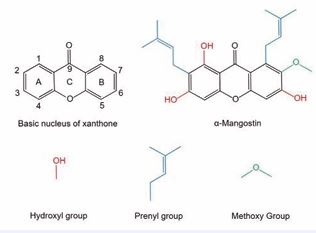
Figure 1 Chemical structure of the major prenylated xanthones from mangosteen pericarp. The xanthone nucleus is an aromatic oxygenated heterocyclic molecule with a planar, symmetric, and tricyclic structure, comprising two aromatics rings: A-ring (carbons 1-4) and B-ring (carbons 5-8), connected by the C ring (γ-pyrone ring, carbon 9). The structure of α-mangostin features specific functional groups attached to the xanthone nucleus: hydroxyl groups at positions C1, C3, and C7, and prenyl groups at C2 and C8. These groups are believed to significantly influence the biological activities of the α-mangostin. The structures were created in ChemDraw version 20.0.0.41 (1998–2000 PerkinElmer informatics, Inc)
Its rigid planar structure, central carbonyl group, and diaryl ether groups enable interaction with diverse biological targets [13]. Natural xanthones commonly feature hydroxyl groups attached at the C1, C3, and C7 positions of the skeleton, with prenyl groups introduced at the C2 and C8 positions. These functional groups play crucial roles in their cytotoxicity and biological activity. Research indicates that the C1 hydroxy and C2-prenyl groups are critical for maintaining cytotoxicity [14]; hydroxyls at C3 and C7 further enhance cytotoxicity, whereas methoxy substitution at these positions attenuates the compound’s ability to interfere with mitochondrial function [9]; retention of the C8-prenyl group is also essential [15]. These structural features collectively confer biological activity. α-Mangostin activities, exhibits including broad antioxidant, pharmacological antitumor, anti inflammatory, antihistamine, antibacterial, antifungal, cardioprotective, hepatoprotective, neuroprotective, and immunomodulatory effects [16-21]. Regarding antitumor effects, α-mangostin has demonstrated broad-spectrum chemopreventive and antitumor activity in multiple in vitro and in vivo experiments. It inhibits the proliferation and migration of various malignant tumors, including cholangiocarcinoma, pheochromocytoma, glioblastoma, osteosarcoma, head and neck cancer, prostate cancer, gastric cancer, pancreatic cancer, lung cancer, cervical cancer, colon cancer, ovarian cancer, skin cancer, renal cancer, and breast cancer [22-30].
Mechanisms of α-Mangostin against Cervical Cancer
The anticancer activity of AM in cervical cancer is mediated through a network of interconnected pathways (Figure 2[31]). This multi-target profile allows simultaneous modulation of several hallmarks of cancer.

Figure 2 Proposed mechanisms of α-mangostin in HPV-driven cervical cancer. α-Mangostin induces intrinsic and extrinsic apoptosis, causes cell cycle arrest, modulates ion channels (KCNH1), downregulates HPV E6/E7 with restoration of p53/pRB, exerts anti-inflammatory effects in the tumor microenvironment, and enhances the efficacy of conventional chemo- and radiotherapy, ultimately suppressing cervical cancer growth and progression. Created with BioGDP.com [31].
Induction of Apoptosis by α-Mangostin in Cervical Cancer
Apoptosis is a form of programmed cell death that plays a crucial role in maintaining tissue homeostasis and eliminating damaged cells. In cancer, evasion of apoptosis is a hallmark of tumorigenesis. α-Mangostin has been demonstrated to induce apoptosis in cervical cancer cells. It primarily induces apoptosis through the mitochondrial dependent intrinsic pathway and the death receptor mediated extrinsic pathway. In the intrinsic pathway, α-mangostin inhibits the viability of cervical cancer cells in a dose-dependent manner and induces significant apoptosis. The core mechanism involves activation of the mitochondrial pathway: α-mangostin increases the Bax/Bcl-2 ratio, causes loss of Mitochondrial Membrane Potential (MMP), and promotes the release of cytochrome c from mitochondria into the cytosol. In the cytosol, cytochrome c participates in the formation of the “apoptosome” with Apaf-1, which activates the caspase-9/caspase-3 cascade and leads to PARP cleavage, thereby inducing apoptosis. The partial reversal of cell death by the caspase inhibitor Z-VAD indicates that this process is caspase-dependent. Notably, upstream signaling exhibits cell line-specific differences: in HeLa cells (HPV18+), α-mangostin activates the ASK1/MKK3/6/p38 signaling cascade in an ROS dependent manner, whereas in SiHa cells (HPV16+), it acts independently of p38 [32,33].
In the extrinsic pathway, α-mangostin downregulates the expression of anti-apoptotic proteins such as FLIP and Survivin, thereby releasing the inhibition on caspase-8 and initiating apoptosis mediated by the death receptor signaling complex [34]. In the context of HPV16/18 infection, α-mangostin and its derivatives can restore impaired TRAIL levels, reactivate the extrinsic apoptotic pathway, and selectively induce apoptosis in infected or transformed cells [35]. Collectively, these mechanisms result in an increased proportion of TUNEL-positive cells, accumulation of cells in the SubG1 phase, and enhanced caspase-3 activity, confirming the induction of irreversible apoptosis [34,36].
Regulation of Ion Channels by α-Mangostin
Ion channels are transmembrane proteins that maintain cellular homeostasis by regulating ion transport across membranes. Their functional abnormalities are associated with cancer initiation and progression [37]. In cervical cancer, abnormal expression of the potassium channel KCNH1 (also known as EAG1 or Kv10.1) correlates with increased tumor cell proliferation, migration, invasion, and metastasis [38]. α-mangostin has been demonstrated to regulate the expression and function of the KCNH1 ion channel in cervical cancer cells. In cervical cancer cells, α-mangostin downregulates KCNH1 gene expression in a concentration-dependent manner. Specifically, KCNH1 mRNA levels decreased by approximately 53% in CaSki cells treated with 10 μM α-mangostin. Furthermore, in vivo experiments revealed that α-mangostin similarly reduced KCNH1 expression levels in transplanted tumor tissues. Knockdown of KCNH1 inhibited proliferation in both SiHa and CaSki cells, suggesting this channel plays a role in cervical cancer cell growth [36]. These findings indicate that α-mangostin may suppress cervical cancer cell proliferation by regulating ion channel expression and function.
Induction of Cell Cycle Arrest by α-Mangostin in Cervical Cancer
The cell cycle process is regulated by a complex network of proteins including cyclins, Cyclin-Dependent Kinases (CDKs), and CDK inhibitors (CDKIs). In cancer, dysregulation of cell cycle control leads to uncontrolled cell proliferation. α-mangostin can induce G1 or G2/M phase arrest in cervical cancer cells by regulating the expression of cycle-related proteins, thereby inhibiting proliferation. Specifically, α-mangostin exhibits distinct mechanisms across different cell lines (Table 1):
Table 1: Cell cycle arrest profiles induced by α-mangostin in different cervical cancer cell lines.
|
Cell Line (HPV Status) |
Primary Phase |
Key Molecular Changes |
|
SiHa (HPV16+) |
G1/S |
↓PCNA, ↓Cyclin B/D/E mRNA |
|
CaSki (HPV16+ high- copy) |
G1 |
↓KCNH1, ↓S-phase cells |
|
HeLa (HPV18+) |
G2/M |
Activation of p38 pathway (ROS-dependent) |
Abbreviations: PCNA, proliferating cell nuclear antigen; ROS, reactive oxygen species. ↓, decreased/downregulated.
in SiHa cells (HPV16+), it downregulates proliferating cell nuclear antigen (PCNA) expression, disrupts DNA replication, and reduces mRNA levels of Cyclin B, Cyclin D, and Cyclin E mRNA levels [34]. In CaSki cells (high-copy HPV16+), α-mangostin primarily induces G1 arrest by inhibiting KCNH1 gene expression, accompanied by reduced S-phase cells [36]. In HeLa cells (HPV18+), it induces G2/M phase arrest. Furthermore, α-mangostin downregulates HPV E6/E7 oncogene expression, attenuating their interference with p53 and pRb pathways and further promoting cell cycle arrest [36]. These findings suggest that α-mangostin may induce G1 or G2/M phase arrest by multi-target regulation of the cell cycle, thereby inhibiting cervical cancer cell proliferation.
Targeting the HPV Oncogenic Source in Cervical Cancer by α-Mangostin
The E6 and E7 proteins encoded by Human Papillomavirus (HPV) drive malignant transformation and maintain the oncogenic phenotype by degrading tumor suppressor proteins such as p53 and pRB. Studies indicate that α-mangostin downregulates the mRNA expression of the E6 and E7 oncogenes. Additionally, it upregulates Vimentin gene expression [36]. As a cytoskeletal protein, Vimentin plays a crucial role in innate immunity by blocking HPV16 virus internalization and interfering with the early infection process. Therefore, α-mangostin may combat HPV-associated cervical cancer through a dual mechanism involving downregulation of E6/E7 and upregulation of Vimentin.
Anti-inflammatory Effects of α-Mangostin in Cervical Cancer
Inflammation plays a central role in HPV-driven cervical carcinogenesis, where persistent viral infection induces a chronic inflammatory microenvironment that promotes cell proliferation, survival, and malignant transformation [39,40]. The primary pathways through which α-mangostin exerts anti-inflammatory effects in cervical cancer include: First, concentration-dependent inhibition of TNF-α gene expression in CaSki cells [36]; in a clinical trial of HPV16/18-infected patients, serum TNF-α levels normalized after 3 months of α-mangostin supplementation. Second, reduction of Myeloperoxidase (MPO) activity—a neutrophil activation marker—in cervical tissue, thereby decreasing inflammatory cell infiltration. Third, it modulates nitric oxide metabolism by decreasing nitrate/nitrite and nitrotyrosine levels, restoring NO balance, and mitigating protein damage caused by nitrosative stress [35]. These mechanisms collectively disrupt the HPV-induced chronic inflammatory microenvironment, thereby inhibiting cervical cancer progression.
α-Mangostin as an Adjuvant Therapy for Cervical Cancer
Adjuvant therapy aims to enhance the efficacy of primary treatments while mitigating their side effects. In cancer treatment, it is commonly used to augment the effects of conventional chemotherapy, radiotherapy, or surgery. α-Mangostin enhances the efficacy of standard cervical cancer treatments through unique molecular mechanisms. In HeLa cervical cancer cells, preincubation with α-mangostin (10–15 μM) potentiates the cytotoxic effect of cisplatin (CDDP; 2 μM). This synergistic effect is associated with enhanced tumor cell apoptosis, increased reactive oxygen species (ROS) production, and induction of G2/M phase cell cycle arrest. The combination therapy not only improves antitumor efficacy but also alleviates cisplatin induced nephrotoxicity, as evidenced by reduced urinary protein and kidney injury molecule-1 (KIM-1) levels [41]. Another study demonstrated that α-mangostin directly binds to and inhibits the deubiquitinase USP45, thereby promoting the ubiquitination and degradation of the oncoprotein MYC. This action subsequently suppresses the stemness, drug resistance, and tumorigenicity of cervical cancer stem cells [42]. Furthermore, α-mangostin enhances tumor cell sensitivity to doxorubicin in vitro. In vivo models show that its combination with doxorubicin inhibits the growth of USP45-overexpressing cervical cancer cells and reverses drug resistance. These findings suggest that α-mangostin may serve as an adjuvant therapy for cervical cancer by enhancing the efficacy of conventional chemotherapeutic agents.
Clinical Trials of α-Mangostin
Although preclinical studies have demonstrated the antitumor potential of α-mangostin, no clinical trials specifically evaluating its efficacy in treating cervical cancer have been completed to date. Existing clinical trials have primarily focused on the antioxidant and anti inflammatory effects of mangosteen-derived products, indicating a favorable safety profile. Future clinical trials are warranted to evaluate the safety and efficacy of α-mangostin or mangosteen extracts for cervical cancer treatment.
DISCUSSION & CONCLUSION
As the primary xanthone component in mangosteen, α-mangostin demonstrates potential against cervical cancer in preclinical models through multiple mechanisms, including apoptosis induction, cell cycle regulation, HPV targeting, tumor microenvironment modulation, and reversal of chemotherapy resistance. This compound also enhances the efficacy of conventional therapies, offering adjuvant therapeutic value. However, its clinical safety and efficacy remain unvalidated, necessitating further studies to advance clinical translation. Current research remains limited, and its mechanisms of action have not been fully elucidated. Subsequent studies should further investigate the effects of α-mangostin on cervical cancer metastasis, epithelial-mesenchymal transition, and invasion processes; strengthen rigorous pharmacokinetic and safety evaluations; expand its efficacy to other cervical cancer cell lines and primary cells; and assess long-term toxicity to facilitate clinical application.
REFERENCES
- Filho AM, Laversanne M, Ferlay J, Colombet M, Piñeros M, Znaor A, et al. The GLOBOCAN 2022 cancer estimates: Data sources, methods, and a snapshot of the cancer burden worldwide. Int J Cancer. 2025; 156: 1336-1346.
- Sung H, Ferlay J, Siegel RL, Laversanne M, Soerjomataram I, Jemal A, et al. Global Cancer Statistics 2020: GLOBOCAN Estimates of Incidence and Mortality Worldwide for 36 Cancers in 185 Countries. CA Cancer J Clin. 2021; 71: 209-249.
- Mayadev JS, Ke G, Mahantshetty U, Pereira MD, Tarnawski R, ToitaT. Global challenges of radiotherapy for the treatment of locally advanced cervical cancer. Int J Gynecol Cancer. 2022; 32: 436-445.
- Chemoradiotherapy for Cervical Cancer Meta-Analysis Collaboration.Reducing uncertainties about the effects of chemoradiotherapy for cervical cancer: a systematic review and meta-analysis of individual patient data from 18 randomized trials. J Clin Oncol. 2008; 26: 5802-5812.
- Gao B, Yang F, Chen W, Li R, Hu X, Liang Y, et al. Multidrug resistance affects the prognosis of primary epithelial ovarian cancer. Oncol Lett. 2019; 18: 4262-4269.
- Yang F, Gao B, Li R, Li W, Chen W, Yu Z, et al. Expression levels of resistant genes affect cervical cancer prognosis. Mol Med Rep. 2017; 15: 2802-2806.
- Kalick LS, Khan HA, Maung E, Baez Y, Atkinson AN, Wallace CE, et al. Mangosteen for malignancy prevention and intervention: Current evidence, molecular mechanisms, and future perspectives. Pharmacol Res. 2023; 188: 106630.
- Shapira A, Livney YD, Broxterman HJ, Assaraf YG. Nanomedicine for targeted cancer therapy: Towards the overcoming of drug resistance. Drug Resist Updat. 2011; 14: 150-163.
- Akao Y, Nakagawa Y, Nozawa Y. Anti-cancer effects of xanthones from pericarps of mangosteen. Int J Mol Sci. 2008; 9: 355-370.
- Pedraza-Chaverri J, Cárdenas-Rodríguez N, Orozco-Ibarra M, Pérez- Rojas JM. Medicinal properties of mangosteen (Garcinia mangostana). Food Chem Toxicol. 2008; 46: 3227-3239.
- Gunter NV, Teh SS, Lim YM, Mah SH. Natural Xanthones and Skin Inflammatory Diseases: Multitargeting Mechanisms of Action and Potential Application. Front Pharmacol. 2020; 11: 594202.
- Badiali C, Petruccelli V, Brasili E, Pasqua G. Xanthones: Biosynthesis and Trafficking in Plants, Fungi and Lichens. Plants (Basel). 2023; 12: 694.
- Pinto MMM, Palmeira A, Fernandes C, Resende DISP, Sousa E, Cidade H, et al. From natural products to new synthetic small molecules: A Journey through the World of Xanthones. Molecules. 2021; 26: 431.
- See I, Ee GCL, Jong VYM, Teh SS, Acuña CLC, Mah SH. Cytotoxic activity of phytochemicals from Garcinia mangostana L. and G. benthamiana (Planch. & Triana) Pipoly against breast cancer cells. Nat Prod Res. 2021; 35: 6184-6189.
- Chi XQ, Zi CT, Li HM, Yang L, Lv YF, Li JY, et al. Design, synthesis and structure-activity relationships of mangostin analogs as cytotoxic agents. RSC Adv. 2018; 8: 41377-41388.
- Das D, Das A, Bhattacharya K, Koch KP, Deuri DJ, Saikia D, et al. Xanthones as neuroprotective agents: A comprehensive review of their role in the prevention and treatment of neurodegenerative diseases. Ageing Res Rev. 2025; 109: 102772.
- Verma N, Pandit S, Kumar A, Yadav G, Giri SK, Lahiri D, et al. Recent update on active biological molecules in generating the anticancerous therapeutic potential of garcinia mangostana. Appl Biochem Biotechnol. 2022; 194: 4724-4744.
- Eisvand F, Imenshahidi M, Ghasemzadeh Rahbardar M, Tabatabaei Yazdi SA, Rameshrad M, Razavi BM, et al. Cardioprotective effects of alpha-mangostin on doxorubicin-induced cardiotoxicity in rats. Phytother Res. 2022; 36: 506-524.
- Fu T, Li H, Zhao Y, Cai E, Zhu H, Li P, et al. Hepatoprotective effect of α-mangostin against lipopolysaccharide/d-galactosamine-induced acute liver failure in mice. Biomed Pharmacother. 2018; 106: 896- 901.
- Gutierrez-Orozco F, Chitchumroonchokchai C, Lesinski GB, Suksamrarn S, Failla ML. α-Mangostin: Anti-Inflammatory activity and metabolism by human cells. J Agric Food Chem. 2013; 61: 3891- 900.
- Jung HA, Su BN, Keller WJ, Mehta RG, Kinghorn AD. Antioxidant xanthones from the pericarp of Garcinia mangostana (Mangosteen). J Agric Food Chem. 2006; 54: 2077-2082.
- Hung SH, Shen KH, Wu CH, Liu CL, Shih YW. Alpha-mangostin suppresses PC-3 human prostate carcinoma cell metastasis by inhibiting matrix metalloproteinase-2/9 and urokinase-plasminogen expression through the JNK signaling pathway. J Agric Food Chem. 2009; 57: 1291-1298.
- Johnson JJ, Petiwala SM, Syed DN, Rasmussen JT, Adhami VM, Siddiqui IA, et al. α-Mangostin, a xanthone from mangosteen fruit, promotes cell cycle arrest in prostate cancer and decreases xenograft tumor growth. Carcinogenesis. 2012; 33: 413-419.
- Shan T, Ma Q, Guo K, Liu J, Li W, Wang F, et al. Xanthones from mangosteen extracts as natural chemopreventive agents: potential anticancer drugs. Curr Mol Med. 2011; 11: 666-677.
- Ma Y, Yu W, Shrivastava A, Srivastava RK, Shankar S. Inhibition of pancreatic cancer stem cell characteristics by α-Mangostin: Molecular mechanisms involving Sonic hedgehog and Nanog. J Cell Mol Med. 2019; 23: 2719-2730.
- Mardianingrum R, Yusuf M, Hariono M, Mohd Gazzali A, MuchtaridiM. α-Mangostin and its derivatives against estrogen receptor alpha. J Biomol Struct Dyn. 2022; 40: 2621-2634.
- Zhu X, Li J, Ning H, Yuan Z, Zhong Y, Wu S, et al. α-Mangostin Induces Apoptosis and Inhibits Metastasis of Breast Cancer Cells via Regulating RXRα-AKT Signaling Pathway. Front Pharmacol. 2021; 12: 739658.
- Jo MK, Moon CM, Kim EJ, Kwon JH, Fei X, Kim SE, et al. Suppressive effect of α-mangostin for cancer stem cells in colorectal cancer via the Notch pathway. BMC Cancer. 2022; 22: 341.
- Phan TKT, Shahbazzadeh F, Pham TTH, Kihara T. Alpha-mangostin inhibits the migration and invasion of A549 lung cancer cells. PeerJ. 2018; 6: e5027.
- Zhang KJ, Gu QL, Yang K, Ming XJ, Wang JX. Anticarcinogenic Effects of α-Mangostin: A Review. Planta Med. 2017; 83: 188-202.
- Jiang S, Li H, Zhang L, Mu W, Zhang Y, Chen T, et al. Generic Diagramming Platform (GDP): A comprehensive database of high-quality biomedical graphics. Nucleic Acids Res. 2025; 53: D1670-D1676.
- Lee CH, Ying TH, Chiou HL, Hsieh SC, Wen SH, Chou RH, et al. Alpha- mangostin induces apoptosis through activation of reactive oxygenspecies and ASK1/p38 signaling pathway in cervical cancer cells. Oncotarget. 2017; 8: 47425-47439.
- El Habbash AI, Mohd Hashim N, Ibrahim MY, Yahayu M, Omer FAE, Abd Rahman M, et al. In vitro assessment of anti-proliferative effect induced by α-mangostin from Cratoxylum arborescens on HeLa cells. Peer J. 2017; 5: e3460.
- Givens NT, Zhao L, Zhu Z, Lequio M, Xiao H, Johnson BD, et al. Mangosteen Inhibits Growth and Survival of Cervical Cancer Cells. Anticancer Res. 2022; 42: 2903-2909.
- Kharaeva Z, Trakhtman P, Trakhtman I, De Luca C, Mayer W, Chung J, et al. Fermented Mangosteen (Garcinia mangostana L.) Supplementation in the Prevention of HPV-Induced Cervical Cancer: From Mechanisms to Clinical Outcomes. Cancers (Basel). 2022; 14: 4707.
- Díaz L, Bernadez-Vallejo SV, Vargas-Castro R, Avila E, Gómez- Ceja KA, García-Becerra R, et al. The Phytochemical α-Mangostin inhibits cervical cancer cell proliferation and tumor growth by downregulating E6/E7-HPV Oncogenes and KCNH1 Gene Expression. Int J Mol Sci. 2023; 24: 3055.
- Prevarskaya N, Skryma R, Shuba Y. Ion Channels in Cancer: Are Cancer Hallmarks Oncochannelopathies? Physiol Rev. 2018; 98: 559-621.
- Hemmerlein B, Weseloh RM, Mello de Queiroz F, Knötgen H, Sánchez A, Rubio ME, et al. Overexpression of Eag1 potassium channels in clinical tumours. Mol Cancer. 2006; 5: 41.
- Fernandes JV, DE Medeiros Fernandes TA, DE Azevedo JC, Cobucci RN, DE Carvalho MG, Andrade VS, et al. Link between chronic inflammation and human papillomavirus-induced carcinogenesis (Review). Oncol Lett. 2015; 9: 1015-1026.
- Jiang N, Xie F, Chen L, Chen F, Sui L. The effect of TLR4 on the growth and local inflammatory microenvironment of HPV-related cervical cancer in vivo. Infect Agent Cancer. 2020; 15: 12.
- Pérez-Rojas JM, González-Macías R, González-Cortes J, Jurado R, Pedraza-Chaverri J, García-López P. Synergic Effect of α-Mangostin on the Cytotoxicity of Cisplatin in a Cervical Cancer Model. Oxid Med Cell Longev. 2016; 2016: 7981397.
- Tu X, Li C, Sun W, Tian X, Li Q, Wang S, et al. Suppression of Cancer Cell Stemness and Drug Resistance via MYC Destabilization by Deubiquitinase USP45 Inhibition with a Natural Small Molecule. Cancers (Basel). 2023; 15: 930.