A Cross-Sectional Analysis to Develop Diagnostic Criteria for the Geriatric Incontinence Syndrome
- 1. Department of Urology, Section on Female Pelvic Health, Atrium Health Wake Forest Baptist, Winston-Salem, USA
- 2. Department of Biostatistics and Data Science, Wake Forest School of Medicine, Winston-Salem, USA
- 3. Department of Medicine and Urology, University of California, San Francisco and Division of General Internal Medicine, San Francisco VA Medical Center, San Francisco, USA
- 4. Sticht Center for Health Aging and Alzheimer’s Prevention, Wake Forest School of Medicine, Winston-Salem, USA
- 5. UConn Center on Aging, University of Connecticut School of Medicine, USA
Abstract
Nephrolithiasis is a highly prevalent disease worldwide with a high level of acute and chronic morbidity. First-line treatment is typically analgesia with non-steroid anti-inflammatory drugs until the stone passes; otherwise urological intervention may be necessary. Certain medications such as alpha blockers and non-steroidal anti-inflammatory drugs, corticosteroids, or anti-spasmodics are sometimes used to create passage of stones in order to avoid further urologic intervention or hospitalization. However, the study results have limited their use and meanwhile major adverse events defined as orthostatic hypotension, collapse, syncope, palpitations, or tachycardia have been reported. At the present global circumstances, the SARS-CoV-2 pandemic (COVID-19) has caused widespread disruption of routine surgical care and forced every surgeon to make triage decisions requiring greater ethical and community health consideration. It is necessary to balance the surgical risks and benefits and the medical risks of any perceived delay in treatment, and potential exposure of health care workers and/or patients to the deadly virus. Hence, to reduce the incidence of renal lithiasis, an im portant number of etiologic factors can be adequately modified through diet. It is possible to treat kidney stones (nephrolithiasis and urolithiasis) successfully and out patiently, by avoiding the required surgery or invasive method of treatment.
Keywords
• Urinary Incontinence
• Geriatric Syndrome
• Older Women
Citation
Parker-Autry C, Neiberg R, Leng I, Bauer SR, Kritchevsky S, et al. (2025) A Cross-Sectional Analysis to Develop Diagnostic Criteria for the Geriatric Incontinence Syndrome. J Genitourin Disord 4(1): 1009.
INTRODUCTION
Urinary incontinence (UI) in older women is heterogenous and common, negatively impacting up to 60% of US women [1,2]. Some older women have UI the well characterized pelvic floor condition featuring UI symptoms with stress or urgency provocation that is highly responsive to evidenced-based treatment algorithms. However, among older women there is a subset of women with severe mixed UI stress and urgency symptoms that are refractory to standard UI therapies. This phenotype is often present concomitant with geriatric impairments in cognition, mobility, vision, or hearing, thus defining it as a geriatric syndrome [2,3]. Geriatric syndromes are pre-frail, heterogeneous clinical conditions, defined by their shared risk factors of older age and impairments in physical function, cognition, and mobility [4-6]. When present concomitantly, these geriatric impairments have an accumulated impact that increases frailty risk in older adults [7]. Urinary incontinence is a known geriatric syndrome in older adults but is understudied in comparision to other geriatric syndromes of falls and dementia. We have previously characterized the geriatric incontinence syndrome (geriatric UI) as a condition that develops in some older women who have concomitant onset of UI with geriatric impairments in physical function [8]. Detecting the presence of geriatric UI is clinically important because when older women seek care for bothersome UI symptoms they have higher risk of morbidity and lower treatment efficacy with standard procedure based UI treatments [9,10]. Thus far, studies have only investigated chronologic age as a predictor for adverse events after UI treatments. However, it is more plausible that the undetected presence of this geriatric UI phenotype in older women may explain these observations. Our previous work demonstrates that the presence of geriatric impairments in mobility and physical performance and more severe UI symptoms is associated with less change in UI symptoms after non-surgical UI treatments [11]. Cumulatively, these data suggest that greater precision in identifying geriatric UI among older women seeking care for UI treatment is needed to inform evidenced-based treatment algorithms. To meet this goal, reliable mechanisms in identifying geriatric UI in clinical practice is needed. Geriatric syndromes have been clinically defined using different mechanisms to include the deficit accumulation model previously applied to characterize clinical frailty [12]. From our previous work identified UI severity of greater than or equal to 2 UI episodes/day as a significant predictor of poor physical function, slower gait speed, and chair stand pace [13]. Building upon the deficit accumulation model, we hypothesized that it is not the single presence of one geriatric impairment but the culminative impact of multiple geriatric impairments present concomitantly with UI severity, that will be key clinical features of the geriatric incontinence syndrome. In this analysis, we applied a statistical model to test this hypothesis to establish preliminary diagnostic criteria of the geriatric incontinence syndrome.
MATERIALS AND METHODS
Study Design
We report a cross-sectional analysis of a prospective cohort study of community-dwelling women older than 70 years with moderate-to-severe UI symptoms [11]. The inclusion, exclusion, and enrollment criteria have been previously reported [11]. Briefly, we included women with a UI diagnosis confirmed by the Questionnaire for Urinary Incontinence Diagnosis (QUID) [14] who desired non-surgical treatment for their UI symptoms and were in agreement to undergo a 12 week program of structured behavioral therapy to include pelvic floor muscle training. Participants were not currently taking any medication for overactive bladder symptoms and had not had anti incontinence surgery within 12 months of enrollment.
Measures of Urinary Incontinence: At baseline, a 3-day bladder diary established daily voiding frequency, UI episodes and type [15]. The mean total UI episodes were determined by the total number of stress and/or urgency UI episodes over a 24-hour period and averaged from the 3-day bladder diary.Using previously established severity criteria [3], severe UI was defined by ≥ 2 UI episodes/day and moderate UI defined as < 2 UI episodes/day.
Measures of Health and Impairment: To assess physical function and disability, a combination of objective physical performance tests and self-reported measures used have been previously described [4,5]. The Short Physical Performance Battery (SPPB) was used to determine lower extremity physical function [16,17]. The Pepper Assessment Tool for Disability (PAT-D) measured self-reported changes in disability in activities of daily living, mobility, and instrumental activities of daily living. The Mobility Assessment Tool-short form (MAT-sf) assessed functional performance minimizing bias from factors such as age, gender, and body image [18,19].
Frailty syndrome is a consequence of geriatric impairments such as urinary incontinence.It is important to note that the presence of geriatric impairments does not indicate the presence of frailty.Therefore frailty risk and sarcopenia were determined using validated questionnaires and physical function measures: 1) two questions from the Center for Epidemiologic Studies Depression (CES-D) scale to self-report exhaustion and poor endurance/energy as components of the frailty phenotype [20]; 2) the “SARC-F”(a questionnaire based assessment of Strength, Assistance with walking, Rising from a chair, Climbing stairs, and Falls) [21]; and 3) grip strength and gait speed to objectively determine presence of weakness [22].Cognitive function was assessed using the Montreal Cognitive Assessment (MoCA) [23].
Defining clinical deficits: Using a previously defined deficit accumulation model of frailty [24], we hypothesized that the geriatric UI phenotype would be characterized by the combined presence of multiple evidenced-based and targeted geriatric impairments and more severe UI symptoms in older women. The clinical geriatric deficits integrated in the model were identified based on the following criteria: 1) the presence of statistical significance in associations with UI incidence and/or severity in a prior study [25]; and 2) clinical assessment is relatively feasible to integrate into the clinical setting. We identified 9 geriatric impairments (Table 1).
Table 1: Geriatric impairments targeted to characterize the geriatric incontinence syndrome phenotype.
|
Outcome measure |
Criteria |
Percentage of subjects with impairment |
|
Physical Function Impairment |
|
|
|
Standing balance |
SPPB Balance subscale score ≤3 [13-27] |
15% |
|
Short Physical Performance Battery (SPPB) |
|
|
|
SPPB Chair stand pace subscale score ≤2 [26] |
45% |
|
|
|
|
|
|
ir stand pace |
Gait speed <1 m/s[25] |
80% |
|
Disability Pepper Assessment Tool for Disability (PAT-D) |
PAT-D ≥ 1.9 [28] |
29% |
|
Mobility Assessment Tool, short form (MAT-SF) |
MAT-SF < 50 [29] |
20% |
|
Sarcopenia/Frailty risk |
|
|
|
SARC-F questionnaire |
Total score ≥ 4 [30] |
20% |
|
Grip strength |
Grip strength <21 kg [31,32] |
74% |
|
|
≥some of the time to |
|
|
CES-D questionnaire |
difficulty with getting going ≥some of the time to everything was an |
49%
34% |
|
|
effort [33] |
|
|
Cognitive Impairment |
|
|
|
Modified Cognitive Assessment |
MOCA <26 [34] |
63% |
Objective measurements of physical function impairment that have been significantly associated with UI among older women include standing balance, chair stand pace, and gait speed [13]. Standing balance is associated with incident UI in previously continent women older than 70 years (8). A score ≤3 on the SPPB captures persons who cannot do semi-tandem stand and some who cannot do full tandem standing; thus we used this cut-point [27]. From our original analysis, the mean chair stand pace in this cohort of women was 14.4 seconds which correlates to SPPB sub-scale cut-point of ≤2 [27]. Older women with severe UI symptoms had a mean gait speed of 0.8 meter/ second; thus, we use a gait speed <1.0 meter/second as the deficit marker for gait speed [25]. To assess for disability in mobility and activities of daily living, a MAT-sf score 4 was used because it is a feasible and reliable clinical tool to screen for sarcopenia [30]. Grip strength is a strong marker of muscle weakness associated with poor physical performance and mobility disability [31]. Weakness is a key element of frailty and sarcopenia [22]. We aimed to identify women with ‘intermediate weakness’ and thus applied a cut-point of <21 kg that has been associated with slower gait speed <0.8 meter/second [32]. Answering ‘yes’ to the presence of fatigue or exhaustion was applied as this has been previously associated with UI and frailty [33]. Mild cognitive impairment as defined by the MoCA score of <26 has not been directly associated with UI severity. However, cognitive impairment was included as an important geriatric impairment because it may impact treatment efficacy [34].
Statistical Methods
The deficit accumulation model was developed to define biologic age that accounts for the presence of geriatric impairments separate from chronological age [24]. Using a similar construct we developed our deficit accumulation model as a simple count of deficits used to create a preliminary diagnostic index defined by the ratio of the total number of deficits present in each individual to the total number of deficits available in the database [35]. For this analysis, we did not use counts of unrelated deficits because of small sample size and exploratory nature of the model. Thus, we included only the 9 geriatric impairments with strong independent associations with UI in older women that were counted and weighted equally because there is not data to suggest otherwise. We then stratified women based on UI severity as this is a clinical feature strongly associated with severity of geriatric physical function impairments. To visually identify any thresholds, a count of geriatric impairments was determined for each individual participant and then summarized by groups based on baseline UI severity. To describe demographic and clinical characteristics, means and standard deviations represent continuous variables and frequencies and percentages represent categorical variables. Continuous and categorical clinical variables and counts of geriatric deficits of the cohort by UI severity were compared with t-tests and chi-square tests, respectively. The Receiver Operating Characteristic (ROC) area under the curve analysis was examined to determine the cut-point with maximized sensitivity and specificity of agreement with the gold-standard UI severity determined from diary data. The best cut-point was ≥ 4 deficits compared to < 4 deficits. Associations between UI severity and geriatric impairment counts were analyzed using categories of ≥ 4 deficits versus < 4. The sensitivity and specificity of a binary cut-point was low; therefore, the frequency of geriatric impairments present was categorized into three groups based on observed breaks in the distribution of the count data: 0-3 deficits, 4-6 deficits, and 7+ deficits. Next, the association between deficit groupings and UI severity was assessed using the chi-square test of general association.
Findings
Eighty women completed in-person screening; nine of these were screen fails, yielding 71 enrolled. Ten women did not return their baseline bladder diary and were consequently excluded, leaving 61 women in this analysis. The mean ± SD age was 77.3 ± 5.9 years. Women with more severe UI were predominant (69%). Other pertinent demographic and clinical characteristics of the cohort have been previously published, but there were no significant differences based on UI severity [13] (Table 2).
Table 2: Demographic and important clinical characteristics of women with UI based on UI severity.
|
|
0-1 Leaks (N= 19) |
2+ Leaks (N= 42) |
P-value |
|
Age, mean ± SD, years |
76.7 ± 4.9 |
77.5 ± 6.3 |
0.63 |
|
Physical function |
|||
|
SPPB Chair Stand Score, mean ± SD |
3.3 ± 0.9 |
2.3 ± 1.4 |
< 0. 01 |
|
SPPB Balance Score, mean ± SD |
3.6 ± 0.5 |
3.3 ± 0.9 |
0.10 |
|
SPPB 4-meter gait speed, mean ± SD, m/sec |
1.0 ± 0.2 |
0.8 ± 0.2 |
0.031 |
|
Objective assessment of disability |
|||
|
Mobility Assessment Tool (MAT- SF), mean ± SD |
62.6 ± 10.4 |
57.0 ± 9.2 |
0.042 |
|
Perceived difficulty (PAT-D), mean ± SD |
1.5±0.6 |
1.8±0.6 |
0.036 |
|
Sarcopenia measures |
|||
|
SARC-F total score, mean±SD |
1.5±1.7 |
2.1±2.0 |
0.19 |
|
Grip strength, mean±SD, kg |
19.4±3.2 |
18.7±7.4 |
0.68 |
|
Cognitive function |
|||
|
MoCA3 Score, mean ± SD |
23.6 ± 3.7 |
24.7 ± 2.7 |
0.20 |
|
Frailty/Fatigue |
|||
|
CESD: I could not get going, some of the time or more N (%) |
8 (42.1%) |
22 (52.4%) |
0.46 |
|
CESD: I felt that everything I did was an effort some of the time or more N (%) |
6 (31.6%) |
15 (35.7%) |
0.75 |
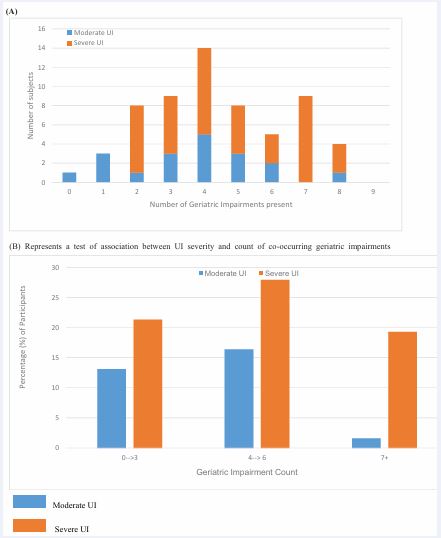
When we examined the targeted geriatric impairments individually, we observed that chair stand pace and gait speed were significantly slower among women with severe UI compared to women with moderate UI (Table 2). Women with severe UI symptoms also had significantly lower MAT-SF scores indicating greater disability with mobility and significantly higher PAT-D scores that indicated greater disability with activities of daily living (Table 2). There were no significant statistical differences in the presence of mild cognitive impairment, frailty, or sarcopenia risk based on the MoCA, SARC-F, and grip strength respectively between groups based on UI severity (Table 2). When examined based on UI severity (moderate UI vs severe UI), the count of cognitive, physical function, and strength related geriatric impairments were significantly higher among women with severe UI symptoms compared to those with moderate UI (p = 0.02). The simple count of geriatric impairments present is presented in Figure 1(A); the distribution pattern of geriatric impairment count was similar between groups based on UI severity. However, higher percentages of participants with severe UI had higher counts of geriatric impairments [Figure 1(B)]. When categories were made based on the distributions, severe UI symptoms trended towards having greater numbers of geriatric impairments, p=0.11, Figure 1(B). Sixty-two percent of participants were found to have 4 or more geriatric impairments concomitantly. However, the sensitivity of this threshold was regarding predicting UI severity was low, 0.42, 95% CI (0.20, 0.64).
Figure 1: Distribution of the number of geriatric impairments present among women geriatric UI symptoms based on UI severity; (A) demonstrates the count of geriatric impairments present based on UI severity as a single category from 0 to 9, (B) demonstrates the categorized counts of the cumulative geriatric impairments based on UI severity.
DISCUSSION
In this cohort of women older than 70 years seeking treatment for UI symptoms, incontinence severity of ≥2 UI episodes/day was significantly associated with the co occurrence of multiple geriatric impairments present in the same individual. This observation confirms our hypothesis that the deficit accumulation model may accurately characterize the nature of the geriatric incontinence syndrome featuring more severe UI symptoms associated with the likely concomitant presence of more than one geriatric impairments. Equipped with this novel observation, geriatric incontinence researchers have a preliminary evidenced based conceptual framework to build upon to further the research into the clinical characteristics and diagnostic criteria for the geriatric incontinence syndrome. Our study is limited in our sample size thus these data require validation in larger population based studies to establish a clinical definition through testing its ability to discriminate the geriatric incontinence syndrome and its impact on outcomes in clinic practice.Geriatric syndromes are multi-factorial in etiology and mechanistically explained by a cumulative effect of shared risk factors for frailty. The presence of a geriatric syndrome is clinically important to detect because when their shared risk factors are present concomitantly worsened clinical outcomes are observed to include increased incidence of frailty, institutionalization, impairments in daily living, and death [4,5]. The cumulative deficit model was designed for use in the clinical setting to determine frailty risk. Thus, our hypothesis that this model may be the best mechanism to clinically define the GIS is logical and confirmed by our observation of a close association between UI severity and higher deficit counts in everyone. Further, our proposed conceptual model for the geriatric incontinence syndrome is also supported by our findings (Figure 2).
Figure 2: Conceptual framework proposing the mechanism of the geriatric incontinence syndrome phenotype based on cumulative geriatric impairments.
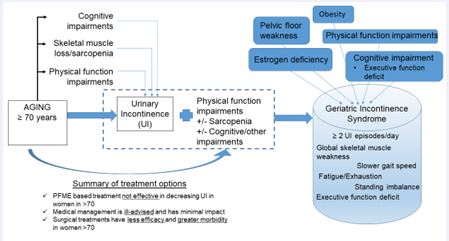
Within this framework, the cumulative impact of multiple geriatric impairments present in an older woman with severe UI symptoms may preliminarily identify the presence of the GIC phenotype.
Among older women, UI increases in prevalence. Aging is independently associated with impairments in physical function, cognition, and skeletal muscle weakness; these impairments are also associated with UI in older women [13]. The concomitant presence of UI with one or more of these geriatric impairments in older women may characterize GIS [2]. Our current treatment options are not effective and have increased morbidity for older women with UI and concomitant geriatric impairments. GIS is impacted by the concomitant presence of multiple geriatric and gender specific traits. The clinical traits of GIS have been isolated to inform its clinical definition. It is plausible that the cumulative impact of geriatric impairments in older women with severe UI may impact on safety and success of UI treatments [20]. Prior studies have demonstrated that women older than 65 years are at increased risk for urologic and non-urologic complications after procedure-based UI interventions, suggesting that chronologic age, not biologic age may be a significant risk factor for procedure-related complications [36,37]. The undetected presence of the GIS may account for the refractory nature and poor outcomes that occur in a subset of older women with UI. For example, we examined the effectiveness of pelvic floor muscle training and behavioral therapy in this cohort and found that after 12 weeks, there was minimal improvement in their UI symptoms and patient satisfaction with this therapy was low [11]. It is plausible that this GIS phenotype will require more precise therapies targeting geriatric impairments as well as pelvic floor dysfunctions for successful treatment. The findings of this study advance our ability to identify women with GIS in clinical practice; a necessary step towards improving the clinical care of all older women with UI. Our findings are novel and clinically important. Unlike the primary analysis for this cohort, this analysis tests the hypothesis that the deficit accumulation model may be applied to explore diagnostic criteria for the GIS. These data are strengthened by the prospective collection of robust assessments of UI, physical performance, and cognitive geriatric assessments using validated measures and all in each individual participant. Our observations are weakened by the lack of follow-up analyses applying this theory to the cohort to determine its impact on UI symptom reduction with treatment. Further, the cross sectional analysis limits determination of the causation and consequences of having these cumulative impairments.Results of this first report need to be replicated in other larger cohorts, including some pre- and post-intervention. We also acknowledge that there may be other geriatric deficits that may be important to characterizing the phenotype of geriatric urinary incontinence that were not assessed in this study.
CONCLUSION
The clinical care of older women with urinary incontinence symptoms does not routinely consider the presence of geriatric impairments. Further, the notion of the importance of the geriatric incontinence syndrome is often overlooked. Despite urinary incontinence being an established geriatric syndrome with clear impact on morbidity after urinary incontinence treatments, its value in clinical practice is limited due geriatric UI being poorly characterized and without diagnostic criteria.To date, older women with UI undergo procedure-based treatments with higher risk of refractory UI symptoms and complications. We propose that the presence of a unique UI phenotype, known as the geriatric incontinence syndrome, is distinct from the pelvic floor-based condition of UI in women but is clinically poorly characterized. This study builds upon previously published work to show that GIS may feature more severe UI symptoms present concomitantly with multiple and diverse geriatric impairments. Confirmative data is needed to validate these clinical features and to understand its impact on treatment success for urinary incontinence in older women.
REFERENCES
- Patel UJ, Godecker AL, Giles DL, Brown HW. Updated Prevalence of Urinary Incontinence in Women: 2015-2018 National Population- Based Survey Data. Female Pelvic Med Reconstr Surg. 2022; 28: 181- 187.
- Parker-Autry C, Kuchel GA. Urinary Incontinence in Older Women: A Syndrome-Based Approach to Addressing Late Life Heterogeneity. Obstet Gynecol Clin North Am. 2021; 48: 665-675.
- Parker-Autry C, Kuchel GA. Urinary Incontinence in Older Women: A Syndrome-Based Approach to Addressing Late Life Heterogeneity. Obstet Gynecol Clin North Am. 2021; 48: 665-675.
- Inouye SK, Studenski S, Tinetti ME, Kuchel GA. Geriatric syndromes: clinical, research, and policy implications of a core geriatric concept. J Am Geriatr Soc. 2007; 55: 780-791.
- Vaughan CP, Markland AD, Smith PP, Burgio KL, Kuchel GA; American Geriatrics Society/National Institute on Aging Urinary Incontinence Conference Planning Committee and Faculty. Report and Research Agenda of the American Geriatrics Society and National Institute on Aging Bedside-to-Bench Conference on Urinary Incontinence in Older Adults: A Translational Research Agenda for a Complex Geriatric Syndrome. J Am Geriatr Soc. 2018; 66: 773-782.
- Inouye SK, Bogardus ST Jr, Vitagliano G, Desai MM, Williams CS, Grady JN, et al. Burden of illness score for elderly persons: risk adjustment incorporating the cumulative impact of diseases, physiologicabnormalities, and functional impairments. Med Care. 2003; 41: 70-83.
- Tinetti ME, Inouye SK, Gill TM, Doucette JT. Shared risk factors for falls, incontinence, and functional dependence. Unifying the approach to geriatric syndromes. JAMA. 1995; 273: 1348-1353.
- Parker-Autry C, Houston DK, Rushing J, Richter HE, Subak L, Kanaya AM, Kritchevsky SB. Characterizing the Functional Decline of Older Women With Incident Urinary Incontinence. Obstet Gynecol. 2017; 130: 1025-1032.
- Richter HE, Goode PS, Brubaker L, Zyczynski H, Stoddard AM, Dandreo KJ, et al. Two-year outcomes after surgery for stress urinary incontinence in older compared with younger women. Obstet Gynecol. 2008; 112: 621-629.
- Amundsen CL, Komesu YM, Chermansky C, Gregory WT, Myers DL, Honeycutt EF, et al. Two-Year Outcomes of Sacral Neuromodulation Versus OnabotulinumtoxinA for Refractory Urgency Urinary Incontinence: A Randomized Trial. Eur Urol. 2018; 74: 66-73.
- Parker-Autry C, Neiberg R, Leng XI, Matthews CA, Dumoulin C, Kuchel G, et al. Examining the Role of Nonsurgical Therapy in the Treatment of Geriatric Urinary Incontinence. Obstet Gynecol. 2022; 140: 243-251.
- Mitnitski A, Rockwood K. Aging as a process of deficit accumulation:its utility and origin. Interdiscip Top Gerontol. 2015; 40: 85-98.
- Parker-Autry C, Neiberg RH, Leng I, Colombo L, Kuchel GA, Kritchevsky SB. The geriatric incontinence syndrome: Characterizing geriatric incontinence in older women. J Am Geriatr Soc. 2021; 69: 3225-3231.
- Bradley CS, Rahn DD, Nygaard IE, Barber MD, Nager CW, Kenton KS, et al. The questionnaire for urinary incontinence diagnosis (QUID): validity and responsiveness to change in women undergoing non- surgical therapies for treatment of stress predominant urinary incontinence. Neurourol Urodyn. 2010; 29: 727-734.
- Madill SJ, Pontbriand-Drolet S, Tang A, Dumoulin C. Effects of PFM rehabilitation on PFM function and morphology in older women. Neurourol Urodyn. 2013; 32: 1086-1095.
- Guralnik JM, Ferrucci L, Simonsick EM, Salive ME, Wallace RB. Lower- extremity function in persons over the age of 70 years as a predictor of subsequent disability. N Engl J Med. 1995; 332: 556-561.
- Pahor M, Blair SN, Espeland M, Fielding R, Gill TM, Guralnik JM, et al. Effects of a physical activity intervention on measures of physical performance: Results of the lifestyle interventions and independence for Elders Pilot (LIFE-P) study. The journals of gerontology Series A, Biological sciences and medical sciences. 2006; 61: 1157-1165.
- Rejeski WJ, Ip EH, Marsh AP, Miller ME, Farmer DF. Measuring disability in older adults: the International Classification System of Functioning, Disability and Health (ICF) framework. Geriatr Gerontol Int 2008; 8: 48-54.
- Rejeski WJ, Ip EH, Marsh AP, Barnard RT. Development and validation of a video-animated tool for assessing mobility. J Gerontol A Biol Sci Med Sci. 2010; 65: 664-671.
- Fried LP, Tangen CM, Walston J, Newman AB, Hirsch C, Gottdiener J, et al. Cardiovascular Health Study Collaborative Research Group. Frailty in older adults: evidence for a phenotype. J Gerontol A Biol Sci Med Sci. 2001; 56: M146-156.
- Malmstrom TK, Miller DK, Simonsick EM, Ferrucci L, Morley JE. SARC-F: a symptom score to predict persons with sarcopenia at risk for poor functional outcomes. J Cachexia Sarcopenia Muscle. 2016; 7: 28-36.
- Studenski SA, Peters KW, Alley DE, Cawthon PM, McLean RR, HarrisTB, et al. The FNIH sarcopenia project: rationale, study description, conference recommendations, and final estimates. J Gerontol A Biol Sci Med Sci. 2014; 69: 547-558.
- Nasreddine ZS, Phillips NA, Bédirian V, Charbonneau S, Whitehead V, Collin I, et al. The Montreal Cognitive Assessment, MoCA: a brief screening tool for mild cognitive impairment. J Am Geriatr Soc. 2005; 53: 695-699.
- Mitnitski A, Rockwood K. Aging as a process of deficit accumulation:its utility and origin. Interdiscip Top Gerontol. 2015; 40: 85-98.
- Parker-Autry C, Neiberg RH, Leng I, Colombo L, Kuchel GA, Kritchevsky SB. The geriatric incontinence syndrome: Characterizing geriatric incontinence in older women. J Am Geriatr Soc. 2021; 69: 3225-3231.
- Parker-Autry C, Leng I, Matthews CA, Thorne N, Kritchevsky S. Characterizing the physical function decline and disabilities present among older adults with fecal incontinence: a secondary analysis of the health, aging, and body composition study. Int Urogynecol J. 2021.
- Guralnik JM, Simonsick EM, Ferrucci L, Glynn RJ, Berkman LF, Blazer DG, et al. A short physical performance battery assessing lower extremity function: association with self-reported disability and prediction of mortality and nursing home admission. Journal of Gerontology. 1994; 49: M85-94.
- Rejeski WJ, Ip EH, Marsh AP, Miller ME, Farmer DF. Measuring disability in older adults: the International Classification System of Functioning, Disability and Health (ICF) framework. Geriatrics & Gerontology International. 2008; 8: 48-54.
- Rejeski WJ, Ip EH, Marsh AP, Barnard RT. Development and validation of a video-animated tool for assessing mobility. J Gerontol A Biol Sci Med Sci. 2010; 65: 664-671.
- Malmstrom TK, Miller DK, Simonsick EM, Ferrucci L, Morley JE. SARC-F: a symptom score to predict persons with sarcopenia at risk for poor functional outcomes. J Cachexia Sarcopenia Muscle. 2016; 7: 28-36.
- Ferrucci L, Guralnik JM, Buchner D, Kasper J, Lamb SE, Simonsick EM, et al. Departures from linearity in the relationship between measures of muscular strength and physical performance of the lower extremities: the Women’s Health and Aging Study. J Gerontol A Biol Sci Med Sci. 1997; 52: M275-85.
- Alley DE, Shardell MD, Peters KW, McLean RR, Dam TT, Kenny AM, et al. Grip strength cutpoints for the identification of clinically relevant weakness. J Gerontol A Biol Sci Med Sci. 2014; 69: 559-566.
- Veronese N, Soysal P, Stubbs B, Marengoni A, Demurtas J, Maggi S, et al. Association between urinary incontinence and frailty: a systematic review and meta-analysis. Eur Geriatr Med. 2018; 9: 571-578.
- Chang PL, Goldstein FC, Burgio KL, Juncos JL, McGwin G, Muirhead L, et al. Exploratory evaluation of baseline cognition as a predictor of perceived benefit in a study of behavioral therapy for urinary incontinence in Parkinson disease. Neurourology and Urodynamics. 2022.
- Rockwood K, Mitnitski A. Frailty defined by deficit accumulation and geriatric medicine defined by frailty. Clin Geriatr Med. 2011; 27: 17- 26.
- Anger JT, Litwin MS, Wang Q, Pashos CL, Rodríguez LV. The effect of age on outcomes of sling surgery for urinary incontinence. J Am Geriatr Soc. 2007; 55: 1927-1931.
- Komesu YM, Amundsen CL, Richter HE, Erickson SW, Ackenbom MF, Andy UU, et al. Refractory urgency urinary incontinence treatment in women: impact of age on outcomes and complications. Am J Obstet Gynecol. 2018; 218: 111. e1- e9.