On Time and the Problem of Variable Speed of its Passage
- 1. Wroc?aw University of Science and Technology, Wroc?aw, Poland
Abstract
The article presents an approach to the resultant time estimation under variable speed of its time lapse. The sample calculations were performed for the adopted linear model of the space expansion.
Keywords
• Time
• Variable speed of passage
INTRODUCTION
Based on the results of an experiment conducted in 1970 and 1971 [1], in which the different speed of passage of time (time dilation effect) was found, this article attempts to apply the concept of changes in the speed of time lapse (δτ) to determine the age of cosmic evolution. Assuming as an example a maximally simplified model of both the cosmos and the functions describing the change in the speed of time, a method of estimation of the resultant time of cosmic evolution (τ) was proposed.
TIME WITH A VARIABLE COURSE OF PASSAGE
Assuming that the expanding cosmos creates a ball shape of a uniformly increasing radius (r), and that the speed of the passage of time depends on the energy density for a given stage of the expansion of the cosmos, a method can be proposed for calculating the resultant time of its evolution for the adopted condition, that is for the variable speed of the time lapse.
Including in the concept of total energy (E) all matter, radiation and energies of electric, magnetic and gravitational fields of space, energy density ΔE can be written as:
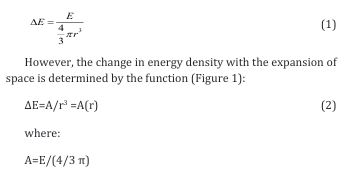
The function A(r) describes the variability not only of the energy density (A=ΔE) during the evolution of the cosmos, but also the proportional variability of the associated time velocity (δτ) with A=bδτ (where b is a constant coefficient, and for relative values b=1).
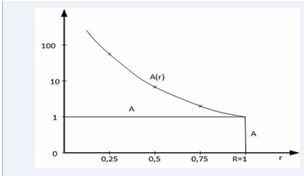
Figure 1 Assumed course of changes in the speed of time passage
It should be emphasized that all quantities are expressed in relative units related to the values at the current stage of the evolution of the cosmos. It means that for today,s situation, i.e. for R = 1.0 (Figure 2), their values are also equal to unity (A = 1, T=1).
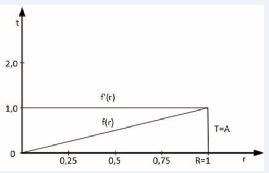
Figure 2 The course of time functions assuming a constant speed of time elapsed f’(r)=const.
It should be emphasized that all quantities are expressed in relative units related to the values at the current stage of the evolution of the cosmos. It means that for today,s situation, i.e. for R = 1.0 (Figure 2), their values are also equal to unity (A = 1, T=1). Considering the time with a constant speed of its passage as a function of the radius (r) of space f(r), one can write:
f(r)=(T/R)r
where: T is the evolution time of the cosmos, assuming the constant A parameter.
The changes of the function f’(r) can then be written in the form:
df(r)/dr=f’ (r)=T/R=const
The constant value of the derivative f(r) means constant time increments (T/R), which is the result of assuming a constant speed of the time passage (A=T=bδτ=1). Both quantities A and f(r) are directly related because the constancy of the quantity A guarantees the constancy of the function f(r) (Figures 1,2).
Taking into account the variable speed of time A(r) one has to multiply the function f(r) by the coefficient A(r)/A. Then from formula (4) we get:
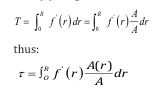
For the assumed variability of the speed of time elapsed and the relationship described by the function A(r)=A/r3, the resultant time of the evolution of the cosmos (τ) is determined by the following expression [2]:
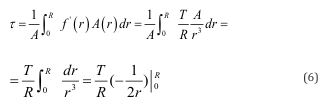
Writing down the equations fo r the times at different time lapse rates, i.e. for the quantities A and A(r), we have
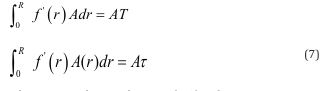
When we omit the singular point (r=0) and compare equations (7) it is obtained that: where, the value of the difference between physical quantities (T,τ ) depends on the assumed course of the function A(r).
CONCLUSIONS
Formula (7) defining the time τ of variable lapse rate time A(r) is a generalization of the formula used under the calculations of constant lapse rate time. The assumption of variability in the speed of time passage results in the calculated resultant time of cosmic evolution (τ) being many years longer than the current one (T). Therefore, an observer performing measurements, in time of the present state of the evolution of the cosmos, can see the universe only at the final stage of its evolution. They encounter the problem of the so-called “depth of time” due to the many years of space development that passed at the beginning of its expansion.
It should be emphasized that the recently published preliminary observations [3,4] do not disqualify the presented hypothesis about the need to take into account the variable speed of time passage. However, it should be assumed that the effect of time dilation in vicinity of the singular point should be taken into account.
The final verification of the assumptions about the variable speed of time passing and, consequently, the practical limitation of the scope of space research to the final phase of its evolution will be provided by the results of the latest observations carried out with the Hubble and/or Luvoir telescopes[ 5].
REFERENCES
- Hafele IC, Keating RE. Around the -world atomic clocks: Observed relativistic time grains. Science. 1972; 177: 14.
- Gradsztein J, Ryzik J. Tables of integrals. Moscow. 1962.
- Adams NJ, Conselice CJ, Ferreira L, Austin D, Trussler JA, Juodžbalis I, et al. Discovery and properties of ultra-high redshift galaxies (9 < z <12) in the JWST ERO SMACS 0723 field. Monthly Notices of the Royal Astronomical Society. 2022; 518: 4755–4766.
- Yan H, Ma Z, Ling C, Cheng C, Huang JS. First batch of z ≈ 11–20 candidate objects revealed by the james webb space telescope early release observations on SMACS 0723-73. The Astrophysical JournalLetters. 2023; 942: 20.
- LUVOIR. Space Telescope Concept for the 2030s