The Process of Formation and Delivery of Oil to Oil-Bearing Strata
- 1. Senior Researcher at the Institute of Physics of the Earth, Russia
Abstract
This article can hardly be called “scientific” in the accepted sense - there are no graphs, formulas, diagrams, numerical values of supposed conditions inside the planet, and it cannot claim to fully explain all the processes occurring in the Earth’s interior. Most likely, this will remain a secret for a long time to come, with the opportunity to build “scientific” theories and mathematical models. However, the article is based on existing, already available, measurement data and observed natural phenomena, which are manifestations on the surface of processes occurring inside the planet. The totality of these manifestations, and there are more than a dozen of them, allow us to confidently speak about the correctness of the proposed idea. This article attempts to show the conditions under which oil and its accompanying fractions can appear their place in the body of the planet, and the processes that force it to rise to depths at which its extraction is possible.
Keywords
• Naphthidogenesis; Oil; Kerogen; Geodynamics; Gravity; Planetary Structure.
Citation
Danilov VI (2025) The Process of Formation and Delivery of Oil to Oil-Bearing Strata. J Phys Appl and Mech 2(2): 1013.
INTRODUCTION. A BIT OF HISTORY
The concept of the biological roots of all naphthides is opposed by the idea of a deep, abiogenic (inorganic) origin of oil and gas, which was put forward by A. Humboldt in 1805 and then substantiated by D.I. Mendeleev - one of the first Russian chemists, who suggested that oil could arise from the interaction of metal carbides with water under conditions of high temperature and pressure.Nikolai Alexandrovich Kudryavtsev was a Soviet geologist who, in 1951, hypothesized about the deep (abiogenic) origin of oil. He noted the presence of hydrocarbons in places where there were no traces of organic life, and considered this an argument in favor of the inorganic origin of oil. Vladimir Linderman and Vladimir Kropotkin were Soviet scientists who actively developed Kudryavtsev’s ideas, suggesting that oil and natural gas could form at depth as a result of geochemical processes. Thomas Gold was an American astronomer and geophysicist who supported the abiogenic hypothesis. He believed that hydrocarbons could come from the depths of the mantle and, rising to the surface, form oil deposits.
MATERIALS AND METHODS
The work [1], is taken as the scientific justification for the proposed chemical transformation. Let us give the floor to the authors of this work.
« In most modern studies of lithospheric (petrogenic) carbon reservoirs in the earth’s crust, it is assumed that crude oil and natural gas (petroleum) are thermal generation products from the relics of biological organic matter accumulated in sedimentary rocks during geological time and deeply buried in a region of high pressure and temperature. In this sedimentary-migration (“biogenic”) concept of the origin of oil, the direction of the proposed evolutionary process of carbon transformation was determined: buried biological material → kerogen → oil
→ gas as a manifestation of progressive metamorphism (pressure and temperature increase). However, the discovery of kerogen in the meteorite’s composition does not allow us to suggest a biological source of carbon for the formation of this polymeric “organic” substance, but in turn allows us to suggest inorganic sources of kerogen, namely “oil” and “gas”non methane hydrocarbons (HCs), originated in the depths of their parent bodies (icy planetesimals). The genetic relationship of oil, natural gas and carbon matter of black shale formations (kerogen) on Earth is also beyond doubt,and therefore, in this paper, the evolution of petrogenic carbon reservoirs, including oil shale rocks in the lithosphere, is considered on the basis of a deep inorganic concept, in which the direction of the carbon transformation process is the opposite of the biogenic concept and is represented as HCs → gas → oil → kerogen. The analysis of phase diagrams and experimental data made it possible to determine two trends in the evolution of non-methane hydrocarbons in the Earth’s interior. In the upper mantle, the “metastability” of heavy (with a lower H/C ratio) HCs increases with depth. However, at temperatures and pressures corresponding to the surface mantle-crustal hydrothermal conditions, the “relative metastability” of heavy hydrocarbons increases with approach to the surface. When deep HCs fluids rise to the surface, petrogenic oil reservoirs are formed as a result of the decreases in hydrogen fugacity and a phase transition: gas HCs → liquid oil. At the physical and chemical conditions of an oil reservoir, metastable reversible phase equilibria are established between liquid oil and H2O, gas HCs and CO2, and solid (pseudocrystalline) “mature” and “immature” kerogens of “oil source” rocks. A decrease in hydrogen pressure and temperature leads to a stoichiometric phase transition (“freezing”) of liquid oil into solid kerogens. This occurs as a result of oil dehydrogenation in the processes of high- temperature CO2 fixation and low-temperature hydration of oil hydrocarbons, which are the main geochemical pathways for its transformation into kerogen. Thus, the formation of carbon matter in petrogenic reservoirs is the result of regressive (retrograde) metamorphism of deep hydrocarbon fluids, natural gas, liquid oil, and naphthide accumulations. »
As we can see, everything is logically and extremely clearly described. But the question remains - how can oil, from its supposed formation depth of 500 kilometers and deeper, reach almost the surface of the planet?
The model of the internal structure of the planet used by the authors does not provide an answer to this. Moreover, this generally accepted model does not correspond to measurements of gravitational forces, does not correspond to observed natural phenomena on the Earth’s surface, and in some places contradicts the basic laws of physics. One can, of course, refer to the supposed convection; by the way, many things are tried to be explained by it in geophysics, but it does not exist and cannot exist in a closed volume, which the Earth is - there cannot be simultaneous heating and cooling for many centuries in a thermos. In addition, the assumed convection speeds of 5-8 cm per year are much lower than simple heat transfer,which even in thermal insulators exceeds such a speed. This means that it will level out the supposed temperature difference and eliminate the conditions for convection to form. Moreover, the decrease in the forces of attraction to the center of the planet suggests that if convection is possible at all, it is towards the center, not upwards. And the presence inside the planet of a supposed eternal source of heat is not confirmed by any fact on the surface or in known physics. Too many assumptions, each easily refuted, to accept the convection hypothesis as even slightly plausible. The works [2-5], substantiate a different structure of the planet, in which the distribution of matter can be roughly compared to the distribution of mass in a round aquarium - it is in the Earth’s gravitational field, similar to how the Earth itself is in the Sun’s gravitational field. The distribution is well known - at the bottom, closer to the source of gravitational forces, are heavy masses, and higher up are those with lower density (Figure 1).

Figure 1 A clear example of mass distribution in an aquarium under the influence of Earth’s gravitational field.
If you rotate the aquarium, there will be movement of mass along the walls inside it, with the heavy part always directed towards the Earth. Similarly, inside the planet, there is a constant movement of mass - which is clearly visible from gravitational measurement data 2. The graphs of the measured values of gravitational forces unequivocally indicate the presence of a third mass, in addition to the Sun and Moon, affecting the readings of the gravimeter. Moreover, a significant mass, comparable in magnitude of influence to the external ones (Figure 2,3).
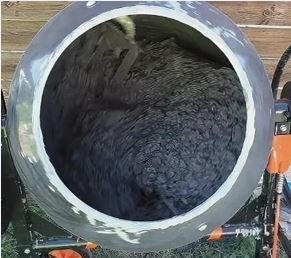
Figure 2 Gravitational concrete mixer - an analogue of the behavior of mass inside the planet.
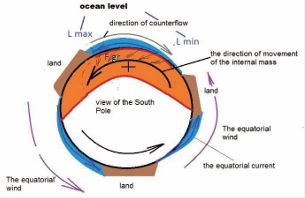
Figure 3 Manifestation of the internal mass movement on the planet’s surface.
The movement of this mass, connected by gravitational forces to the water and air layers on the surface, causes their displacement, observed as major equatorial currents and winds constantly directed in one direction - from East to West. This leads to an increase in ocean levels in their western parts. This increase, in turn, causes the appearance of countercurrents. These and many other manifestations on the surface of the planet prove the correctness of this approach to the Earth’s structure (Figure 4).
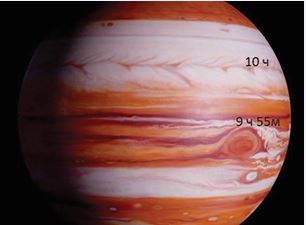
Figure 4 The same behavior of Jupiter’s internal mass leads, in a clear form, to the movement of clouds and the differentiation of rotation time of different parts of the planet.
There are many examples of this behavior in the Solar System. Since the movement of the Earth’s internal mass occurs at a very high speed (over 1000 km/hour), it causes active heating precisely in the contact zone with the planet’s crust, presumably this is the Mohorovi?i? discontinuity. Since other real heat sources are not observed (the currently accepted radiogenic hypothesis is easily refuted []), it turns out that the highest temperature is located precisely under the crust. It is in this zone that the conditions are created for the processes described above for the formation of natural gas, liquid oil, and naphthides. Also, the relatively shallow location of the ongoing processes allows the delivery of water, necessary for the chemical processes, to these areas.In addition to creating suitable temperature conditions, the movement of this mass performs the function of a piston in the resulting peristaltic pump, not only moving in a circle but also squeezing the forming mass towards the surface of the planet, creating a radial component of movement. This is the reason for the appearance of oil in the upper layers of the Earth’s crust (Figure 5).
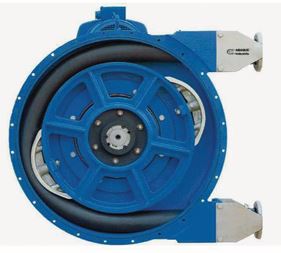
Figure 5 Peristaltic pump.
This, by the way, is also the driving force behind the ongoing magmatic processes in volcanoes, forcing lava to rise to the surface. It was in volcanoes that A. Humboldt discovered oil, bitumens, and petroleum gases. This movement also leads to the processes of geotectonics, mountain formation, the emergence and maintenance of the magnetic field, as mentioned earlier, the main equatorial currents, winds, changes in the shape of the planet into a geoid, causes stress in the tectonic plates, creating conditions for seismic activity, and other observed phenomena. On the Sun, the same influence from Jupiter leads to the 11-year activity cycle, differentiated rotation of various parts. For greater evidence of the movement of the internal mass, let’s present a graph of the behavior of gravitational forces of attraction, combined with the position of the Sun and Moon, which, on almost equal terms with the star, affects the moving mass in the body of the planet (Figure 6).
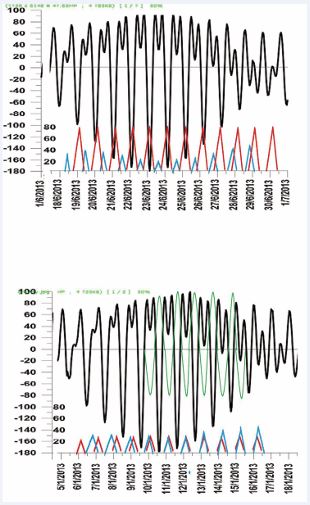
Figure 6 Graphs of the behavior of gravitational forces in June and January 2013. Black color - data from the gravimeter readings in µGal. Red and blue - the angle of the sunrise above the horizon of the Sun and Moon in degrees. Green color shows how the value should change in the absence of mass movement inside the planet.
The graphs show a clear discrepancy between the behavior of the forces of attraction and the position of both influencing external masses. On none of the graphs, regardless of whether the movement of the Sun and Moon is in phase or not, are there sinusoidal readings from the sensor.On the January graph, the Sun and Moon pass across the sky almost simultaneously and along the same trajectory, that is, their influence adds up in one direction. Nevertheless, a complex shape of the graph arises, clearly asymmetric, and even with additional dips in values at the zenith passage point. The shape of the real values deviates far from how it should change if we use the accepted hypothesis of the planet’s structure - the green graph.
CONCLUSIONS
In this article, using not at all scientific words and examples, but based on measured gravity data and observed natural phenomena, on the basis of verified laws of physics,on common sense and analogies with known processes,I have attempted to show how the process of formation and transportation of oil and naphthides to areas accessible for extraction occurs.
It also becomes clear that oil, contrary to the current consensus, is a renewable natural resource.
The work was carried out in non-working hours, at my own expense.No potential conflict of interest was reported by the author(s).
REFERENCES
- Marakushev SA, Belonogova OV. Thermodynamic Model of Deep OilOrigin and its Phase “Freezing”. Russ J Earth Sci. 2022; 22: ES6011.
- Proshkina ZN, Valitov MG, Kulinich RG, Kolpashchikova TN. STUDY OF TIDAL VARIATIONS IN GRAVITY IN THE TRANSITION ZONE FROM THE CONTINENT TO THE SEA OF JAPAN. BULLETIN OF THE KRASEC EARTH SCI. 2015; 3.
- Danilov CONSEQUENCES OF MUTUAL INFLUENCE OF PLANETS. J Geophys Bull. 2017; 1: 11.
- Geotectonics and geodynamics of seismically active regions. Materials of the All-Russian scientific conference dedicated to the 75th anniversary of the birth of EA Rogozhin (1947-2021) and the 115th anniversary of the birth of VV Belousov (1907-1990). Institute of Physics of the Earth RAS. 2022: 265-275.
- Danilov VI. A NEW VIEW ON THE PHYSICS OF PLANET EARTH. ApplPhy Mathemat. 2023; 5.