Genetic findings in a child with deferential abnormalities. From surgery to clinical genetics
- 1. Division of Pediatric Surgery Hospital, Universitario Ramony Cajal. Ctra, Colmenar Km.9,1. Madrid 28035, Spain
Abstract
A male 14 months old had deferential abnormalities during orchidopexy. The genetic study demonstrate cystic fibrosis (?F508 / ?F508). A literature review of the genetic alterations observed in patients with congenital unilateral and bilateral absence of the vas deferens was underwent as well as the role of cystic fibrosis trans membrane conductance regulator gene on fertility.
Keywords
Cystic fibrosis; Congenital absence of vas deferens; Orchidopexy; Cryptorchidism
Citation
Rivilla F (2015) Genetic findings in a child with deferential abnormalities. From surgery to clinical genetics. J Urol Res 2(4): 1036.
INTRODUCTION
Congenital disorders of the vas deferens are an autosomal recessive disease and occur in 1–2% of infertile men [1]. However, it is well known that most patients with cystic fibrosis (CF) and Infertility appears in 98% of cases due to obstructive abnormalities such as congenital bilateral or unilateral absence of the vas deferens (CBAVD and CUAVD respectively), which determine the hypo or azo ospermic appearance [1,2].
This finding is related to alterations in the cystic fibrosis trans membrane conductance regulator gene (CFTR). Based on the observed genetic defects in this gene, different CF variants has been described [3,4]. Classical, non classical and disorders related with CFTR gene with an involvement of a single organ disorders, such as the CBAVD [2,5] or CUAVD [6,7] as it has been demonstrated in our patient.
Moreover, it is believed that CFTR gene influences other aspects of reproduction, such as spermatogenesis [8,9] and semen viscosity [10]. It is described more difficulty obtaining high quality semen samples and a less success in procedures of assisted reproduction [11,12 ].
CASE REPORT
It is reported the case of a male. At birth a healthy boy with a non palpable right testicle in scrotum were explored. He was referred to pediatric surgery outpatient clinic. Decisions on surgery were delayed until a spontaneous descent of the right testicle at one year of age. At 14 months the physical examination was similar to that described at birth. According to surgical protocol in our Institution and with the agreement of parents, an orchidopexy was performed. During surgery, the right testicles were located in middle third of inguinal duct, consistency and gross appearance were normal with a dissociation epididimo-testicularis and without evidence of vas deferens. (Figure 1).
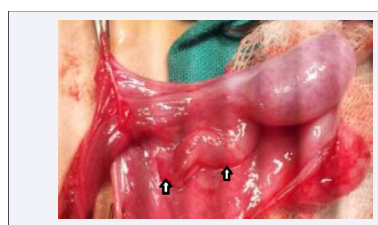
Figure 1 Right arrow (ectopic and hypoplasic epididimys with epidídimo-testicular dissociation), left arrow (absence of vas deferens).
An orchidopexy were performed according to Murphy procedure in a day surgery bases. No left testicle surgical exploration was under went due to a correct anatomical location. It is unknown whether there is a contra lateral vas deferens agenesia.
The postoperative genetic studies demonstrate a cystic fibrosis (?F508 /?F508), classical form in homozygosis. No other structural organic malformation was founded. Parents by history were not known to be consanguineous.
The postoperative first year follow up has been uneventful except by difficulty in weight gain and one episode of Pseudomonas aeruginosa Pneumonia treated early without complications recorded.
DISCUSSION
Deferential abnormalities and specially CBAVD is a common finding in patients with severe CF genotype (98%), although is not a major signs of the disease. However, it has been described several cases diagnosed casually during childhood, especially during inguinal surgical procedures such as herniorraphy and orchidopexy [13,14] as the patient reported here. In fact, it has been suggested in CF a higher incidence of inguinal hernia, hydrocele and cryptorchidism [15]. If it is discovered in a child during surgery is highly recommended to discard CF at any age and some others genitourinary malformations such as the more common renal agenesia [16-18]. Moreover when a child with CF should be operate with those conditions parents must be adviced about the possibility to find deferential abnormalities.
Patients with fortuitous finding during surgery can have an asymptomatic CF with homozygosis mutations of CFTR gene or a middle mutation with a partial function of the gene. In the last, a high genetic heterogeneity has been described in literature [16,19-21]. Most are heterozygous, with other mild or severe mutation and the genotypes more frequently found are ?F508/5T and ?F508/R117H. However, 5T polymorphism penetrance is incomplete [22] and seems to be determined by the number of sequential repetitions of thymine and guanine [23,24] On the other hand there are important geographical differences [21] although the spectrum and frequency distribution of CFTR gene mutations in most patients of European descent or other countries may not be the same for all countries or ethnicities [25]. By contrast, forms ACBCD / ACUCD with renal agenesis not appear to be related to alterations in the CFTR gene or CF [6,17,19].
Although CBAVD patients are able to have children using intra cytoplasmic sperm injection, they will experience a higher risk than normal of having a child with CF. Assuming a risk of 1/25 of the partner being a CF carrier, and the affected male having a chance of 0.5 of transmitting the mutant CFTR gene to the child, the combined risk of a CBAVD-affected couple having a CF child is 1/100 [21]. The partner of the CBAVD patients should be tested for CFTR mutations and clear genetic counselling should be provided. Furthermore, commercial test detect the most frequent mutations and not all mild genetic variations. Thus, only they detect alterations in 60% of cases of CBAVD [21,25]. It has been proposed, although there is no consensus, that in CF patients with CBAVD or CUAVD, is highly recommended a familiar genetic counseling [25,26].
Concerning the importance of CFTR gene on fertility, it seems also to play roles in different stages. First during embryonic development of vas deferens [26]. It has also been observed an increased expression of the gene during spermatogenesis [9,10] with a lower maturation of spermatides in testicular biopsies from patients with mutations 5T of the CFTR gene [8] . In addition, it has been suggested that this gene regulates the viscosity of seminal fluid and may have a role in the maturation of sperm in vitro [11], which has caused a minor success of artificial reproduction procedures [8-10].
Finally, it should be emphasized the importance of the diagnosis of CF in patients with incidental findings CBAVD or CUAVD during surgical exploration of the inguinal area and the genetic counseling of family.
REFERENCES
- Lissens W, Mercier B, Tournaye H, Bonduelle M, Férec C, Seneca S, et al. Cystic fibrosis and infertility caused by congenital bilateral absence of the vas deferens and related clinical entities. Hum Reprod. 1996; 11: 55-80.
- Anguiano A, Oates RD, Amos JA, Dean M, Gerrard B, Stewart C, et al. Congenital Bilateral Absence of the Vas Deferens. A Primarily Genital Form of Cystic Fibrosis. JAMA.1992; 267: 1794-1797.
- Claustres M, Guittard C, Bozon D, Chevalier F, Verlingue C, Ferec C, et al. Spectrum of CFTR Mutations in Cystic Fibrosis and in Congenital Absence of the Vas Deferens in France. Human Mutat. 2000; 16: 143-156.
- Steiner B, Rosendahl J, Witt H, Teich N, Keim N, Schulz H, et al. Common CFTR Haplotypes and Susceptibility to Chronic Pancreatitis and Congenital Bilateral Absence of the Vas Deferens. Hum Mutat. 2011; 32: 912-920.
- Lopez E, Viart V, Guittard C, Templin C, René C, Méchin D, et al. Variants in CFTR untranslated regions are associated with congenital bilateral absence of the vas deferens. J Med Genet. 2011; 48: 152-59.
- Attardo T, Vicari E, Mollica F, Grazioso C, Burrello N, Garofalo MR, et al. Genetic, andrological and clinical characteristics of patients with congenital bilateral absence of the vas deferens. Int J Androl. 2001; 24: 73-79.
- Donohe RE, Fauver HE. Unilateral absence of the Vas Deferens. JAMA. 1989; 261: 1180-1182.
- Larriba S, Bonache S, Sarquella J, Ramos MD, Giménez J, Bassas L, et al. Molecular evaluation of CFTR sequence variants in male infertility of testicular origin. Int J Androl. 2005; 28: 284-290.
- Trezise A, Linder C, Grieger D, Thompson E, Meunier H, Griswold M, et al. CFTR expressions is regulated during both the cycle of the seminiferous epithelieum and the oestrous cycle of rodents. Nat Genet. 1993; 3: 157-164.
- Chen H, Ruan YC, Xu WM, Chen J, Chan HC. Regulation of male fertility by CFTR and implications in male fertility. Hum Reprod Update. 2012; 18: 703-713.
- Elia I, Mazzilli R, Delfino M, Piane M, Bozzao M, Spinosa V, et al. Impact of Cystic Fibrosis Transmembrane Regulator (CFTR) gene mutations on male infertility. Arch Ital Urol Androl. 2014; 860: 171-174.
- Rossi T, Grandoni F, Mazzilli F, Quattrucci S, Antonelli M, Strom R, et al. High frequency of (TG)m Tn variant tracts in the cystic fibrosis transmembrane conductance regulator gene in men with high semen viscosity. Fertil Steril. 2004; 82: 1316-1322.
- Merrot T, Delarue A, Chaumoitre K, Panuel M, Sigaudy S, Chazalette JP, et al. Agénésie déférentielle bilateral et hernie inguinale chez un enfant. Une présentation précore rare dela mucoviscidose. Arch Pédiatr 2001; 8: 728-730.
- Escobar MA, Lau ST, Glick PL. Congenital bilateral absence of the vas deferns. J Pediatr Surg. 2008; 43: 1222-1223.
- Mennicke K, Klingenberg RD, Bals-Pratsch M, Diedrich K, Schwinger E, et al. Rational approach to genetic testing of cystic fibrosis (CF) in infertile man. Andrologia. 2005; 37: 1-9.
- Chillon M, Casals T, Mercier B, Bassas L, Lissens W, Silber S, et al. Mutations in the cystic fibrosis gene in patients with congenital absence of the vas deferens. N Engl J Med. 1995; 332: 1475-1480.
- Dork T, Dworniczak B,Aulehla-Scholz C,Wieczorek D, Bohm I, Mayerova A, et al. Distinct spectrum of CFTR gene mutations in congenital absence of vas deferens. Hum Genet. 1997; 100: 365-77.
- Radpour R, Gourabi H, Dizaj AV, Holzgreve W, Zhong XY. Genetic Investigations of CFTR Mutations in Congenital Absence of Vas Deferens, Uterus, and Vagina as a Cause of Infertility. J Androl. 2008; 29: 506-513.
- Radpour R, Gilani MA, Gourabi H, Dizaj AV, Mollamohamadi S. Molecular analysis of the IVS8-T splice variant 5T and M470V exon 10 missense polymorphism in Iranian males with congenital bilateral absence of the vas deferens. Mol Hum Reprod . 2006; 12: 469-473.
- Tamburino L, Guglielmino A, Venti E, Chamayou S. Molecular analysis of mutations and polymorphisms in the CFTR gene in male infertility. Reprod Biomed Online. 2008; 17: 27-35.
- Jianmin Y, Zhanghui C, Ni Y, Zhongxiang L. CFTR mutations in men with congenital bilateral absence of the vas deferens (CBAVD): a systemic review and meta-analysis. Human Reproduction . 2012; 27: 25-35.
- Shin D, Gilbert F, Goldstein M, Schlegel. Congenital absence of the vas deferens: incomplete penetrance of cystic fibrosis gene mutations. J Urol. 1997; 158: 1794-1799.
- Cuppens H, Cassiman JJ. CFTR mutations and polymorphisms in male infertility. Int J Androl. 2004; 27: 251-256.
- Moccanu E, Shattock R, Barton D, et al. All azoospermic males should be screened for cystic fibrosis mutations before intracytoplasmic sperm injection. Fertil Steril. 2010; 94: 2448-24450.
- Donat R, McNeill AS, Fitzpatrick DR, Hargreave TB. The incidence of cystic fibrosis gene mutations in patients with congenital bilateral absence of the vas deferens in Scotland. Br J Urol. 1997; 79: 74-77.
- Tizzano EF, Chitayat D, Buchwald M, Cell-specific localization of CFTR mRNA shows developmentally regulated expressions in human fetal tissues. Hum Mol Gene. 1993; 2: 219-224.