More Than a Papilloma: Two Rare Cases of Laryngeal Papillary Squamous Cell Carcinoma
- 1. Division of Oncopathology, Clinical Laboratory Services and Translational Research, Malabar Cancer Centre, India
Abstract
Baground: Papillary squamous cell carcinoma (PSCC) is an uncommon variant of laryngeal squamous cell carcinoma with a distinct exophytic papillary architecture and generally better prognosis compared to conventional SCC. Although clinical presentation often resembles other laryngeal malignancies, accurate recognition is essential due to its diagnostic overlap with benign and other exophytic lesions. Objective: We report two cases of laryngeal PSCC in elderly male patients presenting with throat-related symptoms. Endoscopy in Case 1 showed an ulceroproliferative growth on the lingual surface of the epiglottis, while Case 2 revealed a proliferative lesion involving the pyriform fossa and aryepiglottic fold. Histopathology in both cases demonstrated papillary fronds with f ibrovascular cores lined by dysplastic squamous epithelium. p16 immunohistochemistry showed diffuse strong positivity in Case 1 and patchy positivity in Case 2, suggesting HPV association. Result: PSCC may closely mimic squamous papilloma and verrucous carcinoma, especially in superficial biopsies lacking obvious invasion. Awareness of its characteristic morphology aids in avoiding misdiagnosis and guides appropriate management. These cases highlight the importance of considering PSCC in exophytic laryngeal lesions.
Keywords
• Papillary squamous cell carcinoma • Larynx • Head and neck cancer • HPV-related carcinoma • p16 Immunohistochemistry
Citation
Ravikumar V, Nayanar SK (2026) More Than a Papilloma: Two Rare Cases of Laryngeal Papillary Squamous Cell Carcinoma. Ann Otolaryngol Rhinol 13(2): 1385.
INTRODUCTION
Papillary squamous cell carcinoma (PSCC) is an uncommon variant of squamous cell carcinoma of larynx.Although these tumors often present in a manner similar to conventional laryngeal squamous cell carcinomas, their recognition is crucial, as they carry a distinct and generally more favorable prognosis compared to other subtypes. Here we present two cases of papillary squamous cell carcinoma. We highlight the macro and microscopic features of this rare neoplasm and emphasize the importance of distinguishing it from with other exophytic squamous cell carcinomas of the region [1].
CASE PRESENTATION
Case 1
A 70-year-old male presented was evaluated for a foreign body sensation in the throat. Direct laryngoscopic examination revealed an ulceroproliferative growth in the right side of lingual surface of epiglottis, abutting the vallecula.
Endoscopic biopsy sections revealed an atypical squamous proliferative lesion with papillomatous architecture and fibrovascular cores. Immuno-histochemistry for p16 demonstrated diffuse strong block positivity (Figure 1).
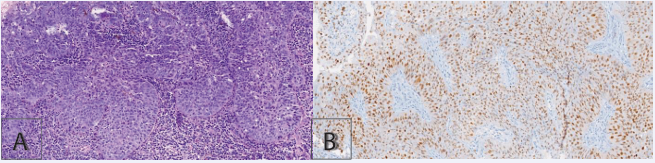
Figure 1 Case 1 (A) Microscopy section (H&E, 20x) showing papillary pattern of tumor. (B) Diffuse p16 immuostaining.
Case 2
A 57-year-old male presented with throat pain. Direct laryngoscopy showed a proliferative growth in the left pyriform fossa extending to left aryepiglottic fold.
Endoscopic biopsy showed fragments of mucosa lined by squamous epithelium arranged in complex papillary fronds with fibrovascular cores. The squamous epithelium shows marked dysplasia involving full epithelial thickness. Immunohistochemistry with p16 showed patchy nuclear and cytoplasmic positivity (Figure 2).
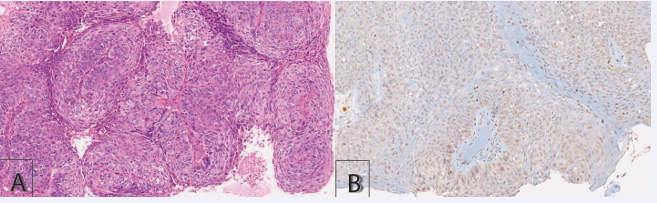
Figure 2 Case 2 (A) Microscopy section (H&E, 20x) show numerous papillae with fibrovascular cores (B) Diffuse p16 immunostaining
DISCUSSION
Tumors of the Hypopharynx:
Larynx and Trachea predominantly originate from the lining epithelium, most commonly squamous or respiratory in nature. Laryngeal cancer affects >1million individuals worldwide and it is the second most common respiratory tract cancers. It accounts for 25% of head and neck cancers. Theses tumors are strongly associated to smoking and alcohol intake. Other risk factors are gastroesophageal reflux and human papilloma virus (HPV).
Squamous Cell Carcinoma: (SCC)
Accounts for vast majority of laryngeal malignancies. There are six variants of squamous cell carcinoma – Verrucous carcinoma, basaloid squamous cell carcinoma, papillary squamous cell carcinoma, spindle cell carcinoma, adenosquamous cell carcinoma and lymphoepithelial carcinoma [2].
Papillary Squamous Cell Carcinoma:(PSCC)
Is a rare variant of squamous cell carcinoma. Like all laryngeal carcinomas these occur most commonly in older men. Analogous to cervical carcinogenesis, these tumors are believed to develop through a multistep sequence beginning with squamous metaplasia, progressing to dysplasia, and eventually culminating in carcinoma. This stepwise pathway is thought to be driven by their association with human papillomavirus (HPV), further supporting the role of HPV as an important etiological factor, much like in the cervix.
Microscopically, the PSCC shows a predominantly exophytic, papillary growth pattern. The lesion is composed of multiple broad based, branching papillae supported by well-developed fibrovasular cores. These papillary fronds are lined by multilayered squamous epithelium exhibiting varying degrees of dysplasia. The epithelial cells display nuclear pleomorphism, hyperchromasia, increased nuclear to cytoplasmic ratio, and mitotic activity, including occasional atypical mitosis. Koilocytic change characterised by perinuclear halos and nuclear irregularity, is often noted, suggesting HPV related cytopathic effect. Surface keratinisation is minimal or absent.
Because of its papillary architecture and superficial nature of endoscopic biopsies, evidence of stromal invasion may be difficult to identify histologically. This poses a diagnostic challenge, as PSCC can closely mimic benign squamous papilloma. However, papillomas are characterised by orderly maturation and an absence of cytological atypia or significant mitotic activity, features that help differentiate from PSCC [3].
It is also important to distinguish PSCC from verrucous carcinoma, another exophytic variant of SCC. Verrucous carcinoma typically exhibits broad pushing rete ridges, abundant surface keratinisation and minimal cytological atypia.
Immunohistochemically, PSCC often shows strong and diffuse p16 positivity, reflecting its associated with high-risk HPV infection. Although p16 immunostaining serves as a useful surrogate marker, routine HPV testing by immunohistochemistry is not currently recommended.
CONCLUSION
Papillary SCC is a distinct and rare variant of laryngeal SCC. Awareness of its characteristic morphology is essential for accurate diagnosis and appropriate management. Recognition of this entity is particularly important given its generally better prognosis compared to conventional SCCs and the potential for more refined, targeted treatment protocols in the future.
ACKNOWLEDGEMENTS
The authors would like to thank the Department of Oncopathology and Clinical Laboratory Services, Malabar Cancer Centre, for providing laboratory facilities and technical support throughout this work. We gratefully acknowledge the assistance of the histopathology laboratory staff in specimen processing and immunohistochemical studies. We also extend our appreciation to the clinicians involved in patient management for their cooperation and valuable clinical input.
REFERENCES
- Mehrad M, Carpenter DH, Chernock RD, Wang H, Ma XJ, Luo Y, et al. Papillary squamous cell carcinoma of the head and neck: clinicopathologic and molecular features with special reference to human papillomavirus. Am J Surg Pathology. 2013; 9:1349-1356.
- Thompson LD, Wenig BM, Heffner DK, Gnepp DR. Exophytic and papillary squamous cell carcinomas of the larynx: a clinicopathologic series of 104 cases. Otolaryngology—Head and Neck Surgery. 1999; 5:718-724.
- Lewis Jr JS. Not your usual cancer case: variants of laryngeal squamous cell carcinoma. Head and neck pathology. 2011; 1:23-30.