The Prevalence of Dichotic Deficits in Children from Clinical and School-Based Assessments
- 1. Audiology Affiliate, Institute of Intelligent Systems Director, The University of Memphis, USA
Abstract
The prevalence of dichotic listening deficits that are associated with language and reading difficulties in children remains poorly understood because assessments occur only in clinical settings. This study examined the prevalence and severity of dichotic listening deficits in typically developing schoolchildren assessed in school-based environments. A total of 1,112 children (473 females) ages 5–16 years with normal peripheral hearing completed the Randomized Dichotic Digits Test and the Dichotic Words Test. Ear scores and interaural asymmetry values were compared with age-based percentile cut-offs derived from nonparametric statistical methods to classify performance as typical, mild, moderate, or severe. Concordant deficit patterns across both tests were used to identify amblyaudia (AMB), dichotic dysaudia (DD), amblyaudia plus (AMB+), or mixed patterns.
Across age groups, fewer than 40% of children demonstrated fully typical performance on both dichotic tests. Severe dichotic deficits were identified in 8–19% of children depending on age group, with an additional 8–13% demonstrating moderate deficits. The highest prevalence of severe deficits occurred between ages 7 and 12 years. Dichotic dysaudia emerged as the most common deficit pattern across middle childhood, while amblyaudia and amblyaudia plus occurred in approximately 4–6% of children across age groups.
These findings indicate that binaural integration deficits are substantially more common in school-age children than suggested by clinic-based prevalence estimates. Population-level screening using dichotic listening measures may reveal a large group of children with previously unrecognized auditory processing weaknesses linked to listening, language, and literacy difficulties. Early identification paired with evidence-based rehabilitation may provide a practical pathway for addressing these largely overlooked barriers to academic achievement
Citation
Moncrieff D. (2026) The Prevalence of Dichotic Deficits in Children from Clinical and School-Based Assessments. Ann Otolaryngol Rhinol 13(3): 1389.
INTRODUCTION
Three domains of auditory processing frequently assessed in the clinic are dichotic listening, temporal processing, and low-redundancy speech perception, particularly speech understanding in background noise [1-4]. Estimates of auditory processing problems in school-age children range from 2-7% [5], to more than 90%, depending on identification criteria [6]. Dichotic listening deficits have been linked for decades to learning and reading problems in children [7-10], who can begin to perform standard dichotic listening tests with open set single syllable words and closed sets of digits by 5–6 years of age [11], but performance improves across development into young adulthood [12].
Dichotic listening (DL) tests measure a listener’s ability to identify different auditory stimuli presented simultaneously to the two ears at a comfortable listening level. Performance depends on the coordination and integration of signals from both ears within ascending auditory pathways, particularly competitive interactions within the auditory brainstem [13] that support the development of attention and working memory during complex listening tasks [14]. Binaural integration relies on patterns of excitation, inhibition, and suppression within nuclei of the superior olivary complex that contribute to sound localization, binaural summation, and the ability to segregate speech signals in complex acoustic environments [15-17].
Two distinct deficit patterns that have consistently emerged from dichotic listening tasks are now termed amblyaudia (AMB) and dichotic dysaudia (DD) [18]. Amblyaudia is characterized by abnormally poor performance in one ear accompanied by an exaggerated interaural asymmetry, whereas dichotic dysaudia is characterized by symmetrically poor performance in both ears. When performance is down in both ears together with a large interaural asymmetry, the pattern is characterized as amblyaudia plus (AMB+). Identification of either deficit requires concordant patterns across two dichotic listening tests, providing an internal cross-check that strengthens reliability. When patterns from two tests represent each deficit, AMB on one test and DD on the other, the results are characterized as mixed (MIX).
Auditory Rehabilitation for Interaural Asymmetry (ARIA) is an adaptive auditory training protocol based on principles of constraint-induced therapy and perceptual learning designed specifically to improve dichotic listening performance in individuals with amblyaudia or dichotic dysaudia [19]. ARIA has demonstrated improvements not only in dichotic listening performance but also in untrained tasks such as oral reading, listening comprehension, and speech recognition in background noise. Because the training protocol adapts to the listener’s performance level, children with more severe deficits often demonstrate the greatest gains [20].
The purpose of this study is to report the prevalence and severity of dichotic deficits in typically developing children who completed two dichotic listening tests in school-based settings. These comparisons provide insight into the occurrence of dichotic deficit patterns in the underserved population of typically developing schoolchildren. By establishing prevalence estimates outside of clinical referral populations, this study aims to support efforts toward earlier identification and intervention for overlooked binaural integration problems that may be interfering with educational achievement.
METHODS
A total of 1,112 children (473 females) ages 5 to 16 years (mean = 11.4 years) were assessed with the Randomized Dichotic Digits Test (RDDT) [21], and the Dichotic Words Test (DWT) [12]. Children who were recruited from public, charter and private schools all demonstrated normal hearing sensitivity in both ears for frequencies from 500 to 4000 Hz. None reported neurologic impairment, developmental disability, or significant co-morbid disabilities. Children were assessed following parental consent or a memorandum of understanding under a protocol approved by the Institutional Review Boards at several universities. The dichotic test stimuli were delivered through headphones attached to a clinical audiometer or to laptop computers. Children were instructed to listen for the pairs of digits or words and to repeat whatever they heard and to guess if they were not sure. Right and left ear scores were recorded and then labeled as dominant and non-dominant and asymmetry was measured as the numeric difference between the dominant and non-dominant ears. Ear scores were compared to low cut-off values for scores within each of 5 age groups as determined by non-parametric statistical methods [22] and designated as severe if below the 5th percentile, moderate if below the 10th percentile and mild if below the 25th percentile. Scores above the 25th percentile were designated as typical. Interaural asymmetry scores were compared to high cut-off values and designated as severe if above the 95th percentile, moderate if above the 90th percentile and mild if above the 75th percentile. Severity rankings of low scores from each test were compared and final severity rankings were assigned to concordant patterns from the two tests for AMB, DD and AMB+ and to non-concordant patterns for MIX results when deficits on the two tests did not match and unidentified (UND) when a deficit occurred in scores from only one test.
RESULTS
The number of children within each age group differed as shown by the gray bars in Figure 1. The black bars represent the total number of children within each age group whose ear scores were above the 25th percentile and whose interaural asymmetry was below the 70th percentile across both dichotic tests, making their performance typical for their age. These represent 37% of the children in the youngest and oldest age groups, 5 to 6 years and 16 to 18 years, but only 27%, 23% and 15% of the children in the other age groups, 7 to 9 years, 10 to 12 years, and 13 to 15 years, respectively.
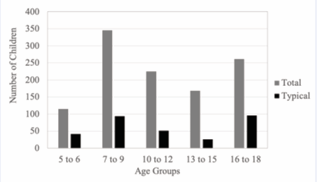
Figure 1: Number of children with typical dichotic performance compared to total number within each age group
The number of children whose scores represented a mild, moderate or severe deficit within each age groups is displayed in Figure 2. The percentages represent the total prevalence of children within each age group whose scores fell below the 5th, 10th, or 25th percentile across both dichotic tests. Among the younger children from ages 5 to 12 years, the prevalence of a severe dichotic deficit across both tests was higher than for moderate or mild deficits, but for the older groups, the prevalence of all ranks of deficits at all 3 ranks were more similar.
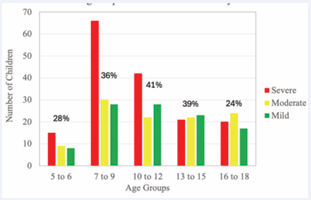
Figure 2: Number of deficit score patterns by severity. Percentages represent total for all severity ranks.
The number of children whose low performance represented a severe deficit across both dichotic tests that matched the AMB, DD or AMB+ deficit patterns and those whose severe deficit performance represented a MIX of the AMB and DD patterns are shown in Figure 3.
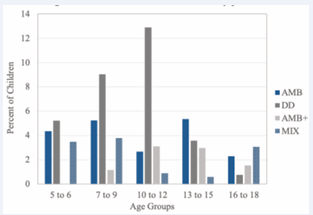
Figure 3: Prevalence of severe deficits by pattern.
These are the children with the most significant dichotic deficits, having produced scores below the 5th percentile for at least one test and below the 5th, 10th, or 25th percentile for the other test. The prevalence of severe deficits was highest among children from ages 7 to 12 years, with a large proportion of the children demonstrating a dichotic dysaudia pattern across both tests. Approximately 4-6% of the children demonstrated the amblyaudia deficit pattern either as AMB or AMB+ across the age groups. The total prevalence of severe deficits alone was 13%, 19%, 19%, 13% and 8% from younger to older age groups with another 8%, 9%, 9%, 13% and 9% demonstrating moderate deficits across the two tests.
CONCLUSIONS
For the past 30 years, approximately 70% of children in 4th grade classrooms in the US have not been able to achieve grade-level proficiency in reading [23]. Some of those children improve before high school graduation but the current rate of adult literacy is over 50%. Billions of dollars have been spent by families, schools, and organizations on literacy programs, educational interventions, and clinical remedies with no significant change in the data. Dichotic deficits have been regularly identified in auditory processing evaluations that are available to only a handful of children with financial resources and access to a clinician who performs the tests. As a result, the prevalence of auditory weaknesses in children has been very low at 2-7%. But even when a dichotic deficit is identified, recommendations are often made for low gain hearing aids or accommodations at home and school for children with poor scores.
This study provides population-level prevalence estimates of dichotic listening deficits among typically developing schoolchildren assessed in naturalistic, school based settings. Across a sample of 1,112 children ages 5 to 16 years, a substantial proportion demonstrated measurable binaural integration deficits on two independent dichotic listening tests. Severe deficits were most prevalent among children ages 7 to 12 years, with dichotic dysaudia emerging as the predominant deficit pattern across the middle childhood age groups. Severe amblyaudia and amblyaudia plus were identified in approximately 4–6% of children across all age groups, while moderate deficits across all patterns added 8–13% more.
Notably, more than half of children showed some degree of dichotic deficit, with fewer than 40% of children in any age group demonstrating fully typical performance across both tests. The higher prevalence of severe relative to mild or moderate deficits among younger children suggests that dichotic processing difficulties may be more pronounced before compensatory maturation of auditory pathways occurs, yet many of these children would likely go undetected without targeted screening. The prevalence estimates reported here more closely reflect the burden of dichotic deficits linked to difficulties in reading, listening comprehension, and speech understanding in noise in the broader pediatric population. With the availability of evidence-based rehabilitation protocols such as ARIA, universal school-based dichotic screening in elementary school may offer a practical pathway to earlier intervention for a population that currently bears a largely invisible burden. Future research should examine the relationship between dichotic deficit severity and academic outcomes in non-referred samples and evaluate the cost-effectiveness of integrating dichotic screening into existing school-based hearing programs.
REFERENCES
- American Academy of Audiology. Clinical practice guide-lines: Diagnosis, treatment and management of children andadults with central auditory processing disorder. 2010.
- American Speech-Language-Hearing Association. (Central) auditory processing disorders-The role of the audiologist. 2005.
- Raben Pedersen E. The Danish test battery for auditory processing disorder evaluated with patient and control data. Int J Audiol. 2018; 57: 755-763.
- Schow RL, Dillon H, Hillam J, Whitaker MM, Seikel JA. Factor Analysis on Multiple Auditory Processing Assessment-2 and Listening in Spatialized Noise-Sentences Test in Children. Am J Audiol. 2021; 30: 433-442.
- Bamiou DE, Musiek FE, Luxon LM. Aetiology and clinical presentations of auditory processing disorders--a review. Arch Dis Child. 2001; 85: 361-365.
- Wilson WJ, Arnott W. Using different criteria to diagnose (central) auditory processing disorder: how big a difference does it make? J Speech Lang Hear Res. 2013; 56: 63-70.
- Dermody P, Mackie K, Katsch R. Dichotic listening in good and poor readers. J Speech Hear Res. 1983; 26: 341-348.
- Moncrieff DW, Black JR. Dichotic listening deficits in children with dyslexia.
-
Dyslexia. 2008; 14: 54-75.Reynard P, Joly CA, Damien M, Le Normand MT, Veuillet E, Thai-Van H. Age-Related Dichotic Listening Skills in Impaired and Non-Impaired Readers: A Comparative Study. J Clin Med. 2023; 12: 666.
- Sharma M, Purdy SC, Kelly AS. Comorbidity of auditory processing, language, and reading disorders. J Speech Lang Hear Res. 2009; 52: 706-722.
- Litovsky RY. Development of Binaural and Spatial Hearing. In: Werner L, Fay R, Popper A. (eds) Human Auditory Development. Springer Handbook of Auditory Research. Springer. 2012; 42.
- Moncrieff D. Age- and Gender-Specific Normative Information from Children Assessed with a Dichotic Words Test. J Am Acad Audiol. 2015; 26: 632-644.
- Della Penna S, Brancucci A, Babiloni C, Franciotti R, Pizzella V, Rossi D, et al. Lateralization of dichotic speech stimuli is based on specific auditory pathway interactions: neuromagnetic evidence. Cereb Cortex. 2007; 17: 2303-2311.
- Penner IK, Schläfli K, Opwis K, Hugdahl K. The role of working memory in dichotic-listening studies of auditory laterality. J Clin Exp Neuropsychol. 2009; 31: 959-966.
- Blauert J. Binaural localization. Scand Audiol Suppl. 1982; 15: 7-26.
- Middlebrooks JC. Sound localization. Handb Clin Neurol. 2015; 129: 99-116.
- Krumbholz K, Schönwiesner M, von Cramon DY, Rübsamen R, Shah NJ, Zilles K, et al. Representation of interaural temporal information from left and right auditory space in the human planum temporale and inferior parietal lobe. Cereb Cortex. 2005; 15: 317-324.
- Moncrieff D, Keith W, Abramson M, Swann A. Diagnosis of amblyaudia in children referred for auditory processing assessment. Int J Audiol. 2016; 55: 333-345.
- Moncrieff D, Keith W, Abramson M, Swann A. Evidence of binaural integration benefits following ARIA training for children and adolescents diagnosed with amblyaudia. Int J Audiol. 2017; 56: 580-588.
- White SL, Moncrieff DW. ARIA treatment benefits are related to severity of dichotic listening deficits in children. Int J Pediatr Otorhinolaryngol. 2023; 168: 111551.
- Moncrieff DW, Wilson RH. Recognition of randomly presented one-, two-, and three-pair dichotic digits by children and young adults. J Am Acad Audiol. 2009; 20: 58-70.
- Moncrieff D, Ray, MA. Identification of dichotic deficits in children, Part I:
- Performance criteria determined from non-parametric statistical procedures. Children.
- U.S. Department of Education, Institute of Education Sciences, National Center for Education Statistics, National Assessment of Educational Progress (NAEP), various years, 1971–2023 Long-Term Trend Reading and Mathematics Assessments.