Phylogenetic Relationships of Greek and Eurasian-Japanese Common Carp: The Origin of Cyprinus carpio from Western Greece
- 1. Department of Aquaculture and Fisheries, Technological Educational Institution of Western Greece, Greece
- 2. Department of Environment and Natural Resources Management, University of Patras, Greece
- 3. Department of Information and Communication Systems Engineering, University of Aegean, Greece
Abstract
To elucidate the origin of the Greek common carp inhabiting the Lakes Amvrakia, Ozeros, Lysimacheia and Trichonida located in Western Greece, representative partial D-loop sequences 573 bp, in length, sequences from European, Asian and Japanese domestic and wild common carp strains (n=45) have been analyzed. Phylogenetic analysis indicates that the Yangtze River wild common carp (YWC1) is the ancestor for the Greek and all Eurasian common carp strains and the Lake Biwa wild common carp represent a possible ancient lineage of Cyprinus carpio. In addition, partial D-loop sequence analysis provided further support regarding the origin of the Greek common carp and revealed that the Ozeros Lake common carp (OZE2a) and Volga River wild common carp (VWC1) strains consist of a closely and a distinct ancestor for European Cyprinus carpio populations, respectively.
Keywords
• Cyprinus carpio
• Greek carp origin
• D-loop
• Phylogenetic analysis
CITATION
Tsipas G, Tsiamis G, Tsipas N, Vidalis K (2017) Phylogenetic Relationships of Greek and Eurasian-Japanese Common Carp: The Origin of Cyprinus carpio from Western Greece. Ann Aquac Res 4(2): 1037.
INTRODUCTION
Common carp (Cyprinus carpio L.) is the best-known oldest domesticated and the most extensively cultivated fish species in the world. It has been farmed for about 4000 years in China and for several hundred years in Europe [1]. The geographical distribution of common carp is now worldwide, as a result of widescale translocations. The natural distribution of common carp probably ranges from Europe throughout Eurasia to China, Japan and South East Asia [2]. Although the taxonomic status of different zoogeographic units is still unclear, many authors suggested that common carp in Europe and Asia is mainly consists of three subspecies Cyprinus carpio carpio (European subspecies), Cyprinus carpio haematopterus and Cyprinus carpio rubrofuscus (Asian subspecies) [3,4]. It has been also stated that the ancestor of European domestic carp was the Asian common carp which was transported from Asia to Europe during ancient Greek and Roman periods [5], while others considered the German domestic strain of common carp as the first improved carp that appeared after the domestication of wild common carp in Danube River in the 17th and 18th century [6]. However, the origins of some domesticated and modern European common carp forms have been resolved after elucidating genetic differences between Cyprinus carpio carpio (European subspecies) and Cyprinus carpio haematopterus (Asian subspecies) [3,7-9].
Previous studies on mitochondrial DNA (mtDNA) indicated that German mirror carp and Russian scatteredscaled mirror carp originated from a European and an Asian subspecies, respectively [3]. Therefore, the origin of wild common carp is still unknown and different disputes have been reported. Some authors believed that the present day wild common carp evolved from an ancestor near the Caspian Sea, subsequently spreading as far as the Danube River and the eastern and southeastern parts of continental Asia [2]. In contrast, an mtDNA study revealed that the haplotypes of European common carp clustered with the highly divergent haplotypes from Amur River [10]. Additionally, the oldest fossil record of Cyprinus carpio was reported from Paleo-lake Biwa (precursors to the present Lake Biwa, located near the present lake) from 0.5 million years ago [11]. Lake Biwa is one of the ?ancient lakes? and includes wild common carp amongst its fauna [12]. Although other authors doubted the natural occurrence of common carp in Japan, mtDNA sequence data indicated a principal phylogenetic split between Lake Biwa wild and Eurasian (wild and domesticated) Cyprinus carpio forms [13].
MtDNA is an excellent marker for studies on animal evolution and populations genetic information while, control region of mtDNA has been used to differentiate species and subspecies stocks [14-17]. The cytochrome b (cyt b), cytochrome c oxidase subunit II (COII), and displacement loop (D-loop) regions are the most commonly used sequences for phylogenetic analysis. D-loop as a noncoding region, may not be directly targeted in natural selection, and its rate of evolution is therefore 5 to 10 times higher than that of coding regions of mtDNA [18-19]. For tracing the ancestor of Cyprinus carpio populations from western Greece, the phylogenetic status of Greek common carp relative to Eurasian and Japanese conspecific forms by using molecular phylogenetic analysis based on partial D-loop mtDNA region has been evaluated.
MATERIAL AND METHODS
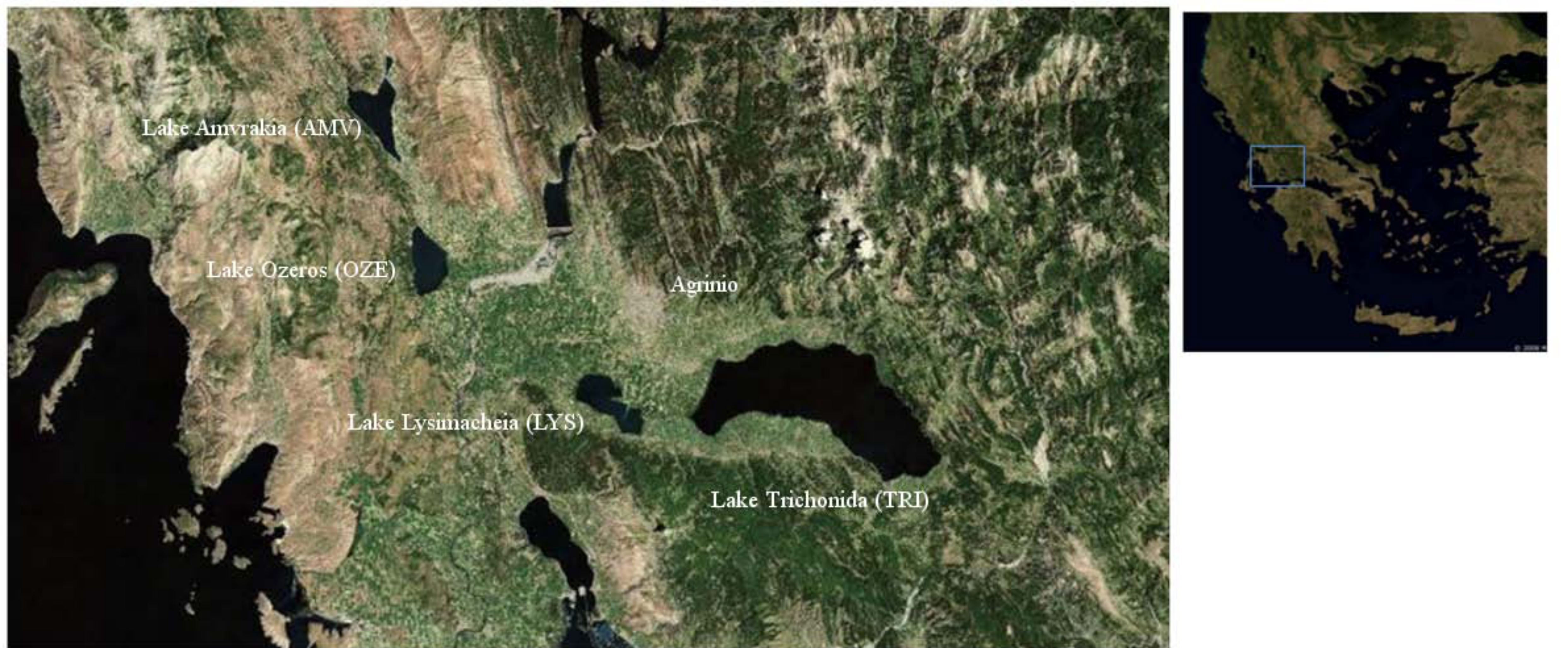
Figure 1 Map of Western Greece indicating Cyprinus carpio population sites that have been included in our analysis. The sites are: (a) Lake Amvrakia (AMV) (b) Lake Ozeros (OZE) (c) Lake Lysimacheia (LYS) and (d) Lake Trichonida (TRI).
Phylogenetic analysis was performed on mtDNA sequence haplotypes previously published sequences of D-loop region, from various strains of common carp shown in Table 1. The dataset was composed of partial D-loop sequences (573 bp) and included 6 haplotypes from Greece originating from 4 lakes in Western Greece (Figure 1), 39 representative partial sequences of common carp strains (30 from Eurasia and 9 from Japan) that have been previously published and cover a wide distribution area, and one outgroup (Carassius auratus langsdorfi: AB006953) (Table 1).
|
Table 1: Taxa of common carp used for comparison in this study, their sample code, source-origin and EMBL/GenBank accession numbers of partial D-loop gene. |
||||
|
Strains/Populations |
Code |
Country |
Accession No. |
References |
|
Xingguonensis |
XI |
China |
AY597942 |
[24] |
|
Qingtian carp |
QTC1 |
China |
AY347297 |
[28] |
|
Xingguo red carp |
XRC1 |
China |
AY345332 |
[28] |
|
Colour |
CL |
China |
AY597945 |
[28] |
|
Big belly carp |
BBC1 |
China |
AY347303 |
[28] |
|
Big belly carp |
BBC2 |
China |
AY347304 |
[28] |
|
Purse red carp |
PRC1 |
China |
AY347300 |
[28] |
|
Purse red carp |
PRC2 |
China |
AY347301 |
[28] |
|
Yuanjiang River |
SWC1 |
China |
AY347302 |
[28] |
|
Yuanjiang River |
SWC2 |
China |
AY345305 |
[28] |
|
Yangtze River |
YWC1 |
China |
AY345331 |
[28] |
|
Nasice |
NA |
Croatia |
AY597982 |
[28] |
|
German mirror carp |
GMC1 |
Germany |
AY345337 |
[3,28] |
|
Lake Amvrakia carp |
AMV2 |
Greece |
EU186836 |
[16] |
|
Lake Lysimacheia carp |
LYS2 |
Greece |
EU186837 |
[16] |
|
Lake Lysimacheia carp |
LYS3 |
Greece |
EU186841 |
[16] |
|
Lake Ozeros carp |
OZE2a |
Greece |
EU186838 |
[16] |
|
Lake Ozeros carp |
OZE2b |
Greece |
EU186839 |
[16] |
|
Lake Trichonida carp |
TRI2 |
Greece |
EU186840 |
[16] |
|
Hajduboszomeny |
HA |
Hungary |
AY597979 |
[24] |
|
Bradra River |
LB |
India |
AY597985 |
[24] |
|
Rajadanu |
RJ |
Indonesia |
AY597971 |
[24] |
|
Dor 70 |
D70 |
Israel |
AY597981 |
[24] |
|
Japanese food |
JF1 |
Japan |
AB307047 |
[15] |
|
Japanese native a1 |
JNA1 |
Japan |
AB307037 |
[15] |
|
Japanese native a2 |
JNA2 |
Japan |
AB307038 |
[15] |
|
Japanese native a12 |
JNA12 |
Japan |
AB307048 |
[15] |
|
Japanese non-native f1 |
JNNF1 |
Japan |
AB307063 |
[15] |
|
Japanese ornamental koi |
JKC1 |
Japan |
AY347298 |
[28] |
|
Lake Biwa wild common carp KPM/NSMT* |
LBW1 |
Japan |
AB158808 |
[13] |
|
Lake Biwa wild common carp KPM/NSMT* |
LBW2 |
Japan |
AB158809 |
[13] |
|
Lake Biwa wild common carp KPM/NSMT* |
LBW3 |
Japan |
AB158810 |
[13] |
|
Wild Amur River |
WA1 |
Russia |
AY597946 |
[24] |
|
Wild Amur River |
WA2 |
Russia |
AY597947 |
[24] |
|
Russian mirror carp |
RMC1 |
Russia |
AY345336 |
[3,28] |
|
Volga River |
VWC1 |
Russia |
AY345340 |
[3,28] |
|
Volga River |
VWC2 |
Russia |
AY345339 |
[3,28] |
|
Putative Taiwan |
TWN1 |
Taiwan |
X61010** |
[29] |
|
Taiwan |
TWN2 |
Taiwan |
AB308053 |
[15] |
|
Bac Kan |
BK1 |
Vietnam |
AY597956 |
[24] |
|
Lo River |
LR2 |
Vietnam |
AY597952 |
[24] |
|
Tuyen Quang |
TQ1 |
Vietnam |
AY597959 |
[24] |
|
Tuyen Quang |
TQ2 |
Vietnam |
AY597958 |
[24] |
|
Yen Bai |
YB2 |
Vietnam |
AY597960 |
[24] |
|
Son La |
SL2 |
Vietnam |
AY597964 |
[24] |
|
*KPM/NSMT: Kanagawa Prefectural Museum of Natural History; National Science Museum, Tokyo. **Complete mitochondrial genome. |
||||
Sequence of partial D-loop mtDNA gene was analyzed for genetic distances and character–based variations using MEGA 6.0 computer package and PAUP (version 4b10) respectively, as previously described by Tsipas et al. [16]. The obtained sequences were aligned using Clustal X (version 1.83), and phylogenetic distances were calculated according to Kimura [20] or/and Jukes and Cantor [21] methods. The resulting genetic distance comparisons and character based variations were used to construct phylogenetic trees using the ‘neighbor-joining’ and maximum parsimony approach, respectively. Phylogenetic confidence was estimated by bootstrapping of 10,000 replicate data sets [22]. In the phylogenetic analysis, all nucleotide sites and substitution classes were weighted equally. In all cases, trees were conducted with the inclusion of Carassius auratus langsdorf .
RESULTS AND DISCUSSION
Sequence divergence values in the D-loop fragment were between 0.00-0.18% among Greek Cyprinus carpio haplotypes forming two major groups. Members of the first group (GRE1) are AMV2, LYS2, LYS3, OZE2b, and TRI2 sharing the same haplotype while OZE2a is the only member of the second group (GRE2). The nucleotide divergence between Greek haplotypes and European haplotypes (GRE1 and RMC1), as well as among the Greek and Asian-Chinese (GRE2 and PRC) were lower than that among the Greek and Japanese haplotypes (GRE1 and LBW). The sequence analysis of D-loop provided further support for the Eurasian and Japanese strains (except nonnative populations JNNF1 and JKC1), as they are placed at the most basal positions in the reconstructed tree (Figure 2). Relationships among the Asian strains however, varied based on D-loop data. Zoogeographic units, such as the Chinese and Vietnamese were recognized as polyphyletic groups, while only the European strains formed a monophyletic clade supported by high bootstrap value in the analysis. The European clade, however, included some non European specimens, such as a wild Amur River (WA2), a non native Japanese (JNNF1) and a Vietnamese (SL2) specimen, while according to Hulata [23], the Israeli strain (D70) is a European strain. The remaining Russian haplotypes (RMC1 and WA1) together with Indian, Indonesian and Taiwanese strains were nested within the Southeast Asian unit (Figure 2). Our phylogenetic analysis demonstrated the close phylogenetic relationships between Greek (two haplotypes/ genotypes were detected among 45 sequences from the Greek lake populations) and European strains, while the Volga wild common carp (VWC1) seems to be a possible ancestor of European strains.
The analysis conducted confirmed the phylogenetic dichotomy between the native Japanese and Eurasian strains of common carp previously recognized by Mabuchi et al. [13,15]. Relationships among the Eurasian strains varied (Figure 2), with no zoogeographic unit formed as a monophyletic group with the Chinese, Vietnamese and non-native Japanese strains all being recognized as polyphyletic groups. These results are expected because of wide-scale translocations/stockings and /or incomplete sorting of mtDNA lineages in the common ancestor of the strains [11,15]. The European and native Japanese haplotypes constitute monophyletic groups with well-supported bootstrap values. For native Japanese strains, given their monophyly the 7 related haplotypes were thought to originate from the (LBW3) Japanese native strain as it has been previously indicated by Mabuchi et al., [15]. The European clade was nested within the large clade that comprised East and South East Asian strains as well. This analysis supports the Asian origin of the European strains as indicated by other researchers [10,13,15].
Haplotypes in the European group including the Greek populations were similar to one another with moderate nucleotide divergence. Their closest relative was the Greek Ozeros Lake (OZE2a) and the Volga wild common carp (VWC1) (Figure 2). The European clade, however includes some nonEuropean specimens, such as the wild Amur River (WA2), the Vietnamese (SL2), the Japanese (JNNF1) specimens. According to Hulata [23], Israel D70 strain is a European strain and as stated by Thai et al., [24] the presence of Amur River wild haplotype in European group might be due to accidental stock mixing in captivity. Because some European strains such as Hungarian and Czechoslovakian carp, have been introduced into Vietnam, and used in research programs on hybridization and selection [25], the Vietnamese specimen (SL2) might be the introduced carp and/or hybridized carp that had acquired the European haplotype through crossbreeding. Regarding the Japanese common carp (JNNF1 and JKC1) it consists non-native strains since they did not form a monophyletic group, being distributed polyphyletically into two clades in Eurasian region, which reflects their multiple origins from Eurasian common carp. Indeed, around 1904, the domesticated mirror carp imported into Japan from Germany, was included in the breeding of the Japanese ornamental carp. Furthermore, the JKC1 strain shared haplotypes with four Chinese (XI, QTC1, XRC1, YWC1) and one Russian (RMC1) strains (Figure 2), clearly originated from a Chinese strain, as also indicated by Froufe et al., [10].
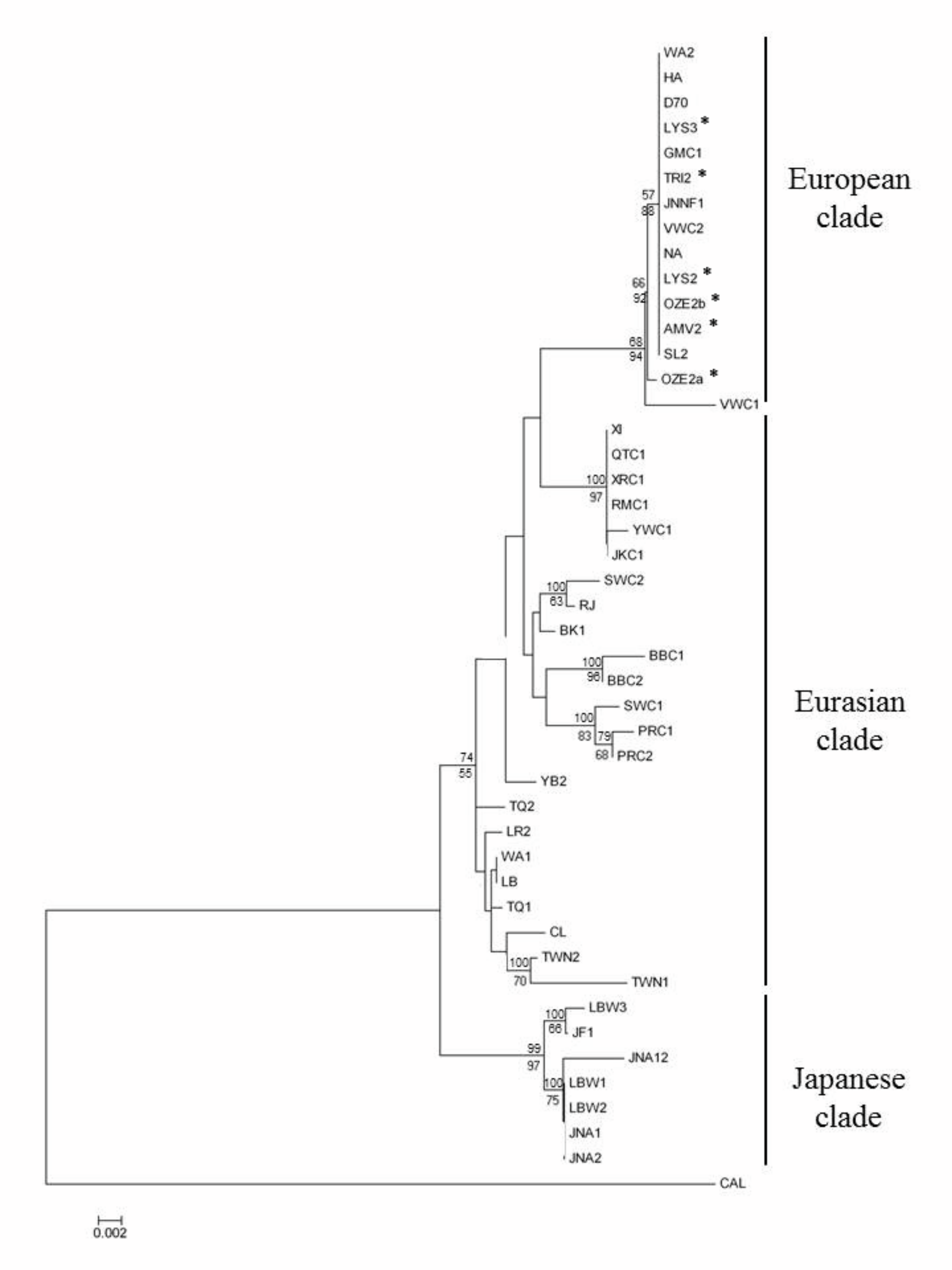
Figure 2 Neighbor-joining phylograms showing the phylogenetic relations of haplotypes detected in Cyprinus carpio based on composite sequences from mtDNA D-loop gene (573 bp) including 6 haplotypes from Greek strains and 39 previously published sequences from Eurasia and Japan. Carassius auratus langsdorfi (CAL) (GenBank: AB006953) sequence was used as outgroup D-loop data. The numbers at each node represent bootstrap proportions based on 10,000 replications for both the NJ (above branch) and the maximum-parsimony (below branch) analysis. Abbreviations code as in Table 1.
CONCLUSION
Although, Cyprinus carpio is considered to be native in Greece, wild populations are still found in confined areas of Thrace, northern Anatolia and possibly in eastern parts of Greece, several introductions and translocations have been made in many natural lakes, reservoirs and rivers [26]. Some species such as Cyprinus carpio, Silurus glanis, Oncorhynchus mykiss and other salmonids have become fully acclimatized and have built up important populations [17,27]. In other cases, the transfer of fish during stocking have had considerably negative impacts, as in the case of the Cyprinus carpio strain with heavier ovaries and testis versus the native carp, in Japan [28]. Indeed, fingerlings from Italy (var. specularis) were initially introduced in Greece before the 1940s and other transfers have been reported from the 1950s to the 1990s, including those from Israel and Hungary [29]. Although, it is almost impossible to be certain where wild, introduced or mixed populations are living, according to our analysis, Greek haplotypes, except OZE2a, were identical to Hungarian (HA) and Israel (D70). Thus, these haplotypes are considered to have originated from Europe, while the OZE2a haplotype seems to be a closely ancestor of the European clade.
Greek Cyprinus carpio samples exhibited low genetic variability (0.00-0.03%) for D-loop region among and within populations [16]. In order to maintain the genetic diversity of Greek strains, as they have long domestic history, they were widely cultivated and were used in fish genetic breeding, it is important to conserve this species. Even if hybridization has not occurred due to the large-scale introduction, the non-native strains may compete ecologically with the native populations. For this reason, nuclear genetic marker analysis are required to elucidate hybridization and ecological interactions between the native and introduced carp, based on the present results, in order to make an effective conservation plan.
REFERENCES
- Wohlfarth G. Common carp. In: Evolution of Domesticated Animals. Masson IL, editor. Longman, Harlow. 1984; 375-380.
- Barus V, Penaz M, Kohlmann K. Cyprinus carpio (Linnaeus, 1758). In: The Freshwater Fishes of Europe. Banarescu PM, Paepke IJ, eds. Vol.5 III. Academic Press, London. 2001; 85-179.
- Zhou JF, Wu QJ, Ye YZ, Tong JG. Genetic divergence between Cyprinus carpio carpio and Cyprinus carpio haematopterus as assessed by mitrochondrial DNA analysis, with emphasis on origin of European domestic carp. Genetica. 2003; 119: 93-97.
- Imsiridou A, Triantafyllidis A, Baxevanis DA, Triantaphyllidis C. Genetic characterization of common carp (Cyprinus carpio L.) populations from Greece using mitochondrial DNA sequences. Biologia. 2009; 64: 781-785.
- Vooren GM. Ecological aspects of the introduction of fish species into natural natural habitats in Europe, with special reference to the Netherlands. J of Fish Biol. 1972; 4: 465-583.
- Kirpichnikov VS. Genetic bases of fish selection. Translated by Gause GG. Springer -Verlag, Berlin. 1981; 1-410.
- Wang C, Liu H, Lou Z, Wang J, Zou J, Li X. Mitochondrial genetic diversity and gene flow of common carp from main river drainages in China. 2010; 55: 1905-1915.
- Zhu J, Zhong LQ, Zhang CF, Liu H, Li B. Sequence variation and secondary structure analysis of the first ribosomal internal transcribed spacer (ITS-1) between Cyprinus carpio carpio and Cyprinus Carpio haematopterus. Biochem Genet. 2011; 49: 20-24.
- Kohlmann K, Kersten P. Deeper insight into the origin and spread of European Common carp (Cyprinus carpio) based on mitochondrial D-loop sequence polymorphisms. Aquaculture. 2013; 376-379: 97-104.
- Froufe E, Magyary I, Lehoeczky I, Weiss S. MtDNA sequence data supports an Asian ancestry and single introduction of the common carp into the Danube Basin. J of Fish Biol. 2002; 61: 301-304.
- Nakajima T. Common carp as an introduced fish. In: Alien Species: Their biology, impact and control. Nakai K, Nakajima T, Rossiter A, eds. Lake Biwa Museum, Kusatsu, Japan. 2003; 86-87.
- Nishino M, Watanabe NC. Evolution and endemism in Lake Biwa, with special reference to its gastropod mollusk fauna. In: Ancient Lakes: Biodiversity, ecology and evolution. Rossiter A, Watanabe H. eds. Academic Press, London. 2000; 151-180.
- Mabuchi K, Senou H, Suzuki T, Nishida M. Discovery of an ancient lineage of Cyprinus carpio from Lake Biwa, central Japan, based on mtDNA sequence data with reference to possible multiple origins of koi. J of Fish Biol. 2005; 66:1516-1528.
- Avise JC. Molecular Markers, Natural History and Evolution, 2nd ed. Sinauer Associates Inc. Publisher, Sundeland. 2004.
- Mabuchi K, Senou H, Nishida M. Mitochondrial DNA analysis reveals cryptic large-scale invasion of non-native genotypes of common carp (Cyprinus carpio) in Japan. Mol Ecol. 2008; 17: 796-809.
- Tsipas G, Tsiamis G, Vidalis K, Bourtzis K. Genetic differentiation among Greek lake populations of Carassius gibelio and Cyprinus carpio carpio. Genetica. 2009; 136: 491-500.
- Sabatini A, Cannas R, Follesa MC, Palmas F, Manunza A, Matta G, et al. Genetic characterization and artificial reproduction attempt of endemic Sardinian trout Salm trutta L., 1758 (Salmonidae): Experiences in captivity. Ital J of Zool. 2011; 78: 20-26.
- Cheng YZ, Jin XX, Shi G, Wang RX, Xu TJ. Genetic diversity and population structure of miiuy croaker populations in East China Sea revealed by the mitochondrial DNA control region sequence. Bioch Syst Ecol. 2011; 39: 718-724.
- Elisabeth W, Gerhard S, Grit M, Haryanti, Ketut S, Hans PS. Paralogous mitochondrial control region in the giant tiger shrimp, Penaeus monodon (F.) affects population genetics inference: A cautionary tale. Mol Phyl Evol. 2011; 58: 404-408.
- Kimura M. A simple method for estimating evolutionary rate of base substitutions through comparative studies of nucleotide sequences. J of Mol Evol. 1980; 16: 111-120.
- Jukes TH, Cantor CR. Evolution o f protein molecules. In: Mammalian Protein Metabolism. Munro HN, editor. Academic Press, New York. 1969; 21-132.
- Saitou N, Nei M. The neighbor-joining method: a new method for reconstructing phylogenetic trees. Mol Biol Evol. 1987; 4: 406-425.
- Hulata G. A review of genetic improvement of the common carp (Cyprinus carpio L) and other cyprinids by crossbreeding, hybridization and selection. Aquaculture. 1995; 129: 143-155.
- Thai BT, Buriridge CP, Pham TA, Austin CM. Using mitochondrial nucleotide sequences to investigate diversity and genealogical relationships within common carp (Cyprinus carpio L.). Animal Genetics. 2005; 36: 23-28.
- Thien TM, Trong TD. Genetic resources of common carp in Vietnam. Aquaculture. 1995; 129: 216.
- Vilizzi L. The common carp, Cyprinus carpio, in the Mediterranean region: origin distribution, economic benefits, impacts and management. Fish Manag and Ecol. 2012; 19: 93-100.
- Economidis PS, Dimitriou E, Pagoni R, Michaloudi E, Natsis L. Introduced and translocated fish species in the inland waters of Greece. Fish Manag and Ecol. 2000; 7: 239-250.
- Zhou JF, Wu QJ, Ye YZ. Molecular phylogeny of three subspecies of common carp Cyprinus carpio, based on sequence analysis, of cytochrome b and control region of mtDNA. J of Zool Syst and Evol Res. 2004; 42: 266-269.
- Chang YS, Huang FL, Lo TB. The complete nucleotide sequence and gene organization of carp (Cyprinus carpio) mitochondrial genome. J of Mol Evol. 1994; 38: 138-155.