Towards Positive Welfare for Equines. Sentient Equine Mental Attributes, Moral Agency and Duties; A Summary
- 1. Centre for Eco Etho Research & Education, UK
Abstract
One hundred and sixteen million equines are in contact with humans today and contribute to the flourishing or demise of our planet. The implications of the mental attributes attached to sentience are reviewed in the light of equine welfare and their environmental effects. A detailed assessment of sentient equines mental aptitudes points out that several mental aptitudes that have previously been considered unique to humans are present in equines. Several of these are discussed, including social contracts, moral agency, collective intentionality, and desire independent rea-son with examples from human equine interactions. As a consequence of these mental attributes, our mutual moral obligations are pointed out. An increase in the under-standing of equine ontology (their world view), can help humans delineate positive welfare in their husbandry, work and interactions with humans, but it will need humans to emerge from many traditional beliefs and practices.
Simple summary
More than 100 million equines are in contact with humans in the world all of whom contribute to the flourishing or demise of our planet. Equines are recognize at sentient but the mental attributes attached to sentience are not always recognized. They are explained and summarized here but they include some that are considered unique to humans (e.g. self-consciousness, social contracts, theory of mind, moral agency, collective intentionality, and desire independent reason). The implications of recognizing sentience for the moral obligations that both human and equines have to each other are outlined. As a result of this, their ontology (what it is to be) can be integrated into their husbandy and teaching, this is “positive welfare”. An example of a stud which has experimented with fulfilling these obligations is given. It is possible for humans to be morally justified in keeping working and interacting with equines provided changes are made to their husbandry to increase their autonomy, and training is cooperative. Only in this way will positive equine welfare and a flourishing living world be achieved.
Keywords
• Equine behaviour and mental attributes; Moral agency; Sentience; Positive welfare
Citation
Kiley-Worthington M (2026) Towards Positive Welfare for Equines. Sentient Equine Mental Attributes, Moral Agency and Duties; A Summary. JSM Brain Sci 6(1): 1025.
INTRODUCTION
Today, bio-abundance and bio-diversity are decreasing rapidly as a result of human activities. For longer term human survival, moral considerations must be ex-tended to the planet and all living things [1]. There are 116 million equines in contact with humans today (Google AI) who contribute to the planets survival or its demise depending on how, why, and in what numbers they live. This paper is concerned with an understanding of what the attribution of other mental abilities attached to sentience means of concerning equines mental aptitudes, one of which is that they are moral agency, and the accompanying mutual obligations.
It is widely recognised that humans have moral obligations to equines. “Moral consideration” is a phrase frequently used [2], although what the moral judgements should be is unclear, although it is agreed that humans should not cause “unnecessarily” suffering, or treat equines “cruelly” [3]. But, when there is a conflict of interests, it is often human interests (economic, social, political, food, companionship or therapy) that trump even life threatening interests of equines [4]. Questionnaires assessing what humans think about equine welfare resulting in a “social license to operate” [5] reflects current human views about equine welfare, but not the horses’. “Positive equine welfare” must refer to the equines concerns rights, and interests which comprise their ontology [6].
The key role that veterinarians play in making judgements on equine welfare sometimes prevents the further development towards positive equine welfare because their training takes into account human interests (e.g. will the treatment be paid for; is the horse insured and economically replaceable?), or is restricted to the physical needs of an individual equine. Veterinarians are generally not trained in environmental concerns, for example, they frequently prescribe ivomectine and other dugs that kill a wide variety of invertebrates when in the faeces and have caused a 30% reduction in invertebrate populations, and the extinction of some dung beetles [7,8]. Also, veterinarians have little training in equine behaviour problems and prescribe drugs (e.g. tranquillisers, sedatives) or surgery (e.g. castration, or cutting muscles in the neck to reduce stereotypies) to control “misbehaviours”, rather than investigating their cause. Some veterinarians also, alas, contribute to administering drugs, surgery and analgesics to equines suffering throughout their lives because their husbandry can only operate with veterinary intervention (e.g. pregnant mares kept in stalls for years with catheters attached to produce progesterone which is harvested for human contraceptives [9,10].
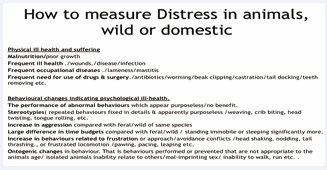
Sentience, that is feelings are involved in all aspects of human and equine life whether it is physical (their bodies), social life or their cognitive/intellectual lives. Failure to provide for these needs results in suffering [11-13].
Measuring equine suffering
Some behaviours which indicate suffering, distress and pain are evident (e.g. screaming and struggling, shivering etc) but some are not (e.g. prolonged periods standing immobile, sleeping or increase in aggression), but we now know when equines are suffering using both behavioural [14,15], and physiological measures (Table 1 after [11].
Table 1: Suffering and Distress in Equines.
|
Performance abnormal behaviour showing no direct benefit |
|
Physical Ill health |
|
Mal nutrition, poor growth, too fat or too thin |
|
Frequent sufferingly illhealth, diseases, wounds, infection |
|
Frequent occupational problems e.g lameness, fatigue, lack of motivation |
|
Frequent need for drugs or surgery to control diseases or infection and parasites |
|
|
|
Behavioural Changes indicating psychological ill health |
|
Stereotypies ( repeated actions in the same form & apparently purposeless ) |
|
High levels of aggression compared to free animals |
|
Large changes in time budgets from wild or feral members of the same species |
|
Increase in behaviours related to frustration, often involved with frustrated locomotion, or irritation |
|
Ontogenic changes, performing behaviours not characteristic of that age group, |
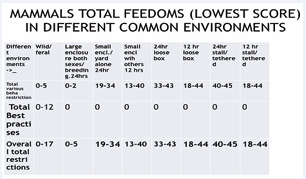
Positive welfare, that is when equines have a “good life”, was originally delineated by the “5 freedoms”[12]; more recently elaborated to the “5 domains`’ [13] and now “teleonome”, has been proposed [14]. These approaches are commendable but not straightforward to apply in practice. A simple way to compare freedoms that is the amount of autonomy in different environments is indicated by the absence of freedoms, that is measuring behavioural restraints [6].
Today, the mental aptitudes attached to sentience has demanded a further for-ward stride using simple rational arguments rather than “opinions” or collective beliefs.
“A rational argument is a structured exchange of reasons, evidence, and logical premises designed to support a conclusion and persuade an audience, rather than relying on emotion or mere assertion. It seeks to find the best possible answer or decision through logical validity,” (Google AI).
The reasons why sentient equines have many other mental attributes are as follows (those **have been previously considered unique to humans).
1) Sentient mammals, including humans and equines try to avoid negative feelings such as pain, fear, terror, panic, anxiety and prolonged frustration [15].
2) All sentient mammals including equines learn to perform voluntary actions [16-18].
3) Voluntary learning requires a “feeling” called motivation which drives a behaviour towards a goal. No mammal learns a voluntary action without this feeling.
4) **As a result of learning, all sentient equines acquire information which is knowledge and understanding about their social and ecological environment
5) **Because they learn, equines acquire beliefs, that is, they believe that: - “if this happens, then that will follow,” but because it is a belief, it can be changed and modified.
6) Learning requires memory without a memory no voluntary action will be learnt.
7) **Sentient mammals have a form of Imagination because memories change, are added to or recombine in different ways, creating an “imaginative truth” for each individual [6].
8) **Normal alive equines, when awake, are conscious of the world around them, aware of being in it and react to it [19,20].
9) **Equines must be conscious of themselves that is “self-conscious” since they are aware of the pain, that is a feeling, and where it is in their own body. Whether they reflect about themselves as some humans do is unknown [21].
10) Learning, conscious beings have some common experiences and feeling, so guesstimates can be made about another’s feelings. However, we can never know exactly what another feels, even of our own species, because experiences are also private and personal [22].
11) Every equine has a unique personality. Each of our combined body/brain “beings” is the result of the species, the individual’s genetic components and his/ her personal knowledge, experiences and beliefs which constitutes their subjectivity. The scientific validity of subjective concepts in models of animal welfare [23].
12) **Sentient learning mammals are rational [24]. When any mammal performs a voluntary act, a rational decision has to be made: IF this then THAT follows using memories from previous experience.
13) **Sentient mammals therefore “consider” and make “judgements”, and can be “uncertain” of the outcome when they make decisions and choices although what and how they “consider” and make “judgements” may be different from how a human does this.
14) **Sentient mammals make plans, that is they have some idea of the future. They can predict because they know what happened in the passed in that situation from their memories [25].
15) **Thinking is combining different knowledge, beliefs, emotions, experiences and sensory abilities. Every sentient equine “thinks” even though we do not know exactly what they think about [26]. Because thinking is linked to subjectivity, although not just to human language. For example, equines are very visual aware so likely to prioritise visual information, [6.16]. Whereas humans prioritise verbal language and are often less aware of their surroundings [6].
16) ** Each individual mammal, if she/he spends enough time with another of her own or another species, will gain experiences, knowledge and understanding from the other and might change some of his/her feelings, thoughts and behaviours. (e.g. untouched wild equines behaviour differently to humans than those who have been raised among humans).
17) **Sentient adult equines and humans recognise the difference between an animate and an inanimate object because animate beings respond.
18) The social mental attributes attached to sentience are:-
a) To live in a group sentient mammals must have a social contract. The social contract is defined by rules [27], which are learnt and vary according to 1) the species, and 2) the environment. Each individual that learns the rules becomes a natural psychologist by acquiring information about others (e.g. their sex, age, personality, role in the group), but, to acquire accurate information, they must learn who to learn from, learning from a foal who knows little, for example, would be unwise [28].
b) Differences between groups in different environments, result in varied cultures [29-31], which can be displayed in different stable yards.
c) **Social mammals are aware of others’ intentions because they communicate. If they are aware of intentions of others, they then have a “theory of mind” [32,33], that is: they recognise that others have feelings and intentions and a mind to have them with.
d) “Pretending” is a complex moulding and mixing of mental aptitudes For example, social play is engaged in by all mammals, particularly young ones because it is enjoyed [34-37], but there are rules, When playing there must be no hurting. If an individual hurts another, then it is no longer play, it could turn into aggression.
e) Individual and collective beliefs. Every mammal has his/her own individual beliefs, memories, experiences and world awareness some of which are shared by other conspecifics and related species but they are also private.
In humans, collective beliefs are usually the result of being told in humans’ context independent language [38], so not learnt by experience. In non-human mammals, collective beliefs are generally the result of experiences. and/or social learning.
f) **Living in a communicating group and knowing the social rules, signifies that moral agency because the individual can choose to do right by obeying the rule of the social contract, or wrong by disobeying it.
A moral agent is:-
“an individual’s capability to make ethical choices, distinguishing between right and wrong, and to be held accountable for those actions. It involves autonomy, self regulation, ….” (Google AI)
The mental attributes marked **have been considered unique to humans until recently when apes and primates joined the “meta-cognitive” club, even though all sentient mammals are qualified. This does not imply that any mammal is exactly like a human because each species also has it unique exceptionalism. But, when there is a conflict of interests, it can no longer be assumed that human interests trump those of sentient equines, rather, their different interests should be balanced against each other and those of the environment.
Human opinion “what is best for the equine” is often circumscribed by human collective beliefs (what humans have been told); lack of knowledge of what sentience must involve and ignorance of equine species and individual ontology, that is “what it is to be that equine”.
One of the factors masking an understanding of equine ontology is that it is still widely believed that their behaviour is predominantly controlled “by instinct” rather than them being active decision makers.
WHY EQUINES ARE MORAL AGENCY
The definition of an agent currently in use is:-
“a person or thing that takes an active role or produces a specified effect” ( Google AI)..
That equines qualify as agents is generally recognised [39,6] although this is a change from the beliefs of previous scientists [40].
A more detailed definition of a Moral Agent is:-
A moral agent is an entity,…. with full mental capacity, capable of understanding right from wrong, exercising free will, and being held morally accountable for their actions. They possess the capacity for rational deliberation and the responsibility to avoid causing unjustified harm [41].
We examine if sentient equines have these mental aptitudes by assessment and critically assessed examples.
Equines have “full mental capacity, capable of understanding right from wrong”
Equines have a social rule not to bite or attack another (usually a juvenile) who approaches an adult, usually “champing” the mouth, and can then he can nuzzle, touch, nip and rub the other.
Example1: Shatish (part bred Arab gelding aged 14 has learnt this rule. But he is annoyed by 2 month filly Shelagh, who continues biting and nibbling him, so he, mildly nips her back. She leaps away. Her mother rushes to kick Shatish and the two mares (her mother and Lilka) chase him out of the barn where there is hay and shelter.
In this case Shatish’s annoyance overcame his reason; he knew he should not hurt a foal, the social contract, but he did, and was “punished” by being kicked out of the group.
Social rules with humans generally involve not biting them when they touch, groom etc.
Example 2: The mare is being groomed but has learnt the rule that she must not bite the groomer, even though she dislikes what he is doing because the brush prickles her. She turns her head with ears flattened back several times to the groomer, threatening to bite her (pointing out she dislikes it). She could bite her, but knows that she must not. She obeyed the social rule, but continues to threaten the groomer. The groomer ignores her behaviour and continues brushing with this irritating brush. When the groomer changes to a soft brush or strokes her with her hand, she stops threatening to bite her.
Equines “exercise free will”, that is they can make choices and decisions which they do, except when they are so physically or chemically restricted or immobilised it is impossible.
Example 1: The group of 4 equines know that in the evening, if they descent to the barn, they will be given a feed. But they do not always come. If the weather is fine, they may choose to stay out and miss their feeds indicating free will.
Example 2: Shatish is chased and attacked by the stallion when they are both with the mares. They are therefore in adjacent fields but the stallion breaks the gate choosing and making an effort to join the mares. Shatish decides to run away from the group, knowing the consequence that if he does , he is less likely to be attacked by the stallion; he retreats to where he can see but also escape should the stallion come towards him.
Equines once they know the social contract, become “accountable for their actions”
Accountable for their actions means that they know what they have done and whether this breaks the social contract.
Example 1: After biting the foal, Shatish was not allowed into the barn for some days, he was attacked if he tried to enter. He must have known that this was the result of his previous behaviour when he was thrown out, so he was aware of his actions and accountable for them. Eventually, he was allowed in, the others had either forgotten or “forgiven” him for disobeying the social contract, or both. Thereafter however, Shatish was more careful and tolerant of the foal’s behaviour. Two months later, they developed a strong relationship and the foal will sometimes follow him rather than his mother.
Example 2: The mare being groomed bites the groomer, but she knows she will be punished by the groomer because she has broken the human/horse social con tract she has learnt. So she leaps away from the groomer before the groomer responds, and pulls back at the tie to try and get away. By predicting the groomers behaviour to “punish” her for breaking the social contract, she shows she is aware she knew the consequences, thus accountable for her action. But the groomer was also breaking the rule of their mutual social contract which is not to irritate or annoy her unnecessarily, but did not, apparently, know it!
Equines show the capacity to “rationally deliberate to avoid causing unjustified harm to other sentient beings”,
Example: A small child of 3 years old finds her way into the barn where the equines are freely moving around and eating hay. She is unfamiliar with equines but curious; she stumbles up to Lilka and falls between her front legs. Lilka remains still until the child rights herself and staggers off when Lilka moves again,… she knew she must not move when the child was at risk from being stepped on by her so did some sort of rational deliberation how not to harm her. This recently also occurred when a one month old 2 kg puppy snuggled down in some dry hay to sleep between the legs Shakti while the mare was eating hay, she avoided touching or treading on him, although he was in the way of the feeder.
The subjects were “thinking” in this case something like: “if I am not careful where I tread, I will hurt this small creature.”These are anecdotal accounts but they are not unique or rare, as any observant horse handler knows. In fact such mental attributes are taken for granted by most experienced handlers. Rational alternative explanations must be found before they can be dismissed.
Human language is often considered necessary for moral agency but in the light of the recognition of sentience in non humans, this is false since equines have all the identified mental attributes necessary for moral agency.
Moral agency has also been linked to self-awareness by declaring only those who have “secondary emotions” can be moral agents. Secondary emotions involve some form of self-awareness and include jealousy, embarrassment, sympathy, compassion, shame and guilt [42]. Since equines must be self-aware (see 9 above), whether these emotions are unique to humans is questionable, although they may not be displayed in the same way. Identifying them in equines is a task for the future but, evidence of “secondary emotions” is not pivotal for identifying moral agency.
More important is having autonomy that is having freedoms to make decisions and choices which have also been linked to moral agency [43]. Any equine who is not so physically restricted that he cannot make a choice (e.g tied up for long periods, or fitted with physical restrictions (e.g. bits, martingales, tight nosebands, curb chains, etc) is constantly making decisions and choices of what to do and what he can do, as any horse person knows, just as slaves did even though they often had little autonomy [44].
Societies, Social Contracts and Moral Agency.
A sentient mammal is from birth social as she/he must be cared for by a mother. As foals grow up, provided they have the option, they learn the social contract and become integrated into a society, which is defined by its rules [27], and develop their own social role within it [28]. The social rules defining the social contract common in equine societies include- “don’t hurt foals”, “don’t step on another lying down”, “observe and learn from others how to behave”, “learn who to learn from”, “learn the roles of others”, “learn to court mares, not rape them” .
Social contract rules can also be developed when associating with another species, humans for example:- “don’t kick, bite, stamp on, push or hurt a human” “ do what the human asks, provided it is reasonable”, “tolerate humans lack of responses to equine messages”.
Frequently, humans lack perception concerning equines emotions so they may put in place rules that cause distress and suffering to equines without knowing it.They also may not understand how quick the equine is to learn and understand (1x learning is not uncommon). The result is that often human trainers teach the equine to do inappropriate things, without knowing that they taught him to do it.
Example the young horse leaps about when taken out of the stable because 1) he is energetic (often over fed and under exercised) 2) released from a “prison”, 3) in an unfamiliar place and slightly scared. Because the human leaders are frightened that they might get hurt or he might break away, they return him to the stable. He has learnt in one trial, that to avoid going out into a slightly scary unfamiliar place, all he needs to do is leap about. In this case the leaders should have predicted this, had longer lead lines so that their fear was reduced, and taken the horse slowly to some-where where he could be lunged or free schooled until he lost some of his energy and relaxed.
It is also maintained that “animals” cannot be held responsible for violating “behavioural norms” [45], otherwise called “instinctive tendencies”. But, because they are agents, they can make choices even though there may have species “instinctive tendencies” to behave in particular ways (e.g. equines have an instinctive tendency to associate in one male groups), but, whether these are practised or not, depends on their life time experiences and circumstances.
Example: The Metropolitan police whose horses are stalled in London eating hay throughout the year, send some of horses to Wales to live in a paddock, associate in a group and eat grass for a “summer holiday” each year. When they lodged on a small farm in Wales in 1995, the owner noticed that 2 of the 8 horses in the field, stood with their heads pointing into a corner of the field all day long. Although they had a “instinct tendency” or “behavioural norm” to eat grass and socialise with other horses, they were in such an unfamiliar environment that these “instinctive tendencies” or “behavioural norms” no longer applied. Thus, moral agents, in addition to having species “instinctive tendencies”, can also learn different physical and social behaviours.
But the possession of moral agency indicates that the individual knows when she/he has received “justice”: that is, the expected response to their action even when there are few behavioural options.
Different Cultures in human / equine interactions.
A culture is defined as:-
“The shared set of beliefs, behaviors, customs, values,…that characterise a group, society, or organisation (Google AI).
Since social contracts vary according to the environment, the species and individuals involved, different groups of the same or different species have divergent “cultures”[29-31]. These common ways of behaving with a particular stable yard are evident because they are run in diverse ways. For example, horses in one stable may be relaxed and easy to handle whereas, in another of the same race, they are up tight and over-reactive and have a different “culture”. Many observant veterinarians or farriers who visit a variety of yards know this.
EQUINE NEEDS
Some of The physical, social, emotional and cognitive needs of humans and equines are the same [33,39], but superimposed on these are species differences because of their different bodies and social, emotional and cognitive lives. Positive welfare, and the fulfilling of an easy going social contract between human and equine depends on most of these needs being fulfilled.
Example. Simple behavioural need. Equines need to eat for between 12 to 16 hours per day. If their food is rationed so they do not have ad lib access to high fiber food, although they may have the appropriate diet for the work they do, they will be “hungry”much of the time. This dissatisfaction causes frustration, over reactivity and distress [6].
There are accounts of the physical, social and emotional needs of equines [39], but they also have cognitive needs which include having enough intellectual stimulation [6].
Desire independent reason, and Re-directing attention.
Desire independent reason is considered unique to humans because it is believed:- 1) that non humans are not rational and 2) it requires human language [46,47]. However, there are many cases in mammals indicating this is false.
Example 1: The mare dislikes the ways she is being brushed because the brush prickles her. She turns her head with ears half back to indicate to the groomer that she dislikes it, the groomer ignores this, and continues brushing .The mare desires this to stop, but knows that she must not bite the groomer as it is a rule of the social contract, so she threatens again with her ears flat back, and moves around. She is showing “desire independent reason” even though the groomer does not understand her desire to stop the grooming, the mare reasons she must not bite the groomer although she desires to.
Example 2: A feral stallion wishes to mate with a mare who is in season, He knows the social contract for mating (although few domestic stallions are permitted to learn this). He knows that if he does what he desires, that is rush up and mate her, she will kick him and leap away. Therefore he exercises “desire independent reason” by approaching carefully, smelling her, and touches and licks her front legs and other pasts of her body. He is using “independent reason” to control his desire to immediately mate with her.
Re-directing attention can be a way to deflect a desire and avoid acting on a desire which will cause social disruption because it is against the social contract. The subject invents ways of redirecting (or pretending to) his own and /or others’ attention, thereby defusing an inflammatory situation.
Example 3: Two stallions both of whom have lived with the same mares at different times will fight each other if they are loose within sight of a familiar mare. When ridden together, they behave with caution to each other. If they see a familiar mare or come within a few meters of her, the desire to attack and chase the other stallion could overcome the social contract with their rider. When riding out with two stallions and a familiar mare, both stallions can developed a way around having to attack each other and suffer the consequences of disobeying the social contract with the humans. One of the stallions, turns his head away and pricks his ears “as if” he had seen something particularly interesting in another direction. This attracts the attention of the other stallion who looks in the same direction away from the mare. To do this, the stallion “reasoned” something like he would like to attack the other stallion, but if he did, there would be unpleasant repercussions from the rider. By “inventing” a way of switching attention, both horses changed their focus/attention to avoid following their primary desire. This a not uncommon way of resolving conflict in many mammalian societies including human [48], which allows the continuation of the status quo avoiding causing or receiving injuries . As well as redirecting the attention of other equines, equines can also use it to re-direct attention of their riders and other humans, and equine trainers and veterinarians use it to redirect the attention of the horse [6,49].
COLLECTIVE INTENTIONALITY
This is when at least 2 individuals take part in a joint activity,
``’Collective intentionality implies that when two or more individuals under-take a task together, they are aware of their intentions” (Google AI).
The classic example in humans is playing different instruments in an orchestra, or in animals, lionesses hunting. The individuals may do the same or different things but they are aiming to achieve a common goal [46].
Shared intentionality has also been called “social facilitation” which has been argued as not involving [50]. This is false, because even if it is facilitated by others doing an action, each individual still has to make a choice, to do it or not, so it is done with intent.
Any form of collective intentionality requires mental action whether this is eating, escaping, playing, racing, or even, just sitting or lying down because others are. Examples include the performance of a crowd of humans entering a room with chairs and sitting down when one sits, or several horses lying down when one has lain down. These are activities motivated by a desire to achieve the same goal.
Collective intentionality also occurs between species. Demonstrations of human horse collective intentionality are when the animal voluntarily does something with the human, without physical or chemical restrictions forcing him/her to do it. Humans use a host of physical restrains including ropes, chains, bridles, bits and restrictive harnesses to coerce the equine physically to doing what is required and to reduce his/her choices. These restriction are so common that most horsemen believe that an equine will only do what is required by being coerced. Coercion of equines with the use of physical restraints is beginning to be recognised and there are now competitions in UK , Holland and US where horses compete without bridles, but with a few exceptions animal training has not evolved into “ animal education”, where both gain:
“Education serves a dual purpose, benefiting both the individual and society (human or otherwise). While it empowers the educated with personal growth (and) critical thinking,…. [51] (my italics).
Cooperative teaching or “equine education” is modelled on how gifted pre-verbal infants learn [52,44], where physical restraints are reduced or absent, and no chemical restraints used. Historically, the European school of equitation understood centuries ago that there should be voluntary participation of the horse rather than physical restrictions. (e.g. Le Cadre Noire in France, Spanish Riding School in Vienna [53], although this is not always practised.
A characteristic of feral and domestic equines is that frequently provided they are cooperatively taught and understand what is required, they are enthusiastic to work with humans even though they have the size and strength not to. This should be further encouraged in equine education.
Example 1: Shemal, a yearling filly, is taken for a walk on the lead in our experiments to teach her to comprehend words. She is asked verbally and with gestures to look at, touch and smell an unfamiliar table. She follows the human teacher to the table, hears her verbalising “table”, watches her touching and rubbing the top with her hand. Shemal then imitates this by rests her nose, smelling and touching the table and in this way, learns to associate it with the word “table”.
Example 2: During teaching sessions when the teacher verbally asked the horse to lift her right or left leg, within 6 sessions (the behaviour of the equines and the teacher were recorded), it was found that the equine frequently imitated the teacher’s action.
Implications of imitating are that the subject voluntarily partakes of the action, demonstrating collective intentionality, but also makes an association between the part of the body used by the teacher and his own [6].
COOPERATION, TRUST AND CONFIDENCE IN HUMANS
Through history there have been difficult situations where equines overcome their fear and show cooperation, trust and confidence in humans [54].
The meaning of Trust used here is :-
“reliance on the character, ability, strength, or truth of someone or something and/ or having confidence in them. It also involves the ability to predict an acceptable outcome.” AI Google.
Examples of Horse/human trust
1) Several horses who worked for armies have been decorated for their courage and trust in transporting goods in war zones, sometimes unsupervised by humans,( e.g. US army horse from Korean War decorated as a hero, mules working in the mountains of Afghanistan for the British army).
2) Police horses trust their riders and enter difficult crowded places often with violent humans, bombs and guns.
3) Many War horses in the cavalry displayed great trust and courage and some saved their riders.
4) Horses calmly accept heavy large traffic, or follow a human onto a narrow plank across a river or a narrow precipitous paths (Druimghigha Stud 2005).
5) Two horses and a man travelled for 2 years the length of South America, crossing bridges made of plaited grass across ravens and confronting many other very dangerous situations. The horses clearly “trusted” the human, even if he was not always sure what was going to happen! [55].
6) When riding in the Scottish highlands peat bogs are encountered into which a horse may sink . If the equine has experience of assessing where to walk safe-ly, presumably by reading by the “feel” under his feet and the flora that marks the bogs, he will refuse to go forward in risky boggy places. If the rider continues to insist when the horse knows it is unsafe and he sinks in, the equine learns that that rider is untrustworthy and thereafter may refuse to do what that rider asked in unfamiliar places (Druimghigha Shindi & a student, Isle of Mull 1986).
7) A yearling colt cut his right hock deeply with barbed wire. He was asked to stand still while it was washed with a high pressure hose. He was very tense and shivered, showing fear and pain with a high heart and respiration rates, yet remained still “trusting” the humans (1996 Druimghigha Stud). After 2 days of such treatment, he stood without tension and had a resting heart rate (44bpm) apparently recognising that even if it was painful, it felt better afterwards, so his “trust” in the humans grew.
All these incidences show that equines are capable of desire independent reason, and “trust”, that is they may not want to do what is required but know they must and “trust” the human who asks them.
Humans can fulfil their moral obligations to equines by re-appraising the ways in which they keep, handle and are taught [56]. But, If of its nature any operation inevitably causes distress, suffering and trauma, then it cannot be morally justified, such as keeping an equine in a stall tided up for 24 hour periods, or hitting the equine without the horse having identified the reason.
The 116 million working equines world wide which transporting goods and humans who support 600 million humans, can be morally acceptable for the equines, provided they are not carrying loads more than 15% of their body weight, working for more than 6 hours a day, have sufficient food, and the harness is not causing pain and wounds.
As well as these requirement, the pre-requisites for all equines in contact with humans to have a life of quality or “positive welfare” is that they should have 1) more autonomy or freedoms, 2) their species and individual needs fulfilled, 3) show collective intentionality and trust in the humans and the other equines they live and work with.
Both human and equine moral agents have obligations to each other, although the rules of their social contracts may vary according to the needs and abilities of the diverse equines and humans.
Many handlers and trainers intuitively assume that equines are “blameworthy” without attributing moral agency. This is irrational since only if the individual is a moral agent can she/he be blameworthy and punished if he breaks the social contract. This is a problem for equines because often she/he has been taught the inappropriate behaviour by the human…. although the human did not realise that she/he had taught it.
The joint human and equine moral obligations when together are
1) Not to hurt or cause any member of either the human or equine society, to be hurt when in contact without clear reason.
2) Demonstrate Collective Intentionality, that is mutually work towards a common goal.
3) Respect and act on each others desires and needs whether physical, social, emotional or cognitive wherever possible.
4) Only when rules of the known social contract are broken can punishment of either be justified.
5) Both should enjoy their contact without requiring physical restraints, if they do not, then changes must be made.
There are also obligations that the humans have towards the equines which have been developed at the Druimghigha Stud, an experimental Arab and part bred Arab stud which for 50 years (7 horse generations) has been experimenting, monitoring, breeding, teaching and competing up to International level in endurance and dressage.
Moral Obligations of humans to equines on Druimghigha Stud
1) To ensure that the physical, social, emotional and cognitive needs of each equine are fulfilled for the majority of their lives [6].
2) To ensure that most of the time, the equines can exercise autonomy and have a behavioural restriction score lower than the average wild situation (around 5 behavioural restrictions, compared to feral, wild or some stabled equines which vary between 3-9 for wild or feral, to 59 for stalled equines) [6].
3) In all interactions, humans must practise quiet relaxed handling, repeat cues and movements calmly until the horse is performing what has been asked and then praise (positive reinforcement).
4) The equines must not be ridden/worked/ trained for more than 6 hours a day,
5) Gestures, body positions, facial expressions, imitation, voice expression and individual words are used to help the equine understand what is required [44].
6) All adult equines are not only taught word commands, they also learn the meaning of English words and phrases, 3 learnt over 600 words and phrases.
7) It is the duty of the human to ensure that the equine understands what is asked by “explaining it” using the teaching aids (5 above), and both positive and non-violent negative reinforcement, and recognising that s/he may know WHAT but not yet HOW to perform an action.
8) If the equine breaks the multi-species social contract, punishment in the form of disapproval using non violent means (facial and body expressions, movements and voice) helps his/her understand that s/he has broken the rule and behaved in-appropriately.
9) From shortly after birth, the equines are briefly and gently handled, without interfering with bonding with their mother, so they begin to relate and recognise humans. Example: A 2 week old foal living with her mother and others, nickered in greeting when she saw the handler from a distance of 20 m after she had been handled for 3 minutes every 2 days from birth: total handling time approximately 20 mins.
10) The handler should know some of the life experiences of that individual to under-stand when and where the equine may want or not want to do what is required and to help teach him/her to do it willingly.
11) The handler must behave consistently in each situation. Inconsistency leads to lack of “trust” and insecurity. Unpredictability leads to fear and behavioural difficulties, “trust”/ predictability in relationship with humans is essential.
12) The human must choose the place and time to ensure that the equine will want to do what is asked voluntarily, and to have new experiences and even take risks when the human has proved his trustworthiness.
The equine moral agents obligations to humans are:-
MORAL OBLIGATIONS OF EQUINES TO HUMANS AT DRUIMGHIGHA STUD
1) Not intentional hurting a human by biting kicking standing on them, pushing shoving, in any circumstance.
2) No bucking, rearing, leaping around while being lead or ridden once the equine has understood what is required, is no longer fearful, the rider is not too heavy or riding out of balance or tense. Only if such behaviour continues after the equine is familiar with the situation, his fear or excitement reduced, and the riding improved might the behaviour be the result of any physical pain.
3) No refusing to go forward in an area considered by the handler/rider as safe (e.g. approaching new objects/ through water/ towards traffic etc) when asked, unless the equine is unfamiliar or there are other reasons (e.g. nervous rider) although the equines degree of familiarity and his/her previous bad experiences are relevant.
4) When told to do something, they are encouraged and expected to do it and re-warded by food gestures and/or voice, related the difficulty of the task.
5) When told NOT to do something, they do not do it, unless there is a justified reason from their point of view (e.g.4 and 6)
6) If the human asks the equine to do anything when the equine has not understood, or does not “ trust” the human, (that is have confidence in him/her), then the moral obligation is the human’s to establish understanding and trust before expecting him/her to do it.
7) The use of pharmacological and physical restraints are reduced and replaced by cultivating mutual “trust”.
Neither human nor equine always obeys their social contracts, but, humans’ duty is first to blame themselves for not ensuring trust and understanding before blaming the horse, although, of course the horse, as a moral agent, can be blameworthy.
CONCLUSIONS
The belief that equine behaviour, is dominated by inflexible instincts, assumes that suffering and using restrictive practices when keeping and training equines are inevitably. It is shown that sentience has many mental aptitudes attached to it, some of which have previously been considered unique to humans. Sentient equines learn, have experiences, show collective intentionality and desire independent reason when working with humans.
By learning and knowing the rules of the social contracts with each other and knowing when they have broken them, equines are moral agents, not just beings of moral concern. Therefore, both humans and equines have moral obligations when in contact which are summarised. Provided their is no suffering and the rules of the multi species social contract learnt, their physical, social, emotional and cognitive needs fulfilled, and each species has autonomy, that is freedoms to make choices and demonstrated a multi-species collective intentionality, and both the humans and equines ontology recognised and catered for, then they can morally continue doing what they do together. This constitutes “positive equine welfare”.
If these changes are not understood and made within the next 30 years, it is likely that having to do with equines at least in the richer countries, will be denied by law because of false human collective beliefs.
REFERENCES
- Reed P, Rothenberg D. Intrinsic value: Will the defenders of nature please rise. In Wisdom in the air open air. The Norwegian roots of deep ecology. 1993.
- Stanford Encyclopedia of Philosophy. 2024.
- Zimmerman MJ. “Intrinsic vs. Extrinsic Value”. In Zalta, Edward N. (ed.). Stanford Encyclopedia of Philosophy. 2015.
- Dawkins MS. Through our eyes only. The search for animal conscious-ness. Freeman Oxford. 1993.
- World Horse Welfare 2026 License to Operate.
- Kiley-Worthington M. Horse watch. What is it to be an equine? 2005.
- Halley BA, Jacob TA, Lu AYH. The environmental impact of the use of ivermectin: environmental effects and fate. Chemosphere. 1989; 18: 1543-1563.
- Torabian S, Leffler AJ, Perkins L. Importance of restoration of dung beetles in the maintenance of ecosystems. Ecosystem services. 2024; 5: e12297.
- Raeside JI. A Brief Account of the Discovery of the Fetal/Placental Unit for Estrogen Production in Equine and Human Pregnancies: Relation to Human Medicine. Yale J Biol Med. 2017; 90: 449-461.
- Young-Powell A. Iceland urged to ban ‘blood farms’ that extract hormone from pregnant horses. The Guardian. 2022.
- Kiley-Worthington M. The welfare of animals in circuses and zoos. Eco publishing. 1993.
- Animal Welfare council UK. The five freedoms for animal welfare.1965.
- Mellor DJ, Beausoleil NJ, Littlewood KE, McLean AN, McGreevy PD, Jones B, et al. The 2020 Five Domains Model: Including Human-Animal Interactions in Assessments of Animal Welfare. Animals (Basel). 2020; 10: 1870.
- Wilkins CL, Henshal C, Lykins AD, Mellor DJ, Fillios M, McGreevy PD. The teleonome: a framework for understanding animal welfare integrating adaptive capabilities, affective regulation, agency, and environmental affordances. Frontiers Animal Sci. 2026; 7.
- Hall C, Randle H, Pearson G, Preshaw L, Waren N. Assessing equine emotional state. Appl Anim Behav Sci. 2018; 205: 183-193.
- Evans LK. Learning on the Blink: Physiological Predictors of Adaptive Learning in an Equine Model. 2024.
- Evans L, Cameron-Whytock H, Carrie I. Eye understand: 2018. Physiological measures as novel predictors of adaptive learning in horses. Appl Anim Behav Sci. 2018; 205: 183-193.
- Ricci-Bonot C, Brosche K, Baragli P, Nicol C. A systematic review on the effect of individual characteristics and management practices on equine cognition. Anim Cogn. 2025; 28: 96.
- Chalmers DJ. The conscious mind: In search of a fundamental theory. Oxford University Press. 1996.
- Antony MV. Concepts of consciousness, kinds of consciousness, meanings of ‘consciousness’. Philos Stud. 2002; 109: 1-16.
- Ben-Artzi E, Mikulincer M, Glaubman H. The multifaceted nature of self-consciousness: Conceptualization, measurement, and consequences”. Imag Cognit Pers. 1995; 15: 17-43.
- Zentall Thomas R. The study of emotion in animals. Anim Sentience. 2017; 14.
- Wemelsfelder F. The scientific validity of subjective concepts in models of animal welfare. Appl Anim Behav Sci. 1997; 53: 75-88.
- Yong JC, Li NP, Kanazawa S. Not so much rational but rationalizing: Humans evolved as coherence-seeking, fiction-making animals. Am Psychol. 2021; 76: 781-793.
- Krueger K, Esch L, Farmer K, Marr I. Basic Needs in Horses?-A Literature Review. Animals (Basel). 2021; 11: 1798.
- Lea SEG, Kiley-Worthington M. Do animals think? In Unsolved mysteries of the mind. 1996: 34.
- Wittgenstein L. Philosophical Investigations. New York: Macmillan. 1954.
- Ricci-Bonnot C, Kiley-Worthington M. The Roles of Individuals and Social Networking in a Small Group of Domestic Horses at Pasture. J Anim Health Behav Sci. 2017; 1: 2.
- Bonnor JT. The evolution of culture in animals. Princeton Univ Press. 1980.
- Brakes P, Aplin L, Carroll EL, Greggor AL, Whiten A, Garland EC. Animal culture: conservation in a changing world. Philos Trans R Soc Lond B Biol Sci. 2025; 380: 20240127.
- Cantor M, Whitehead H. The interplay between social networks and culture: theoretically and among whales and dolphins. Philos Trans R Soc Lond B Biol Sci. 2013; 368: 20120340.
- Krupenye C, Call J. Theory of mind in animals: Current and future directions. Wiley Interdiscip Rev Cogn Sci. 2019; 10: e1503.
- Kiley-Worthington M. The Mental Homologies of Mammals. Towards an Understanding of another Mammals World View. Animals (Basel). 2017; 7: 87.
- Bekoff M. Social play behavior. Biosci. 1984; 34: 228-233.
- Howard JA, Pillay N. Hold your horses: The effect of play behaviour in horses (Equus caballus) under imposed stress. Appl Anim Behav Sci. 2025; 292.
- Maglieri V, Scopa C, Modica G, Palagi E. All in good time: Play development and tactics in foals (Equus caballus). Appl Anim Behav Sci. 2024; 273: 106244.
- McDonnell SM, Poulin A. Equine play ethogram. Appl Anim Behav Sci. 2002; 78: 263-290.
- Gilbert M. Modelling Collective Belief. Synthesis. 1987; 73: 185-204.
- Fiedler JM, Ayre ML, Rosanowski S, Slater JD. Horses are worthy of care: Horse sector participants’ attitudes towards animal sentience, welfare, and well-being. Anim Welf. 2025; 34: e6.
- Tomasello M. The role of roles in uniquely human cognition and sociality. J theory soc behav. 2020; 50: 2-19.
- Prentice R. Quote from Ethics Unwrapped. 2026.
- Newmyer ST. Some Ancient and Modern Views on the Expression of Shame in Animals. J Anim Ethics. 2012; 2: 87-97.
- Biscof A. Animal moral agency. Duke University. 2022.
- Kiley-Worthington M, Rendle-Worthington J. Exploding the myths. Large mammal handling and training. Xlibris. 2012: 212.
- Hauser M. Wild minds: What animals really think? Allen Lane. 2001.
- Searle J. Collective intention and action. Intentionality in communication. 1990: 401-415.
- Recanati F, Seale JR. Rationality in action. MIT press. 2001.
- Riemer S, Müller C, Virányi Z, Huber L, Range F. Choice of conflict resolution strategy is linked to sociability in dog puppies. Appl Anim Behav Sci. 2013; 149: 36-44.
- Pearson G. Managing difficult behaviour in horses. Clinical Practice.2019; 41: 329-336.
- Zajonc RB. Social Facilitation. Sci. 1965; 149: 269-274.
- National Institute of health UK. 2026.
- Fowler W. Early stimulation and the development of verbal talents. In encouraging the development of exceptional skills and talents. Ed MJA Howe. 1990.
- Pojansky A. My horses, my teachers. Trafalgar Square Books. 1967: 202.
- Keaveney SM. Equines and their human companions. J Bus Res. 2008; 61: 444-454.
- Tschiffely A. The Tale of Two Horses: A 10,000 Mile Journey as Told by the Horses. 2001: 224.
- Javanaud K. The Ethics of Horse Riding, Sports, and Leisure. J Anim Ethics. 2022; 12: 158-171.