When Ammonia (NH3) Meets the Skin-A Case Series
- 1. Sri Venkateshwaraa Medical College Hospital and Research Institute, India
Abstract
Ammonia is a pungent irritant colourless gas. On contact with water present in the tissues, it forms ammonium ions. This triggers an exothermic reaction in the tissues leading to protein denaturation and saponification of fats thereby resulting in thermal injury and liquefaction necrosis. We report a case series of 5 patients who presented with cutaneous manifestations following accidental ammonia gas leak at an industry.
Keywords
• Ammonia
• Cutaneous Manifestations
• Liquefaction Necrosis
• Exothermic Reaction
• Protein Denaturation
Citation
Sai Kavya D, Ajith Kumar C, Anandan V (2026) When Ammonia (NH3) Meets the Skin-A Case Series. J Dermatolog Clin Res 14(1): 1170.
INTRODUCTION
Ammonia produced in humans as a by-product of amino acid metabolism and by the gut flora is rapidly metabolized to urea by the liver and excreted through kidneys [1]. Normal blood ammonia level ranges between 15–45 μg/dL [2]. Toxicity occurs when the blood ammonia levels exceeds the liver’s ability to metabolize it [2]. The Immediately Dangerous to Life or Health Concentrations (IDLHC) of ammonia is 300 to 500 ppm for 30 to 60 minutes [3]. A concentration of 5,000 to 10,000 ppm is considered to be fatal [3]. Ammonia is extensively used in the manufacturing of household cleaners, pesticides, refrigerant gas, paper, plastic, pulp, textile, leather and pharmaceuticals [4]. Acute ammonia toxicity can induce damage to the lungs, skin, eyes and gastrointestinal system [4]. Cutaneous features may vary from mild erythema and irritation to necrosis and ulceration [4].
MATERIALS AND METHODS
This study is a retrospective descriptive case series evaluating the various cutaneous manifestations among 5 patients following accidental ammonia gas leak at an industry on June 21, 2026.
CASE PRESENTATIONS
Among 27 patients screened after accidental industrial ammonia exposure, five patients exhibited cutaneous manifestations:
• Case 1: 19-year-old female presented with concomitant respiratory distress and multiple superficial erosions isolated to the facial region
• Case 2: 21-year-old pregnant female presented with multiple superficial facial erosions accompanied by acute onset respiratory distress
• Case 3: 19-year-old female presented with multiple facial erosions with significant erosions and crusting of the lips
• Case 4: A 20-year-old female presented with widespread superficial erosions and significant hemorrhagic crusting over the face and lips accompanied by diffuse facial edema. Cutaneous examination revealed two distinct flaccid bullae over the dorsal trunk, measuring 2×4 cm and 2×3 cm. These bullae subsequently ruptured, progressing into superficial erosions with secondary hemorrhagic crusting
• Case 5: A 20-year-old female presented with erythema, multiple superficial erosions, bullae and sloughing of skin over the face, trunk and extremities associated with oedema over the face and conjunctival congestion (Figures 1 to 5).
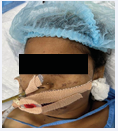
Figure 1: Case 1

Figure 2: Case 2
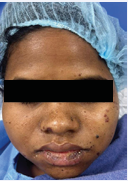
Figure 3: Case 3

Figure 4: Case 4
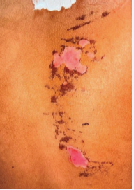
Figure 5: Case 4
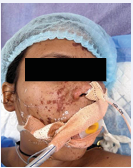
Figure 6: Case 5

Figure 7: Case 5

Figure 8: Case 5
DISCUSSION
This case series details the cutaneous features of 5 patients exposed to accidental ammonia gas leak at an industry. Ammonia toxicity can occur due to ingestion, inhalation or contact with skin or eye [1]. Upon contact with water in body tissues, ammonia reacts exothermically to form ammonium ions, causing simultaneous thermal injury and deep liquefaction necrosis through protein denaturation and fat saponification [1]. A multidisciplinary approach incorporating an ophthalmologist, pulmonologist, dermatologist, gastroenterologist and cardiologist is required to effectively manage the clinical manifestations of ammonia toxicity [2]. Upon arrival,immediate management prioritized decontamination and stabilization.
Contaminated clothing was removed, skin and hair were flushed with water for 5 minutes, and eyes were irrigated with normal saline for 15 minutes. Following decontamination, vital functions were evaluated; patients with severe respiratory distress, airway was secured with endotracheal intubation, while those with reactive bronchospasm received aerosolized bronchodilators. Strict fluid and electrolyte monitoring was maintained throughout stabilization.Baseline routine laboratory studies were obtained for all exposed patients including a complete blood count (CBC), serum glucose, arterial blood gas (ABG) measurements and chest radiography.
CONCLUSION
While industrial ammonia toxicity remains an uncommon occupational hazard, its potential for life threatening systemic complications necessitates both stringent workplace safety measures and targeted emergency training for primary care physicians to optimize patient outcomes.
LIMITATIONS
• Limited sample size
• As it is a retrospective study, the precise airborne ammonia concentrations (parts-per-million) and durations of inhalation cannot be quantified at the disaster site
REFERENCES
1. Padappayil RP, Borger J. Ammonia Toxicity. 2023.
2. Pallavi, Arshad Z, Kamil, Vaishali, Agarwal S. Accidental ammonia gas leakage in a cold storage: A case report. J Health Science Studies. 2023; 5: 103.
3. National Institute for Occupational Safety and Health. Ammonia: Immediately dangerous to life or health concentrations (IDLH). Centers for Disease Control and Prevention. 2014.
4. Agency for Toxic Substances and Disease Registry. Medical management guidelines for ammonia. Centers for Disease Control and Prevention. 2014.