Controlling Dengue by Fighting the Mosquito Vector: Insecticide Activity of the Basil against Aedes aegypti
- 1. Biotechnology Center, Federal University of Paraiba, Brazil
- 2. Department of Cellular and Molecular Biology, Federal University of Paraíba, Brazil
Abstract
Dengue is a systemic viral disease mainly transmitted by Aedes aegypti, which is the main target for the disease control. The use of insecticides has been widely used to combat the dengue vector, but studies have demonstrated the emergence of resistant insects. Thus, the search for new insecticides is required. In this sense, natural products, especially those derived from plants may be an important source of new insecticides. The basil (Ocimum basilicum) is a plant from India, widely used as a spice in worldwide cuisine and intensely cultivated in Brazil. The aim of this study was to evaluate the larvicidal effect of essential oil of O. basilicum against Ae. aegypti. As methods, thirdstage larvae were exposed for 24 hours to different concentrations of O. basilicum essential oil (0.015 to 0. 25 uL/mL) to verify their larvicidal activity. After 24 hours of exposure, the larvae mortality was recorded. As results, the concentrations of 0.05, 0.06, 0.12 and 0.25 µl/mL caused 73.2, 56, 53.2 and 64 % of deaths, respectively. Thus, we conclude that O. basilicum essential oil has insecticidal activity against Ae. Aegypti and it can be exploited in the development of new insecticides against the larval stage of dengue vector.
Keywords
• Ocimum basilicum
• Insecticides
• Larvicidal
• Essential oil
Citation
Lopes ECS, Oliveira LHG, Sousa PAPS, Nascimento GJ, Nunes FC (2016) Controlling Dengue by Fighting the Mosquito Vector: Insecticide Activity of the Basil against Aedes aegypti. Clin Res Infect Dis 3(3): 1033.
INTRODUCTION
Dengue is considered one of the major public health concerns in the world, particularly in tropical and subtropical countries. Dengue is an arboviruses, caused by a flavivirus with four distinct serotypes (DEN-1, DEN-2, DEN-3 and DEN-4) and transmitted by Aedes mosquitos [1,2]. Although laboratory experiments show the susceptibility of other Aedes species (Aedes aegypti, Aedes albopictus and Aedes polynesiensis) to the dengue virus, the most important dengue vector is Aedes aegypti [2].
According to the World Health Organization, the incidence of dengue has increased more than 30 times in the last 30 years [3]. Despite of the recent release of the dengue vaccine, the fight against the mosquito vector still the main control strategy of arboviruses transmitted by Ae. aegypti [4,5]. The use of chemical insecticides has been widely used to combat Ae. aegypti, however, studies have shown the emergence of resistance by the insects [6]. In this sense, many studies have been conducted exploring the potential of natural products as sources of new insecticides [7-9]. Plants of the genus Ocimum are widely used worldwide in folk medicine [10,11]. Several chemicals may be found in the essential oil of O. basilicum, such as monoterpenes and sesquiterpenes, linalool being the major constituent [11,12]. Innumerous studies have been conducted to investigate biological activities of essential oil of O. basilicum [11,13,14]. In this sense, the aim of this study was to investigate the larvicidal activity of O. basilicum essential oil against Ae. aegypti larvae.
MATERIALS AND METHODS
Plant material
The O. basilicum essential oil was obtained from Laslo Aromaterapia, Belo Horizonte (Brazil) and its quality parameters (appearance, color, purity, odor, density –20 °C, refraction index –20 °C) were described in a accompanying technical report. The essential oil was extracted from the leaves by steam distillation method.
Larvicidal activity assay
The larvicidal activity of essential oil of O. basilicum was evaluated according to the World Health Organization [15]. The third-stage Ae. aegypti larvae (L3), from Rockefeller strain, were provided by the Laboratory of Biotechnology Applied to Microbiology and Parasitology from the Biotechnology Center at the Federal University of Paraiba. Twenty L3 larvae were placed in a beaker containing 50 mL of O. basilicum essential oil diluted in distilled water at different concentrations (0.015 to 0.25 uL/ mL). For dilution, 2% of DMSO was used. The larvae remained for 24 h at 28 ± 4 °C over a photoperiod of 12 h of natural light and 12 h of darkness. The positive control group was composed of 20 L4 larvae exposed to the insecticide esbiothrin (2 %). The negative control group consisted of 20 L3 larvae exposed to tap water with 2% of DMSO for 24 h. The experiments were performed in triplicate, and larvae mortality was assessed after 24 h. Statistical analyzes was performed by GraphPad Prism software version 5.0 for Windows (GraphPad Software, San Diego, CA). Significant differences among groups were analyzed by ANOVA followed by the Tukey post test (P<0.05).
RESULTS AND DISCUSSION
Aiming to evaluate the larvicidal activity of O. basilicum essential oil, larvae were exposed to different concentrations of the essential oil (0.015 to 0.25 uL /mL) for 24 h as shown in Figure (1).
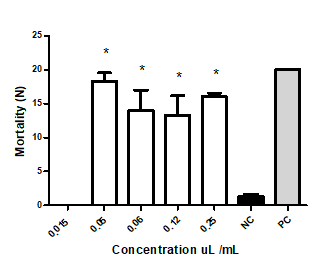
Figure 1: Average mortality of Ae. aegypti larvae exposed to different concentrations of O. basilicum essential oil.
Abbreviations: NC: Negative Control; PC: Positive Control
After 24 hours of exposure, the concentrations of 0.05, 0.06, 0.12 and 0.25 µl/mL caused 73.2, 56, 53.2 and 64 % of deaths, respectively. The average mortality and standard deviation for the concentrations of 0.05, 0.06, 0.12 and 0.25 µl/mL was 18.3 (+ 2.1), 14 (+ 4.2), 13.3 (+ 4.9) and 16.0 (+ 1.0), respectively. Statistical analysis showed no significant difference (p <0.05) between the concentrations of 0.05 and 0.25 uL/mL, which can explain the small decrease in mortality even at increased concentrations.
Several plants have been studied in order to investigate their insecticidal activity against Aedes aegypti. Nunes et al., [9] investigated the larvicidal activity of crude extract of Agave sisalana against Ae. aegypti. The authors reported that A. sisalana crude extract was able to kill 100% of the larvae with concentrations higher than 6.5 mg/mL. Da Silva et al., [16] evaluated the larvicidal activity of Commiphora leptophloeos leaf oil against Ae. aegypti. The results showed a good larvicidal activity (LC50value of 99.4 ± 2.7 μg/mL). Santos et al.,[17] showed the larvicidal activity of the leaf of Croton rhamnifolioides against Ae. aegypti (LC50 values of 122.35 and 89.03 ppm). Govindarajan et al., [18] reported a larvicidal activity of essential oil from O. basilicum against Culex tritaeniorhynchus, Aedes albopictus and Anopheles subpictus with an LC50 of 14.01, 11.97 and 9.75 ppm, respectively. Murugan et al., [19] also reported a larvicidal activity of O. basilicum essential oil against against Ae. aegypti (LC50 for the third instar larvae was 4.664).
Thus, according to several studies, many plants have insecticidal activity against Ae. aegypti. The fact of basil (O. basilicum) is widely grown in Brazil, a country that suffers from constant dengue epidemics is an advantage compared to other plants [20-22].
CONCLUSION
Our data show that the essential oil of O. basilicum constitutes an effective larvicidal agent against larvae of Ae. aegypti. The essential oil of O. basilicum was able to kill more than 70 % of Ae. aegypti larvae in 24 h. Basil is a very common plant in Brazil and is widely used as a spice in many parts of the world. Thus, the essential oil of O. basilicum may be an interesting raw material for the production of insecticides against Ae. aegypti, thus contributing to the control of dengue fever.
REFERENCES