Clinical Utility of ‘VAAFT’ in Perianal Crohn’s Disease: A Systematic Review
- 1. Department of Colorectal Surgery, University Hospital Coventry and Warwickshire, United Kingdom
- 2. Medical Student, University of Warwick, United Kingdom
Abstract
Perianal Crohn’s Disease (PCD) is a debilitating manifestation of Crohn’s disease, associated with high recurrence rates, impaired wound healing, and significant morbidity. Management is complex and typically requires a multidisciplinary approach combining medical and surgical therapies. Conventional surgical interventions are limited by the risk of sphincter injury and suboptimal healing outcomes. Video-Assisted Anal Fistula Treatment (VAAFT) is a minimally invasive, sphincter-preserving endoscopic technique that has emerged as a potential alternative for the management of complex perianal fistulas; however, evidence supporting its use in PCD remains limited.
This systematic review evaluated the safety, efficacy, and feasibility of VAAFT in the treatment of PCD. A comprehensive search of all major databases was conducted for studies published between 2011 and 2025. Studies reporting the use of VAAFT in adult patients with PCD were included. Primary outcomes assessed included feasibility, success, healing rates, symptom resolution, and post-procedural complications.
Seven single-centre studies met the inclusion criteria, comprising five prospective and two retrospective studies. Feasibility rates ranged from 84% to 96%. VAAFT demonstrated notable diagnostic utility, identifying previously unrecognized fistula tracts in up to 64% of cases. Reported success rates varied widely (27–82%), largely due to heterogeneity in outcome definitions. Complication rates were low, with minimal morbidity and rare continence disturbance. Improvements in pain and discharge were reported in selected studies, alongside favourable patient satisfaction.
Overall, VAAFT appears to be a safe and feasible sphincter-preserving option for the multidisciplinary management of PCD. Further large-scale, multicentre randomized studies are required to standardize outcomes and confirm long-term efficacy.
Citation
Raza Z, Randall C, Iskander T, Patel A, Aslam I (2026) Clinical Utility of ‘VAAFT’ in Perianal Crohn’s Disease: A Systematic Review. JSM Gastroenterol Hepatol 13(1): 1139.
INTRODUCTION
Perianal fistula is a severely debilitating sequalae of Crohn’s disease. While anal fistulas can occur idiopathically, they are commonly seen in Crohn’s disease with reports of fistula occurrence in 20-23% of patients [1,2]. These fistulas are often further complicated by the presence of perianal abscesses, multiple external openings and ongoing disease [3].
Surgical management of perianal Crohn’s fistula is a rapidly developing area with several novel procedures under evaluation. Over the past two decades, sphincter sparing techniques like advancement flaps, the Ligation of Intersphincteric Fistula Tract (LIFT), anal fistula plug, FiLaC (fistula laser closure), TROPIS (transanal opening of the intersphincteric space), and Video-Assisted Anal Fistula Treatment (VAAFT) have emerged [4].
Among these, VAAFT has drawn considerable interest due to its capacity to merge endoscopic visualization with targeted destruction of fistula epithelium, drainage and secure closure of the internal opening, without creation of additional tracts or exacerbating incontinence [4]. Given that rates of recurrence in PCD are as high as 30% despite optimal management, VAAFT has been considered for symptomatic management in simple cases [5].
VAAFT was first described by P. Meinero in 2011 and reported no major complications and full healing in 73.5% (n=72) of patients [6]. Further studies have gone on to evaluate VAAFT for the management of perianal fistula including systematic reviews by a number of researchers [7-9]. However, to date, no reviews have evaluated the use of VAAFT exclusively for perianal fistulae in PCD, which is the focus of this review.
Pathology
Idiopathic fistulas often form when anal glands become obstructed by stool or trauma which can then develop abscesses, these then may progress into fistulas [10]. Patients with Crohn’s disease, however, are more likely to incur ulcers or abscesses in their rectum or anus spontaneously [11]. These epithelial defects, in combination with unregulated inflammation and reduced fibroblast recruitment in Crohn’s disease result in impaired healing of these areas [12]. This allows the disease process to progress, often with associated bacterial infection, furthering this process until a tract is formed. The epithelium within the fistula is understood to transition to mesenchymal like cells due to the influence of cytokines [11].
Current Management Guidelines
The treatment of perianal Crohn’s disease is complex and requires a multidisciplinary team for the most effective management [13]. A combination of pelvic Magnetic Resonance Imaging (MRI) and Examination Under Anaesthesia (EUA) are the most appropriate measures for evaluation [13]. The consensus is that first line treatment should always involve drainage to prevent accumulation of perianal sepsis. This can be achieved through the placement of a seton which can be immediately followed by commencement of anti-TNF therapy (Infliximab first line) [13].
The National Institute for health and Care Excellence (NICE) guidelines recommends surgery for repair of anal fistula, [14] with definitive surgical options often reserved for patients with ongoing or complex disease [13]. While fistulotomy is often inappropriate in Crohn’s disease due to risk of incontinence and infection, there are several novel procedures, including VAAFT and fistula plugs, which are designed to be minimally invasive. However, variable success rates reported in Crohn’s disease and a lack of high-quality evidence makes recommendations for a single procedure difficult [9].
Description of Procedure
The VAAFT surgical kit consists of a fistuloscope, unipolar electrode, fistula brush and grasping forceps for removing debris and other unwanted tissue from the tract [15]. The procedure is divided into a diagnostic and therapeutic phase.
Patients are treated while in the lithotomy position and are appropriately anaesthetised. The initial phase involves passing the fistuloscope through the external opening to the internal opening with continuous irrigation of the tract with sterile glycine solution.
The use of a scope allows observation of the entire length of the tract meaning that secondary tracts can be visualised. The light at the end of the fistuloscope can then be used to locate the internal opening. The second phase involves cauterisation and brushing of the tract, to remove debris, and closure of the fistula tract. The internal opening is sealed, either by suture or staple, then the fistula tract can be visualised and cauterised as the scope is retracted, using the brush and forceps to clear material from the tract.
Aim
This study aims to perform a critical analysis of the available literature regarding the management of perianal fistula in Crohn’s disease to extract and synthesise data on feasibility, success rates, and patient safety, allowing for robust conclusions to be drawn.
METHODS
Search Strategy
The search strategy was undertaken following PRISMA guidelines [16]. A comprehensive search was undertaken across electronic databases including PubMed, Medline, EMBASE, Web of Science, Google Scholar and Cochrane databases from 2011 (year of first VAAFT description) till December 2025, using combinations of keywords and MeSH terms such as ‘VAAFT’, ‘video-assisted anal fistula treatment’, ‘Crohn’s disease’, and ‘Perianal Fistula’, ‘Anal fistula’, ‘Endoscopic’, ‘Cryptoglandular fistula’, ‘Intersphincteric fistula’, ‘Transphincteric fistula’, ‘Suprasphincteric fistula’, ‘Extrasphincteric fistula’ and ‘Inflammatory bowel disease’.
Controlled vocabulary (MeSH/Emtree) and free-text terms were combined using Boolean operators to find the maximum number of appropriate papers and search strategies were adapted to the syntax of each database. Limiters were used as appropriate to exclude studies. These search terms were chosen through analysing papers in the pilot search as well as from expert advice from the project supervisors and university librarian.
The literature search strategy is outlined in Appendix 1. In addition, World Health Organization International Clinical Trials Registry (http://apps.who.int/trialsearch/), ClinicalTrials.gov (http://clinicaltrials.gov/) and ISRCTN Register (http://www.isrctn.com/) were searched for details of ongoing and unpublished studies. The bibliographic lists of relevant articles and reviews were interrogated for further potentially eligible studies.
Inclusion/Exclusion Criteria
All studies from 2011 onwards formed part of the initial screening. Studies were required to be peer-reviewed, primary research articles with full-text availability. Case studies, conference abstracts, editorial articles and non English language studies were excluded.
All duplicates identified during primary screening were excluded. Sources with insufficient or inappropriate record of evidence were excluded at secondary screening to maintain the quality of the reviewed data. Paediatric patients and treatment resistant fistula were beyond the scope of this review and therefore studies focused on these patient groups were also excluded. As the data would not be appropriate to generalise to a live patient group, studies on animals and cadavers were also excluded [17]. Additionally, studies involving patients with fistula complicated by other disease, such as malignancy or tuberculosis, were also excluded from the study to avoid channelling bias in the results [18].
Studies were included if they reported evidence on the use of VAAFT in treating perianal fistulae in patients with Crohn’s disease and provided outcome data on feasibility, efficacy, and/or safety. Studies reviewing the treatment of perianal disease in Crohn’s by other non-invasive methods were excluded in order to ensure that VAAFT was the sole intervention analysed.
Critical Appraisal of Studies
Quality of included studies was critically appraised using the “Critical Appraisal Skills Programme cohort studies checklist”, as which is appropriate for the appraisal of observational cohort studies [19]. Quality assessment was performed narratively, with key methodological strengths and limitations summarised. Results of which can be seen in Appendix 2.
RESULTS
Search Results
The initial search identified a total of 4347 articles across all databases. Duplicates were removed manually and an initial screen was undertaken by two independent reviewers using the Rayyan software [20], with discrepancies resolved by a third reviewer, rejecting articles based on the title and/or abstract in line with the exclusion criteria. This resulted in 70 papers of which the full text was assessed for inclusion in the review. This resulted in a total of 7 papers for inclusion. Details of the search strategy are displayed in Figure 1 and PRISMA checklist in Appendix 3.
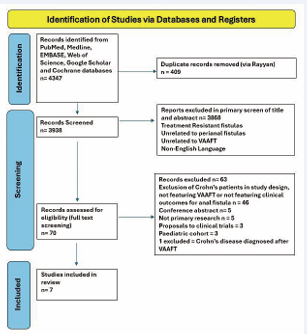
Figure 1: PRISMA diagram
Study Characteristics
A summary of key characteristics of the included studies can be seen in Table 1. Most studies adopted a prospective approach, recruiting patients and following up post procedure to investigate outcomes while two studies adopted a retrospective approach.
Table 1: Depicts a summary of key characteristics of the included studies:
|
SOURCE |
LOCATION |
STUDY DESIGN |
CROHN’S SAMPLE SIZE |
AGE |
GENDER – F:M |
|
O, SCHWANDER 19 |
Germany |
Prospective cohort study |
13 |
21-51 |
3.5:2 |
|
T, GROLICH ET AL.21 |
Czech Republic |
Prospective cohort study |
9 |
NR |
NR |
|
H, JIANG ET AL., 22 |
China |
Prospective cohort study |
1 |
19-71 |
1:5.5 |
|
S, ADEGBOLA ET AL., 20 |
UK |
Prospective cohort study |
25 |
17-64 |
7:5.5 |
|
F, CHEUNG ET AL., 23 |
UK |
Prospective cohort study |
7 |
NR |
3.25:6 |
|
M. SUYAMBU RAJA ET AL., 24 |
India |
Retrospective cohort study |
3 |
17-64 |
2:6.75 |
|
T. J. G. CHASE ET AL., 25 |
UK |
Retrospective cohort study |
11 |
22-77 |
2.5:1 |
Sample sizes varied considerably between studies, with the number of Crohn’s disease patients undergoing VAAFT ranging from as few as one patient to a maximum of 25. Age ranges, where reported, were broad, spanning from adolescence to older adulthood, although age data was not consistently documented across all studies.
While all studies included patients with Crohn’s disease as a proportion of their studied cohort, only two papers [21,22], focused solely on these patients within their study. Distribution of age was comparable across all studies reviewed. Across all included studies, there was a greater proportion of female participants, with an overall female-to-male ratio of approximately 1:2. Although the included studies spanned a diverse geographical area including Germany, the Czech Republic, China, and the United Kingdom, all were single-centre investigations.
Study Outcomes
Key outcomes identified and extracted can be seen in Table 2, with additional outcomes listed in Table 3. Feasibility was reported by four studies and varied between 84% to 96%, with a mean feasibility of 90% from these papers. Of the seven studies identified, six reported a measure of success. Of these, Schwander [21] & Grolich et al. [23], employed VAAFT during the diagnostic phase then used a mucosal flap for fistula closure. Reported success rates were 82% & 67.5% respectively. While a higher median operating time was reported by Grolich et al. [23], 50 minutes vs 22 minutes, no significant procedure related morbidity was reported in either study.
Table 2: Shows the key identified and extracted outcomes:
|
SOURCE |
NO. CROHNS PATIENTS |
FEASIBILITY |
SUCCESS RATE |
SYMPTOM CONTROL |
SURGICAL METHOD |
|
DEFINITION OF SUCCESS |
|||||
|
Video-assisted anal fistula treatment (VAAFT) combined with advancement flap repair in Crohn’s disease. O, Schwander, 2012. |
13/13 |
84% (11/13) |
82% (9/11) |
0% Worsening of continence |
VAAFT used diagnostically + Mucosal flap repair |
|
Closure of internal & external opening, absence of drainage and absence of abscess formation. Cleveland Clinic Incontinence Score used to rate incontinence. |
|||||
|
Role of Video Assisted Anal Fistula Treatment in our management of fistula-in-ano. T, Grolich et al. 2014. |
9/30 |
89% (8/9) |
67.5% (5/8) |
No recurrence in 25% (2/8) |
VAAFT used diagnostically + Mucosal flap repair / Seton Drainage |
|
NR |
|||||
|
Video-Assisted Anal Fistula Treatment (VAAFT) for Complex Anal Fistula: A Preliminary Evaluation in China. H, Jiang et al., 2017. |
1/52 |
100% (1/1) |
100% (1/1) |
Improvement of Gastrointestinal Quality of Life Index |
VAAFT for diagnosis and treatment via cauterisation, brushing and irrigation with closure of internal opening |
|
No symptoms of fistula and no anal incontinence. |
|||||
|
Symptom Amelioration in Crohn’s Perianal Fistulas Using Video-Assisted Anal Fistula Treatment (VAAFT). S, Adegbola et al., 2018. |
25/25 |
96% (24/25) |
NR |
Decreased pain Decreased discharge No patient regretted the procedure, 81% agreed/ strongly agreed that the procedure was the right decision. |
VAAFT for diagnosis and treatment via cauterisation, brushing and irrigation without closure of internal opening and seton placed for drainage. |
|
Measured using MYMOP2 (Measure your medical outcome profile) pre and post operatively as well as a decisional regret scale. |
|||||
|
Video-assisted anal fistula treatment: a high volume unit initial experience. F, Cheung et al., 2018. |
7/78 |
NR |
71% (5/7) |
NR |
VAAFT for diagnosis and treatment via cauterisation, brushing and irrigation with closure of internal opening |
|
Patient self-reporting as being 'cured' or asymptomatic |
|||||
|
Video-assisted anal fistula treatment: A single-center experience to opt the right tract. Raja, Ramachandran and Pillai, 2020. |
3/35 |
NR |
0% (0/3) |
NR |
VAAFT for diagnosis and treatment via cauterisation, brushing and irrigation with closure of internal opening |
|
No recurrence of symptoms at follow-up appointments. |
|||||
|
VAAFT for complex anal fistula: a useful tool, however, cure is unlikely. T. J. G. Chase et al., 2021. |
11/84 |
NR |
27% (3/11) |
45% symptom improvement 18% No change |
VAAFT for diagnosis and treatment via cauterisation, brushing and irrigation with closure of internal opening |
|
Healing of fistula with full resolution of symptoms |
|||||
|
Total |
69 |
90% (Jiang et al., 2017 excluded due to sample size) |
56% (Of those reporting full healing as the success criteria) |
NA |
|
Table 3: Shows the additional identified and extracted outcomes:
|
SOURCE |
PRE-OPERATIVE INVESTIGATIONS |
FOLLOW UP PERIOD |
OPERATING TIME (MEDIAN) |
ALL INSTANCES OF MULTIPLE VAAFT |
CONCOMINANT THERAPY |
ADDITIONAL PROCEDURES |
ALL PATIENT MORBIDITY |
|
O, SCHWANDER, 2012 |
Clinical examination Endoanal ultrasound |
2W,3M,6M,9M |
22 minutes (18-42) |
0 |
46% on biological therapy |
Stoma n=4 (Reversed n=3) |
0 |
|
T, GROLICH ET AL. 2014 |
Fistulography, Endosonography,MRI |
4-476D (144D average) |
50 minutes (25-130) |
0 |
Not reported |
Loose seton drainage n=8, Stoma n=3, Abdominoperineal amputation n=2 |
0 |
|
H, JIANG ET AL., 2017 |
Clinical examination, Anorectal endoscopy, MRI, Pelvic Ultrasound, Contrast examination, Colonoscopy |
1M,3M,9M |
55 minutes (35-90) |
0 |
Not reported |
Cutting seton n=3 |
Perianal sepsis n=3, Bleeding n=3, Intolerable pain n=9 |
|
S, ADEGBOLA ET AL., 2018 |
Not reported |
6W |
Not reported |
0 |
92% on biological therapy |
EUA n=1 |
0 |
|
F, CHEUNG ET AL., 2018 |
Not reported |
14M |
Not reported |
9 Patients |
Not reported |
0 |
0 |
|
M. S. RAJA ET AL., 2020 |
MR fistulogram |
1M,3M,6M,12M |
58 minutes (40-100) |
4 Patients |
Not reported |
Fistulectomy + seton n=7 |
0 |
|
T. J. G. CHASE ET AL., 2021 |
MRI |
6W, 3M, 6M |
Not reported |
21 patients |
|
Incision and drainage of perianal abscess n=1 |
Faecal incontinence n=1, local infection n=4, HAP n=1, Postoperative bleeding n=1 |
Four of the remaining studies all utilised the Meinero method [4], involving the full diagnostic and therapeutic phase. Jiang et al. [24] reported one patient who had full recovery with no reoccurrence at nine months and no complications.
Cheung et al. [25] reports a 71% success rate, with five out of seven patients self-reporting as being ‘cured’ or asymptomatic at 14 months and additionally there was no reported complications.
Raja, Pillai and Ramachandran [26], had a success rate of 0% (0/3) in PCD patients, with recurrence of symptoms at a follow up appointment. Chase et al. [27], saw 27% (3/11) of patients had complete resolution with no reoccurrence at 6 months.
Two studies, Adegbola et al. [22] & Chase et al. [27],included symptom control as a measured outcome. Adegbola et al. [22], used MYMOP2 (measure your medical outcome profile) at 6 weeks, with pain scores decreasing from 4 to 1 and levels of reported discharge decreasing from 4 to 1. 95% of the patients disagreed/strongly disagreed that the procedure did them harm. Chase et al. [27] found that 45% of their cohort reported symptom improvement with 18% reporting no change. One patient went on to develop faecal incontinence and was worse following the procedure (9%).
Overall morbidity was low, across all studies these include: four episodes of local infection, three episodes of perianal sepsis, one patient with faecal incontinence, one patient with postoperative bleeding and one episode of hospital acquired pneumonia. Most studies did not report on whether patients were on concomitant therapy with only Schwander [21] & Adegbola et al. [22] noting 46% and 92% of their patients taking biological therapy at the time of surgery.
DISCUSSION
Evidence from this review suggests that VAAFT was technically feasible in the majority of PCD patients with high success rates as reported by Schwander [21], Adegbola et al. [22], and Grolich et al. [23]. Feasibility was typically defined by the ability to successfully complete the procedure including fistuloscope insertion, identification of fistula tracts, and localisation of the internal opening. Several studies reported the use of adjunctive procedures such as loose seton placement or mucosal advancement flaps alongside VAAFT, which may have influenced feasibility outcomes. Repeat VAAFT procedures were reported in selected patients, suggesting that while initial feasibility was high, a single procedure was not always sufficient for symptom control or fistula closure [25-27].
Results from Jiang et al. [24] were not considered for feasibility due to a cohort including only one patient with Crohn’s disease, however, it is worth noting that this patient was able to undergo the procedure without any issue. All reported patients for whom VAAFT was not feasible were those with narrow fistula tracts for which the fistuloscope could not be introduced or advanced without causing trauma. There were no cases of lack of feasibility where the procedure was aborted mid-way through. Patients who are not appropriate for VAAFT due to narrow fistula are likely to receive a fistulotomy which may result in worsening continence issues [28].
While VAAFT appears to be technically feasible, its effectiveness remains uncertain; however, evidence suggests a potential benefit in selected patients. When considering this, we have three major areas to review: success rate, symptom control and complications or morbidity. Some studies defined success as complete fistula healing [21, 23], while others focused on symptom resolution or absence of discharge [22-27].
Indeed, a major difficulty is the heterogenicity of the study results. This largely stems from variation in the definition of success but is also confounded by variation in surgical method. If looking at all studies there is a wide variation in success rates reported, with as low as 27% [27] to 82% [21]. Symptom control was more frequently achieved than complete fistula closure, indicating that VAAFT may offer symptomatic benefit even when radiological or clinical healing is incomplete. Therefore, symptom control may represent a more appropriate measure of success for VAAFT in patients with Crohn’s disease.
The most common technique employed was the Meinero method [4], used by four studies and slightly modified to omit closure of the internal opening by Abegdola et al. [22]. Within the studies utilising this method, we can see a success rate of 39% in 9 out of 23 patients. This is significantly lower than the reported success rate of VAAFT for idiopathic fistula with Meinero et al. [6], and Chowbey et al. [29], reporting 70% and 73.8% respectively. However, it is likely this variation is due to the increased complexity of fistulas in Crohn’s disease with greater risk of accessory tracts as noted in Safar and Sands [3], impacting the efficacy of the procedure.
Follow-up duration varied and was inconsistently reported, further complicating interpretation of long term efficacy and recurrence. Where longer follow-up was available, recurrence or persistent disease remained a concern.
As shown by Ellis [30], patients with anal fistula place a high priority on continence with 75% of patient’s surveyed prioritising preventing incontinence over resolution of their fistula. The number of studies evaluating symptom control of VAAFT in Crohn’s disease is limited with only Schwander [21], Jiang et al. [24], Adegbola et al. [22], and Chase et al. [27], providing data. From these studies, we can see good results with the majority of patient’s finding symptom relief or no change in their symptoms and no worsening of incontinence. This presents good evidence for the use for VAAFT as a tool for symptom management. However, it is important to recognise that this is a conclusion drawn from a very limited sample size and therefore should be interpreted with caution.
It is important to consider efficacy of anti-TNF therapy in combination with the usage of VAAFT as this has already been used as an effective, non-surgical, treatment for relief of Crohn’s symptoms [13]. Indeed, Yassin [31], has highlighted that this combination can improve success rates by up to 35% compared with surgery alone. Schwander [21], and Adegbola et al.[22], both recorded usage of concurrent biological therapy and saw positive results in their cohorts regarding closure of fistula (82% recorded by Schwander[21]) and symptom relief. However, we are unable to determine how the biological therapy influenced these results as the data does not differentiate between those on treatment and those who were not. This is an important differentiation for further studies to allow for evidenced based patient management.
Assessment of the safety of VAAFT can be achieved by examining the morbidity associated with the procedure and whether these patients required further procedures other than VAAFT to manage their symptoms, such as proctectomy, putting them at increased risk of harm. Five of the seven papers included here are of a cohort of both Crohn’s and idiopathic fistula. In no instance have episodes of morbidity or additional procedures been attributed to either group, making it difficult to draw conclusions of safety from these papers. We can see however that across all patients (279) in studies with mixed cohorts there were only 22 episodes of procedure related complications. The most common complications being local infection or perianal sepsis and pain, which is in line with what has previously been reported for VAAFT [27]. More encouraging still is that when looking at the two papers, Schwander [21] & Adegbola et al.[22], who had cohorts entirely composed of Crohn’s patients (n=38), no morbidity was recorded with only a single examination under anaesthesia performed which found no concern. This may be explained by the decreased cohort size in addition to the fact that Adegbola et al. [22], had the shortest follow up time of all studies at 6 weeks. However, overall, this suggests a good safety profile in Crohn’s disease.
LIMITATIONS
This review has several important limitations which have to be considered when interpreting the findings. First, the number of studies and patients with Crohn’s disease included were small, with five of the seven reporting only a limited Crohn’s disease subgroup within larger mixed cohorts. This substantially limits statistical power and the generalisability of the findings.
Second, all included studies were single centre, despite representing a wide geographical distribution; this increases the risk of selection bias and limit external validity, particularly given variations in surgical expertise and institutional protocols. Indeed, Raja, Pillai and Ramachandran[26] involved data from a single surgeon; while this was done with the intent of reducing inter operator variation, this severely impacts the usage of these results in a wider setting.
Third, there was significant heterogeneity in outcome definitions, with some studies defining success as complete fistula healing and others focusing on symptom resolution or absence of discharge. This inconsistency prevented meaningful quantitative comparison and limited the strength of conclusions regarding efficacy.
Fourth, demographic and clinical data were inconsistently reported, including age, sex distribution, disease severity, and fistula characteristics. In particular, follow-up duration varied (with periods ranging from 6 weeks to 14 months) and was often insufficient to assess long-term recurrence, which is especially relevant in a relapsing condition such as Crohn’s disease. In particular, Grolich et al.[23], had no set times for follow up appointments resulting in a range between 4 and 476 days meaning a potential for information bias [32], where complications have not presented, and healing will be at different stages.
Fifth, several studies reported the use of adjunctive procedures alongside VAAFT, such as seton placement or advancement flaps. This introduces confounding and makes it difficult to attribute outcomes solely to VAAFT, despite attempts to restrict analysis to VAAFT-focused interventions. No radiological methods were used to assess patients at follow up in any study reviewed, as suggested by Yassin et al. [31], this would provide an objective measure of healing rates, without this there is a risk of misclassification of outcomes, bringing the reliability of the data into question [18]. This in combination with the lack of control groups in any of the studies, due to the nature of the study designs, meant that further data synthesis was not appropriate.
Finally, most included studies were observational in design, with no randomised controlled trials identified. As a result, the overall quality of evidence is low, and conclusions regarding effectiveness should be interpreted with caution. Additionally, this study has not examined the cost effectiveness of VAAFT which would be key for implementation in an NHS trust.
CONCLUSION
Evidence from this literature review suggests that VAAFT has potential as an effective option in perianal fistula in Crohn’s disease for both definitive closure and symptom management. The procedure is feasible and has shown low morbidity, and good efficacy. However, the impact of these results must be considered carefully as several factors influence the generalisability of this data. As such, more high-quality evidence such as a multicentre randomised control trial is required to truly demonstrate the effectiveness of this procedure within the PCD patients.
Conflict of Interest
The authors declare that there are no financial or non-financial competing interests, including commercial funding, personal relationships, or academic competition, that could have influenced this work.
Statement on Funding
This research received no specific grant from any funding agency in the public, commercial, or not-for-profit sectors.
Data availability statement
No new data were generated in this study. All data analysed were derived from previously published literature. All data supporting the findings of this study are available within the article and its Supplementary materials.
Ethic Statement
This study is a review of existing published literature and therefore did not require ethical approval or participant consent. No primary data were collected, and no identifiable personal information was used.
PLAIN LANGUAGE SUMMARY
Perianal Crohn’s disease (PCD) is a painful and difficult condition where abnormal tunnels (fistulas) form around the anal canal. These fistulas are hard to treat because they often come back after treatment and can take a long time to heal. Traditional surgery can sometimes damage the muscles that control bowel movements, which may lead to problems with continence. Because of this, surgeons are looking for safer and more effective treatment options.
Video-Assisted Anal Fistula Treatment (VAAFT) is a newer, minimally invasive technique that uses a small camera to help surgeons see and treat fistulas from the inside while protecting surrounding muscles. This review looked at published studies between 2011 and 2025 to understand how safe and effective VAAFT is for people with Crohn’s disease.
Seven studies were included. Overall, VAAFT was possible to perform in most patients and helped identify hidden fistula tunnels during surgery. Success and healing rates varied between studies, but complications were generally low. Some studies also showed improvements in pain and discharge symptoms, and most patients were satisfied with treatment results.
VAAFT appears to be a promising treatment option in patients with PCD. However, larger studies involving multiple hospitals are needed to confirm how well it works in the long term and to develop standard treatment guidelines.
AUTHORS CONTRIBUTIONS
All authors were involved in the conceptualisation and design of the study. ZR and CR independently screened articles and performed inclusion and exclusion assessment, with AP acting as a third independent reviewer where required. IA provided overall supervision and support throughout the review process. ZR and TI drafted the initial version of the manuscript. ZR and IA contributed to the development and synthesis of tables and figures. ZR and CR was involved in data synthesis for the review and in writing the results section. All authors contributed to critical revision and proofreading of the manuscript and approved the final version for submission.
ACKNOWLEDGEMENT
The authors acknowledge the support of Amber Dunlop, Librarian at CSB, University Hospitals Coventry and Warwickshire NHS Trust, for her assistance in developing the literature search strategy for this review.
REFERENCES
- Schwartz DA, Loftus EV Jr, Tremaine WJ, Panaccione R, Harmsen WS, Zinsmeister AR, et al. The natural history of fistulizing Crohn’s disease in Olmsted County, Minnesota. Gastroenterology. 2002; 122: 875-880.
- Hellers G, Bergstrand O, Ewerth S, Holmström B. Occurrence and outcome after primary treatment of anal fistulae in Crohn’s disease. Gut. 1980; 21: 525-527.
- Safar B, Sands D. Perianal Crohn’s disease. Clin Colon Rectal Surg. 2007; 20: 282-293.
- Meinero P, Mori L. Video-assisted anal fistula treatment (VAAFT): A novel sphincter-saving procedure for treating complex anal fistulas. Tech Coloproctol. 2011; 15: 417-422.
- Malian A, Rivière P, Bouchard D, Pigot F, Eléouet-Kaplan M, Favreau-Weltzer C, et al. Pedictors of Perianal Fistula Relapse in Crohn’s Disease. Inflamm Bowel Dis. 2020; 26: 926-931
- Meinero P, Mori L. Video-Assisted Anal Fistula Treatment (VAAFT). Anal Fistula: Principles and Management: Springer. 2013; 121-128.
- Garg P, Singh P. Video-Assisted Anal Fistula Treatment (VAAFT) in Cryptoglandular fistula-in-ano: A systematic review and proportional meta-analysis. Int J Surg. 2017; 46: 85-91.
- Emile SH, Elfeki H, Shalaby M, Sakr A. A Systematic review and meta-analysis of the efficacy and safety of video-assisted anal fistula treatment (VAAFT). Surg Endosc. 2018; 32: 2084-2093.
- Adegbola S, Sahnan K, Pellino G, Tozer P, Hart A, Phillips R, et al. Short-term efficacy and safety of three novel sphincter-sparing techniques for anal fistulae: A systematic review. Techniques in coloproctology. 2017; 21: 775-782.
- Pescatori M. Surgery for anal fistulae: State of the art. Int J Colorectal Dis. 2021; 36: 2071-2079.
- Scharl M, Rogler G. Pathophysiology of fistula formation in Crohn’s disease. World J Gastrointest Pathophysiol. 2014; 5: 205-212.
- Dignass AU. Mechanisms and modulation of intestinal epithelial repair. Inflamm Bowel Dis. 2001; 7: 68-77.
- Gionchetti P, Dignass A, Danese S, Magro Dias FJ, Rogler G, Lakatos PL, et al. 3rd European Evidence-based Consensus on the Diagnosis and Management of Crohn’s Disease 2016: Part 2: Surgical Management and Special Situations. J Crohns Colitis. 2017; 11: 135-149.
- NICE. VAAFT for treating anal fistulae (MIB102). 2017.
- Meinero P. Video-Assisted Anal Fistula Treatment (VAAFT).
- Page MJ, McKenzie JE, Bossuyt PM, Boutron I, Hoffmann TC, Mulrow CD, et al. The PRISMA 2020 statement: An updated guideline for reporting systematic reviews. Int J Surg. 2021; 88: 105906.
- Pound P, Ebrahim S, Sandercock P, Bracken MB, Roberts I; Reviewing Animal Trials Systematically (RATS) Group. Where is the evidence that animal research benefits humans? BMJ. 2004; 328: 514-517.
- Pannucci CJ, Wilkins EG. Identifying and avoiding bias in research. Plast Reconstr Surg. 2010; 126: 619-625.
- Programme CAS. CASP cohort studies checklist. 2019.
- Ouzzani M, Hammady H, Fedorowicz Z, Elmagarmid A. Rayyan-a web and mobile app for systematic reviews. Syst Rev. 2016; 5: 210.
- Schwandner O. Video-Assisted Anal Fistula Treatment (VAAFT) combined with advancement flap repair in Crohn’s disease. Tech Coloproctol. 2013; 17: 221-225.
- Adegbola SO, Sahnan K, Tozer PJ, Strouhal R, Hart AL, Lung PFC, et al. Symptom Amelioration in Crohn’s Perianal Fistulas Using Video-Assisted Anal Fistula Treatment (VAAFT). J Crohns Colitis. 2018; 12: 1067-1072.
- Grolich T, Skricka T, Robek O, Kala Z, Hemmelová B, Hrivnák R. Role of video assisted anal fistula treatment in our management of fistula-in-ano. Acta chirurgica Iugoslavica. 2014; 61: 83-85.
- Jiang HH, Liu HL, Li Z, Xiao YH, Li AJ, Chang Y, et al. Video-Assisted Anal Fistula Treatment (VAAFT) for Complex Anal Fistula: A Preliminary Evaluation in China. Med Sci Monit. 2017; 23: 2065-2071.
- Cheung F, Appleton N, Rout S, Kalaiselvan R, Nicholson J, Samad A, et al. Video-assisted anal fistula treatment: A high volume unit initial experience. The Annals of the Royal College of Surgeons of England. 2017; 100: 37-41.
- Raja MS, Pillai AV, Ramachandran R. Video-assisted anal istula treatment: A single-center experience to opt the right tract. Formosan J Surg. 2020; 53: 211-215.
- Chase TJG, Quddus A, Selvakumar D, Cunha P, Cuming T. VAAFT for complex anal fistula: A useful tool, however, cure is unlikely. Tech Coloproctol. 2021; 25: 1115-1121.
- Jayarajah U, Wickramasinghe DP, Samarasekera DN. Anal incontinence and quality of life following operative treatment of simple cryptoglandular fistula-in-ano: a prospective study. BMC Res Notes. 2017; 10: 572.
- Chowbey PK, Khullar R, Sharma A, Soni V, Najma K, Baijal M. Minimally Invasive Anal Fistula Treatment (MAFT)-An Appraisal of Early Results in 416 Patients. Indian J Surg. 2015; 77: 716-721.
- Ellis CN. Sphincter-preserving fistula management: What patients want. Dis Colon Rectum. 2010; 53: 1652-1655.
- Yassin NA, Askari A, Warusavitarne J, Faiz OD, Athanasiou T, Phillips RK, et al. Systematic review: The combined surgical and medical treatment of fistulising perianal Crohn’s disease. Aliment Pharmacol Ther. 2014; 40: 741-749.
- Ramirez-Santana M. Limitations and biases in cohort studies. IntechOpen London; 2018..