Loading

JSM General Surgery Cases and Images

Incidental Finding of a Gastrointestinal Stromal Tumor during an Inguinal Hernia Repair.

Case Report | Open Access | Volume 2 | Issue 2

  • 1. Department of General Surgery, Geisinger Medical Center, USA
+ Show More - Show Less
Corresponding Authors
Rebekah Campbell, Department of Surgical Oncology, Geisinger Medical Center, Danville, PA, USA, 100 N Academy Avenue, MC 21-69, Danville, PA
Abstract

 Gastrointestinal Stromal Tumors (GISTs) are rare tumors derived from the mesenchyme. They are usually benign and are most commonly found in the stomach. They arise from the interstitial cells of Cajal, and the majority express c-kit, a tyrosine kinase receptor. Only about a third of patients with GIST have symptoms. There have been several reports of GIST found incidentally during gastric bypass surgery. However, there is a paucity of literature regarding GISTs found incidentally during other types of operations.

Case presentation: A 53-year old male was referred to the general surgery clinic for bilateral inguinal hernias. A bilateral inguinal hernia repair with plug and patch mesh was performed. At the time of his operation, a nodule was noted in the right hernia sac and was subsequently sent to pathology. The pathology report revealed a GIST with a high mitotic rate.

Discussion: Most GISTs are symptomatic or found incidentally on CT (computerized tomography) scans. This is an interesting case because previous literature regarding GIST found incidentally at the time of a hernia repair is rare.

Conclusions: A Computerized Tomography and Positron Emission Tomography (CT/PET)scan revealed a large mass in the left upper quadrant of the abdomen that had a necrotic center and involved several loops of small bowel. The patient was placed on Imatinib. A repeat CT/PET scans revealed decrease size in the left upper quadrant mass. This case illustrates the importance of sending tissue to pathology when there are unanticipated findings in the operating room.

Keywords


•    Gastrointestinal stromal tumor
•    Incidental
•    Inguinal hernia

Citation

Campbell R, Hashmi A, Marie Hunsinger RN BSHS, Shabahang M, Blansfield J, et al. (2017) Incidental Finding of a Gastrointestinal Stromal Tumor during an Inguinal Hernia Repair. JSM Gen Surg Cases Images 2(2): 1024.

ABBREVIATIONS

GIST: Gastrointestinal Stromal Tumor; CT: Computed Tomography; CT/PET: Computed Tomography and Positron Emission Tomography; HPF: High Powered Field; AJCC: American Joint Committed on Cancer; NCCN: National Comprehensive Cancer Network

INTRODUCTION

Gastrointestinal Stromal Tumors (GISTs) are rare mesenchymal tumors which account for 0.1-3% of all gastrointestinal malignancies. However, they are the most common sarcoma and account for 80% of all gastrointestinal mesenchymal neoplasms. Median age of diagnosis is 60 years old, and has an increased risk in male and black patients. [1,2]. They are usually slow growing tumors and are most commonly found in the stomach and second most commonly in the small bowel. They arise from the interstitial cells of Cajal, and the majority express c-kit, a tyrosine kinase receptor [3]. This expression helps identify these cells on immune histochemical staining.

Roughly one third of patients with GIST are symptomatic [1]. These symptoms are usually vague and include abdominal pain and anemia [4]. Twenty-two percent of GISTs are found at the time of autopsy [5]. Twenty to thirty percent of patients are found to have GISTs incidentally, usually on computed tomography (CT) scan performed for another indication [4]. There have been several reports of GIST found incidentally during gastric bypass surgery [6,7]. However, there is a paucity of literature regarding GIST found incidentally during other types of operations. Typically, GIST presents as a solitary tumor but these tumors do have the potential to metastasize. They spread hematogenously, as well as directly through seeding of the peritoneum in up to 40- 60% of patients [8,9].

Here we will present the case of a small bowel GIST found incidentally during an inguinal hernia repair due to carcinomatosis in the hernia sac

CASE PRESENTATION

A 53-year old male was referred to the general surgery clinic for a bulge in his right groin. He denied past medical history, and his past surgical history was only significant for an appendectomy. Physical exam revealed a reducible right inguinal hernia in addition to a small left inguinal hernia. An open bilateral inguinal hernia repair with plug and patch mesh was performed electively. At the time of surgery, a nodule was noted in the right hernia sac and the sac with the nodule was subsequently sent to pathology. The final pathology report revealed a GIST on immune histo chemical staining for c-kit, with a high mitotic rate of 7 in a 50 high powered field (Figure 1).
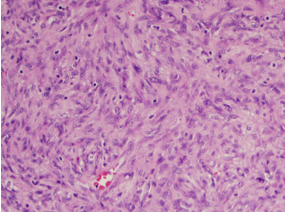
 Mixed spindle cells with foci of epitheliod tissues. Mitotic rate of 7/50  HPF.

Figure 1 Mixed spindle cells with foci of epitheliod tissues. Mitotic rate of 7/50 HPF.

A computed tomography and positron emission tomography (CT/PET) scan was performed for staging and revealed a large 7.5 by 10 cm mass in the left upper quadrant of the abdomen that had a necrotic center and involved several loops of small bowel (Figure 2).
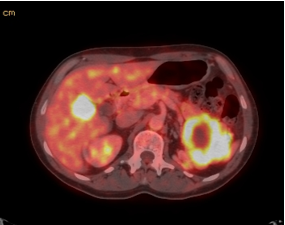
 CT/PET scan showing liver nodule and large left upper quadrant  mass with necrotic center

Figure 2 CT/PET scan showing liver nodule and large left upper quadrant mass with necrotic center.

In addition, the patient had liver nodules, and right lower quadrant abdominal lesions. The patient was seen by oncology and started on Imatinib. Four months after initial diagnoses, a repeat CT/PET scan revealed a decrease in the volume of his disease. He was continued on Imatinib therapy; however, he developed resistance which was evident with tumor growth. He was subsequently switched to Sunitinib therapy, but he was noted to have continued growth and deemed nonresponsive. He was taken to the operating room for tumor cytoreduction 32 months after diagnosis. Heunder went en bloc resection of the left upper quadrant mass involving the splenic flexure of the colon and jejunum with primary jejunal anastomosis. He had tumor nodules involving the right colon, and therefore an extended right hemicolectomy with ileosigmoid anastomosis was performed. He also required resection of segment V of his liver for 3 metastatic nodules. The left upper quadrant tumor on final pathology was 9.5 cm, and the nodules in the right colon and liver were metastatic nodules. He had 2 out of 8 lymph nodes positive. He was then treated with Regorafenib, and will be followed with CT/PET scans.

DISCUSSION

It is extremely rare to find a GIST incidentally at the time of a hernia repair. There have been a few reports of GIST being found incidentally during an inguinal hernia repair. One case reported found a GIST which had herniated through an inguinal hernia and presented with what appeared to be an incarcerated inguinal hernia [10]. In another case a patient presented with a femoral hernia and bowel obstruction. On initial examination, the patient did not appear to be obstructed due to the hernia. This prompted further exploration, which revealed a jejunal mass which was resected and determined to be a GIST [11]. There are also reports of GIST found during bariatric surgery [6,7]. These tumors were all resected successfully, and found to be of low risk for recurrence. Our patient’s primary tumor was not discovered until CT scan after the incidental finding of a metastasis in the hernia sac.

Most GISTs are found to be low risk for malignant potential. It has been reported that roughly 50% of GISTs present with metastatic disease [12]. However, these tumors can still have malignant potential even after being labeled as “benign”. Up to 50% of patients have recurrent disease at 5 years [1,13]. The Fletcher Model (Table 1)

Table 1:  Fletcher Model.

T-stage

Tumor size

Mitosis (50 HPF)

Fletcher

T1

<2 cm

<5

Very Low Risk


5 to 10

Intermediate Risk


>10

High Risk

T2

2-5 cm

<5

Low Risk


5 to 10

Intermediate Risk


>10

High Risk

T3

5-10 cm

<5

Intermediate Risk


5 to 10

High Risk


>10

High Risk

T4

>10 cm

<5

High Risk


>5

High Risk

Abbreviations:  HPF:  High Powered Field.


uses tumor size and mitotic rate to determine the risk for malignant potential [13]. Tumors less than 5 cm with mitotic rate of less than 5 in a 50 high powered field (HPF) are at low risk. Tumors less than 5 cm with a mitotic rate of 5-10 in 50 HPF are at intermediate risk. Tumors greater than 5 cm or with a mitotic rate greater than 10 in a 50 HPF are at a high risk for malignant potential.

The American Joint Committee on Cancer (AJCC) stages GIST by first stratifying location of the tumor [14]. For gastric GIST stage one is any tumor less than 10 cm with a low mitotic rate. Stage 2 is either a tumor greater than 10 cm with a low mitotic rate or a tumor less than 5 cm with a high mitotic rate. Stage 3 is any tumor greater than 5 cm with a high mitotic rate. Stage 4 is any positive lymph nodes or any distant metastasis (Table 2).

Table 2:  American Joint Committee on Cancer (AJCC) Model.

AJCC (gastric)

AJCC (Small intestine)

T-stage

Mitosis (50 HPF)

N-stage

M-stage

stage IA

stage I

T1

low

N0

M0


T2

low

N0

M0

stage IB

stage II

T3

low

N0

M0

stage II

stage IIIA

T4

low

N0

M0

stage II

stage IIIA

T1

high

N0

M0

stage II

stage IIIB

T2

high

N0

M0

stage IIIA

stage IIIB

T3

high

N0

M0

Stage IIIB

stage IIIB

T4

high

N0

M0

stage IV

stage IV

any T


N1

M0

stage IV

stage IV

any T


any N

M1

Abbreviations:  HPF:  High Powered Field

While size and mitotic rate are both important in determining malignant potential in GIST, mitotic rate is the most important predictor [3,15]. Metastases usually occur in the liver or peritoneum which was the case in our patient. Our patient also had lymph node metastasis, which is a rare presentation for GIST occurring around 1% of the time [16,17]. The treatment for solitary tumors with a low malignant potential is local resection. For higher malignant potential patients, imatinib is administered adjuvantly based on several studies that show decrease in recurrence [18-20].

Our patient had stage IV disease at the time of his presentation. The best treatment for the primary tumor is still resection. The treatment for metastatic disease or unresectable disease is Imatinib [21]. Our patient, who had unresectable, metastatic disease at the time of presentation, began treatment with Imatinib and initially had a good response to treatment but eventually developed resistance. After developing resistance to Imatinib he was treated with Sunitinib, but unfortunately developed resistance to this as well. At this point he underwent tumor cytoreduction with an en bloc resection of the tumor involving the splenic flexure and proximal jejunum, an extended right hemicolectomy, and liver wedge resection. There have been several studies that have shown benefit for patients to undergo cytoreductive surgery after imatinib therapy and this has been incorporated into the National Comprehensive Cancer Network (NCCN) guidelines [22-24].

It is very unusual to have an incidental finding of carcinomatosis at the time of an inguinal hernia repair. There have been case reports of enlarged lymph nodes found during inguinal hernia repairs, but there is little literature regarding metastatic disease found during an inguinal hernia repair. It is more common for incidental findings to occur at the time of umbilical hernia repairs. Most of the incidental findings during umbilical hernia repairs are metastatic spread of gastrointestinal tract, ovarian, or endometrial cancers [25]. However, there is a case report of a GIST found at the time of an umbilical hernia repair [26]. This case illustrates the importance of sending tissue to pathology when there are unanticipated findings in the operating room. All tissue that is removed during an operation should be inspected closely for abnormalities prior to being sent for pathology.


REFERENCES

1. Cameron JL, Cameron AM editors. Current Surgical Therapy. 11th ed. Philadelphia, PA: Elsevier. 2014.


2. Tran T, Davila JA, El-Serag HB. The epidemiology of malignant gastrointestinal stromal tumors: an analysis of 1,458 cases from 1992 to 2000. Am J Gastroenterol. 2005; 100: 162-168.

3. Miettinen M, Lasota J. Gastrointestinal stromal tumors--definition, clinical, histological, immunohistochemical, and molecular genetic features and differential diagnosis. Virchows Arch. 2001; 438: 1-12.

4. von Mehren M. Management of Gastrointestinal Stromal Tumors. Surg Clin North Am. 2016; 96: 1059-1075.

5. Agaimy A, Wunsch PH, Hofstaedter F, Blaszyk H, Rummele P, Gaumann A, et al. Minute Gastric Sclerosing Stromal Tumors (GIST Tumorlets) Are Common in Adults and Frequently Show c-KIT Mutations. Am J Surg Pathol. 2007; 31: 113-120.

6. Beltran MA, Pujado B, Méndez PE, Gonzáles FJ, Margulis DI, Contreras MA, et al. Gastric gastrointestinal stromal tumor (GIST) incidentally found and resected during laparoscopic sleeve gastrectomy. Obes Surg. 2010; 20: 393-396.


7. Sanchez BR, Morton JM, Curet MJ, Alami RS. Incidental finding of gastrointestinal stromal tumors (GISTs) during laparoscopic gastric bypass. Obes Surg. 200; 15: 1384-1388.

8. Agaimy A, Vassos N, Wunsch PH, Hohenberger W, Hartmann A, Croner RS. Impact of serosal involvement/extramural growth on the risk of synchronous and metachronous peritoneal spread in gastrointestinal stromal tumors: proposal for a macroscopic classification of GIST. Int J Clin Exp Pathol 2012; 5: 12-22.

9. Rutkowski P, Nowecki ZI, Michej W, DebiecRychter M, Wozniak A, Limon J, et al. Risk Criteria and Prognostic Factors for Predicting Recurrences After Resection of Primary Gastrointestinal Stromal Tumor. Ann Surg Oncol. 2007; 14: 2018-2027.

10. Tinoco-Gonzalez J. Gastrointestinal stromal tumor (GIST) presenting as a groin mass mimicking and incarcerated hernia. Int J Surg Case Rep. 2015; 6: 166-168.

11. Zyluk A, Majewski W. Parietal Strangulation Of Small Intestine In Femoral Hernia Site With Symptoms Of Intestinal Obstruction In Patient With Incidentally Found Small Intestine Tumor--A Case Report. Pol Przegl Chir. 2015; 87: 413-416.

12. DeMatteo RP, Lewis JJ, Leung D, Mudan SS, Woodruff JM, Brennan MF. Two Hundred Gastrointestinal Stromal Tumors: Recurrence Patterns and Prognostic Factors for Survival. Ann Surg. 2000; 231: 51-58.

13. Fletcher CD, Berman JJ, Corless C, Gorstein F, Lasota J, Longley BJ, et al. Diagnosis of gastrointestinal stromal tumors: a consensus approach. Hum Pathol. 2002; 10: 459-465.

14. Edge SB, Compton CC. The American Joint Committee on Cancer: the 7th edition of the AJCC cancer staging manual and the future of TNM. 2010; 17: 1471-1474.

15. Liu Q, Wang Y, Kong L, Kan Y. Study on Clinicopathological Features of Gastrointestinal Stromal Tumor and Relevant Prognostic Factors. Cell Biochem Biophys. 2015; 73: 743-747. 

16. Agaimy AW, Peter H. Lymph node metastasis in gastrointestinal stromal tumours (GIST) occurs preferentially in young patients < or = 40 years: an overview based on our case material and the literature. Langenbecks Arch Surg. 2009; 394: 375-381.

17. Shafizad A, Mohammadianpanah M, Nasrolahi H, Mokhtari M, Mousavi SA. Lymph Node Metastasis in Gastrointestinal Stromal Tumor (GIST): to Report a Case. Iran J Cancer Prev. 2014; 7: 171-174.

18. Lin J, Chen Q, Zheng C, Li P, Xie J, Wang J, et al. Is 3-years duration of adjuvant imatinib mesylate treatment sufficient for patients with high-risk gastrointestinal stromal tumor? A study based on long-term follow-up. J Cancer Res Clin Oncol. 2017; 143: 727-734.

19. Jakhetiya A, Garg PK, Prakash G, Sharma J, Pandey R, Pandey D. Targeted therapy of gastrointestinal stromal tumours. World J Gastrointest Surg. 2016; 8: 345-352.

20. Joensuu H, Eriksson M, Sundby Hall K, Reichardt A, Hartmann JT, Pink D, et al. Adjuvant Imatinib for High-Risk GI Stromal Tumor: Analysis of a Randomized Trial. Journal of clinical oncology: official. J Amer Soc Clin Oncol. 2016; 34: 244-250.

21. National Comprehensive Cancer Network. Gastrointestinal Stromal Tumors (GIST). 2017.

22. Raut CP, Posner M, Desai J, Morgan JA, George S, Zahrieh D, et al. Surgical Management of Advanced Gastrointestinal Stromal Tumors After Treatment With Targeted Systemic Therapy Using Kinase Inhibitors. J Clin Oncol. 2006; 24: 2325-2331.

23. Piotr R, Zbigniew N, Pawel N, Dziewirski W, Grzesiakowska U, Nasierowska-Guttmejer A, et al. Surgical treatment of patients with initially inoperable and/or metastatic gastrointestinal stromal tumors (GIST) during therapy with imatinib mesylate. J Surg Oncol. 2006; 93: 304-311.

24. Andtbacka RH, Ng CS, Scaife CL, Cormier JN, Hunt KK, Pisters PW, et al. Surgical resection of gastrointestinal stromal tumors after treatment with imatinib. Ann Surg Oncol. 2007; 14: 14-24.

25. Piura B, Meirovitz M, Bayme M, ShacoLevy R. Sister Mary Joseph’s nodule originating from endometrial carcinoma incidentally detected during surgery for an umbilical hernia: a case report. Arch Gynecol Obstet. 2006; 274: 385-388.

26. Cybulka B, Golanski M, Rapela J, Wach A. Elective Surgery of Umbilical Hernia as a First Clinical Manifestation of a Gastrointestinal Stromal Tumor (Gist) - Case Report. Pol Przegl Chir. 2016; 88: 221-225

:Campbell R, Hashmi A, Marie Hunsinger RN BSHS, Shabahang M, Blansfield J, et al. (2017) Incidental Finding of a Gastrointestinal Stromal Tumor during an Inguinal Hernia Repair. JSM Gen Surg Cases Images 2(2): 1024.

Received : 10 May 2017
Accepted : 28 Apr 2017
Published : 01 May 2017
Journals
Annals of Otolaryngology and Rhinology
ISSN : 2379-948X
Launched : 2014
JSM Schizophrenia
Launched : 2016
Journal of Nausea
Launched : 2020
JSM Internal Medicine
Launched : 2016
JSM Hepatitis
Launched : 2016
JSM Oro Facial Surgeries
ISSN : 2578-3211
Launched : 2016
Journal of Human Nutrition and Food Science
ISSN : 2333-6706
Launched : 2013
JSM Regenerative Medicine and Bioengineering
ISSN : 2379-0490
Launched : 2013
JSM Spine
ISSN : 2578-3181
Launched : 2016
Archives of Palliative Care
ISSN : 2573-1165
Launched : 2016
JSM Nutritional Disorders
ISSN : 2578-3203
Launched : 2017
Annals of Neurodegenerative Disorders
ISSN : 2476-2032
Launched : 2016
Journal of Fever
ISSN : 2641-7782
Launched : 2017
JSM Bone Marrow Research
ISSN : 2578-3351
Launched : 2016
JSM Mathematics and Statistics
ISSN : 2578-3173
Launched : 2014
Journal of Autoimmunity and Research
ISSN : 2573-1173
Launched : 2014
JSM Arthritis
ISSN : 2475-9155
Launched : 2016
JSM Head and Neck Cancer-Cases and Reviews
ISSN : 2573-1610
Launched : 2016
JSM Anatomy and Physiology
ISSN : 2573-1262
Launched : 2016
JSM Dental Surgery
ISSN : 2573-1548
Launched : 2016
Annals of Emergency Surgery
ISSN : 2573-1017
Launched : 2016
Annals of Mens Health and Wellness
ISSN : 2641-7707
Launched : 2017
Journal of Preventive Medicine and Health Care
ISSN : 2576-0084
Launched : 2018
Journal of Chronic Diseases and Management
ISSN : 2573-1300
Launched : 2016
Annals of Vaccines and Immunization
ISSN : 2378-9379
Launched : 2014
JSM Heart Surgery Cases and Images
ISSN : 2578-3157
Launched : 2016
Annals of Reproductive Medicine and Treatment
ISSN : 2573-1092
Launched : 2016
JSM Brain Science
ISSN : 2573-1289
Launched : 2016
JSM Biomarkers
ISSN : 2578-3815
Launched : 2014
JSM Biology
ISSN : 2475-9392
Launched : 2016
Archives of Stem Cell and Research
ISSN : 2578-3580
Launched : 2014
Annals of Clinical and Medical Microbiology
ISSN : 2578-3629
Launched : 2014
JSM Pediatric Surgery
ISSN : 2578-3149
Launched : 2017
Journal of Memory Disorder and Rehabilitation
ISSN : 2578-319X
Launched : 2016
JSM Tropical Medicine and Research
ISSN : 2578-3165
Launched : 2016
JSM Head and Face Medicine
ISSN : 2578-3793
Launched : 2016
JSM Cardiothoracic Surgery
ISSN : 2573-1297
Launched : 2016
JSM Bone and Joint Diseases
ISSN : 2578-3351
Launched : 2017
JSM Bioavailability and Bioequivalence
ISSN : 2641-7812
Launched : 2017
JSM Atherosclerosis
ISSN : 2573-1270
Launched : 2016
Journal of Genitourinary Disorders
ISSN : 2641-7790
Launched : 2017
Journal of Fractures and Sprains
ISSN : 2578-3831
Launched : 2016
Journal of Autism and Epilepsy
ISSN : 2641-7774
Launched : 2016
Annals of Marine Biology and Research
ISSN : 2573-105X
Launched : 2014
JSM Health Education & Primary Health Care
ISSN : 2578-3777
Launched : 2016
JSM Communication Disorders
ISSN : 2578-3807
Launched : 2016
Annals of Musculoskeletal Disorders
ISSN : 2578-3599
Launched : 2016
Annals of Virology and Research
ISSN : 2573-1122
Launched : 2014
JSM Renal Medicine
ISSN : 2573-1637
Launched : 2016
Journal of Muscle Health
ISSN : 2578-3823
Launched : 2016
JSM Genetics and Genomics
ISSN : 2334-1823
Launched : 2013
JSM Anxiety and Depression
ISSN : 2475-9139
Launched : 2016
Clinical Journal of Heart Diseases
ISSN : 2641-7766
Launched : 2016
Annals of Medicinal Chemistry and Research
ISSN : 2378-9336
Launched : 2014
JSM Pain and Management
ISSN : 2578-3378
Launched : 2016
JSM Women's Health
ISSN : 2578-3696
Launched : 2016
Clinical Research in HIV or AIDS
ISSN : 2374-0094
Launched : 2013
Journal of Endocrinology, Diabetes and Obesity
ISSN : 2333-6692
Launched : 2013
Journal of Substance Abuse and Alcoholism
ISSN : 2373-9363
Launched : 2013
JSM Neurosurgery and Spine
ISSN : 2373-9479
Launched : 2013
Journal of Liver and Clinical Research
ISSN : 2379-0830
Launched : 2014
Journal of Drug Design and Research
ISSN : 2379-089X
Launched : 2014
JSM Clinical Oncology and Research
ISSN : 2373-938X
Launched : 2013
JSM Bioinformatics, Genomics and Proteomics
ISSN : 2576-1102
Launched : 2014
JSM Chemistry
ISSN : 2334-1831
Launched : 2013
Journal of Trauma and Care
ISSN : 2573-1246
Launched : 2014
JSM Surgical Oncology and Research
ISSN : 2578-3688
Launched : 2016
Annals of Food Processing and Preservation
ISSN : 2573-1033
Launched : 2016
Journal of Radiology and Radiation Therapy
ISSN : 2333-7095
Launched : 2013
JSM Physical Medicine and Rehabilitation
ISSN : 2578-3572
Launched : 2016
Annals of Clinical Pathology
ISSN : 2373-9282
Launched : 2013
Annals of Cardiovascular Diseases
ISSN : 2641-7731
Launched : 2016
Journal of Behavior
ISSN : 2576-0076
Launched : 2016
Annals of Clinical and Experimental Metabolism
ISSN : 2572-2492
Launched : 2016
Clinical Research in Infectious Diseases
ISSN : 2379-0636
Launched : 2013
JSM Microbiology
ISSN : 2333-6455
Launched : 2013
Journal of Urology and Research
ISSN : 2379-951X
Launched : 2014
Journal of Family Medicine and Community Health
ISSN : 2379-0547
Launched : 2013
Annals of Pregnancy and Care
ISSN : 2578-336X
Launched : 2017
JSM Cell and Developmental Biology
ISSN : 2379-061X
Launched : 2013
Annals of Aquaculture and Research
ISSN : 2379-0881
Launched : 2014
Clinical Research in Pulmonology
ISSN : 2333-6625
Launched : 2013
Journal of Immunology and Clinical Research
ISSN : 2333-6714
Launched : 2013
Annals of Forensic Research and Analysis
ISSN : 2378-9476
Launched : 2014
JSM Biochemistry and Molecular Biology
ISSN : 2333-7109
Launched : 2013
Annals of Breast Cancer Research
ISSN : 2641-7685
Launched : 2016
Annals of Gerontology and Geriatric Research
ISSN : 2378-9409
Launched : 2014
Journal of Sleep Medicine and Disorders
ISSN : 2379-0822
Launched : 2014
JSM Burns and Trauma
ISSN : 2475-9406
Launched : 2016
Chemical Engineering and Process Techniques
ISSN : 2333-6633
Launched : 2013
Annals of Clinical Cytology and Pathology
ISSN : 2475-9430
Launched : 2014
JSM Allergy and Asthma
ISSN : 2573-1254
Launched : 2016
Journal of Neurological Disorders and Stroke
ISSN : 2334-2307
Launched : 2013
Annals of Sports Medicine and Research
ISSN : 2379-0571
Launched : 2014
JSM Sexual Medicine
ISSN : 2578-3718
Launched : 2016
Annals of Vascular Medicine and Research
ISSN : 2378-9344
Launched : 2014
JSM Biotechnology and Biomedical Engineering
ISSN : 2333-7117
Launched : 2013
Journal of Hematology and Transfusion
ISSN : 2333-6684
Launched : 2013
JSM Environmental Science and Ecology
ISSN : 2333-7141
Launched : 2013
Journal of Cardiology and Clinical Research
ISSN : 2333-6676
Launched : 2013
JSM Nanotechnology and Nanomedicine
ISSN : 2334-1815
Launched : 2013
Journal of Ear, Nose and Throat Disorders
ISSN : 2475-9473
Launched : 2016
JSM Ophthalmology
ISSN : 2333-6447
Launched : 2013
Journal of Pharmacology and Clinical Toxicology
ISSN : 2333-7079
Launched : 2013
Annals of Psychiatry and Mental Health
ISSN : 2374-0124
Launched : 2013
Medical Journal of Obstetrics and Gynecology
ISSN : 2333-6439
Launched : 2013
Annals of Pediatrics and Child Health
ISSN : 2373-9312
Launched : 2013
JSM Clinical Pharmaceutics
ISSN : 2379-9498
Launched : 2014
JSM Foot and Ankle
ISSN : 2475-9112
Launched : 2016
JSM Alzheimer's Disease and Related Dementia
ISSN : 2378-9565
Launched : 2014
Journal of Addiction Medicine and Therapy
ISSN : 2333-665X
Launched : 2013
Journal of Veterinary Medicine and Research
ISSN : 2378-931X
Launched : 2013
Annals of Public Health and Research
ISSN : 2378-9328
Launched : 2014
Annals of Orthopedics and Rheumatology
ISSN : 2373-9290
Launched : 2013
Journal of Clinical Nephrology and Research
ISSN : 2379-0652
Launched : 2014
Annals of Community Medicine and Practice
ISSN : 2475-9465
Launched : 2014
Annals of Biometrics and Biostatistics
ISSN : 2374-0116
Launched : 2013
JSM Clinical Case Reports
ISSN : 2373-9819
Launched : 2013
Journal of Cancer Biology and Research
ISSN : 2373-9436
Launched : 2013
Journal of Surgery and Transplantation Science
ISSN : 2379-0911
Launched : 2013
Journal of Dermatology and Clinical Research
ISSN : 2373-9371
Launched : 2013
JSM Gastroenterology and Hepatology
ISSN : 2373-9487
Launched : 2013
Annals of Nursing and Practice
ISSN : 2379-9501
Launched : 2014
JSM Dentistry
ISSN : 2333-7133
Launched : 2013
Author Information X