ELAC2-Related Mitochondrial Cardiomyopathy with Marked Hyperprolinemia: A Case Report
- 1. Department of Genetics and Precision Medicine, King Abdullah Specialized Children Hospital, Saudi Arabia
- 2. Department of Pediatrics, King Abdullah Specialized Children Hospital, Saudi Arabia
- 3. College of Medicine, Imam Mohammed Ibn Saud Islamic University, Saudi Arabia
- 4. Department of Medical Genomics, King Faisal Specialist Hospital and Research Center, Saudi Arabia
- 5. Medical Genomic Research Department, King Abdullah International Medical Research Center, Saudi Arabia
Abstract
Mitochondrial dysfunction is a recognized cause of early-onset cardiomyopathy. Mutations in ELAC2, encoding mitochondrial RNase Z, disrupt mitochondrial mt-tRNA processing and impair oxidative phosphorylation, resulting in combined oxidative phosphorylation deficiency type 17. We report a 2-month-old female infant with a homozygous ELAC2 variant who presented with acute dilated cardiomyopathy, severe lactic acidosis, and rapid clinical deterioration. Notably, plasma proline was markedly elevated (>2500 μmol/L), a finding not previously described in ELAC2-related disease. Despite intensive supportive therapy, the patient died within days of presentation. This case expands the phenotypic and biochemical spectrum of ELAC2-related disease and emphasizes the importance of detailed metabolic evaluation in infants presenting with unexplained cardiomyopathy.
Keywords
• ELAC2
• Mitochondrial Cardiomyopathy
• Hyperprolinemia
• Case Report
Citation
Ahmed H, Alenezy N, Shlhoob RB, Rahbeeni Z, Eyaid W (2026) ELAC2-Related Mitochondrial Cardiomyopathy with Marked Hyperprolinemia: A Case Report. JSM Intern Med 4(1): 1008.
INTRODUCTION
Pediatric cardiomyopathy may result from mitochondrial dysfunction and can manifest as hypertrophic, dilated, or mixed phenotypes, often accompanied by systemic metabolic involvement [1]. ELAC2 encodes mitochondrial RNase Z, an enzyme essential for 3′-end processing of mitochondrial precursor mt-tRNAs. Biallelic pathogenic variants in ELAC2 (OMIM #615440) cause combined oxidative phosphorylation deficiency type 17 (COXPD17), a rare autosomal recessive mitochondrial disorder characterized by early-onset cardiomyopathy, lactic acidosis, and poor outcomes [2,3].
Since the initial description of ELAC2-associated cardiomyopathy in 2013, only a limited number of affected individuals have been reported, mostly presenting in infancy or early childhood.
Here, we report an infant with early-onset hypertrophic cardiomyopathy and marked hyperprolinemia associated with a novel homozygous ELAC2 variant, highlighting a previously unrecognized biochemical feature that may aid diagnosis [4].
CASE REPORT
The patient was a 2-month-old female infant, born full-term via normal vaginal delivery, who presented with acute respiratory distress, poor feeding, and lethargy. The parents were second-degree cousins, and the family history was notable for multiple early infant deaths on both maternal and paternal sides, consistent with autosomal recessive inheritance (Figure 1).
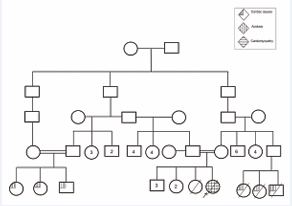
Figure 1: The family pedigree
On physical examination, the patient had normal growth parameters and no dysmorphic features. Cardiovascular examination revealed a gallop rhythm without murmurs. There was no hepatomegaly, and neurological examination was unremarkable.
Chest radiography demonstrated marked cardiomegaly. Transthoracic echocardiography revealed severe left ventricular dilation with concentric hypertrophy, a left ventricular ejection fraction of 35%, mild mitral regurgitation, and a small patent foramen ovale with left to-right shunting.
The patient exhibited severe metabolic derangements consistent with mitochondrial dysfunction (Table 1). Genetic testing identified a homozygous ELAC2 c.460T>C (p.Phe154Leu) variant in the amino-terminal region.
Table 1: Laboratory Findings.
|
Parameter |
Result |
Reference / Comment |
|
Lactate |
8.84 mmol/L |
Elevated; common in mitochondrial dysfunction |
|
Ammonia |
89 μmol/L |
Mildly elevated |
|
Proline |
>2500 μmol/L |
Markedly elevated; novel finding in ELAC2 cases |
|
Citrulline |
10 μmol/L |
Low |
|
Glutamic acid |
89 μmol/L |
Elevated |
|
ALT |
209 U/L |
Elevated; hepatic involvement |
|
AST |
448 U/L |
Elevated; hepatic involvement |
|
Coagulation |
Prolonged |
Reflects metabolic/liver dysfunction |
|
Uric acid |
506 μmol/L |
Hyperuricemia |
|
Blood cultures |
Stenotrophomonas maltophilia. |
|
Despite aggressive supportive management, including mechanical ventilation, inotropic support, carnitine supplementation, and broad-spectrum antibiotics, the patient’s clinical condition deteriorated rapidly, and she died within days of presentation.
DISCUSSION
The clinical phenotype associated with ELAC2 mutations is heterogeneous, including hypertrophic, dilated, or mixed cardiomyopathy, often accompanied by systemic metabolic failure and early mortality [5,6]. Previously reported ELAC2 cases and their major clinical features are summarized in Table 2.
Table 2: Previously reported cases of ELAC2-related cardiomyopathy.
|
cDNA Change |
Protein Change |
Zygosity |
Clinical Features |
Reference |
Age at Death |
|
c.1564C>A |
p.Pro522Thr |
Homozygous |
Infantile HCM, lactic acidosis |
Haack et al. 2013 |
6 months |
|
c.2158_2160delTCT |
p.Ser720del |
Homozygous |
Neonatal HCM, early death |
Haack et al. 2013 |
Neonatal |
|
c.95C>T |
p.Ala32Val |
Homozygous |
Global delay, seizures, cardiomyopathy |
Shinwari et al. 2017 |
Childhood |
|
c.511C>T |
p.Arg171Trp |
Homozygous |
Dilated CM, lactic acidosis |
Shinwari et al. 2017 |
Infantile |
|
c.947A>G |
p.Tyr316Cys |
Homozygous |
Progressive HCM, lactic acidosis |
Akawi et al. 2016 |
2 years |
Most pathogenic ELAC2 variants cluster within the canonical catalytic C-terminal tRNase Z domain of the protein, as it directly affects enzymatic activity, leading to defective tRNA maturation and mitochondrial translation problems [3-6]. In contrast, the p.Phe154Leu variant identified in our patient lies in the N-terminal region, which has not previously been associated with COXPD17. Despite this, the patient’s phenotype closely resembles previously reported cases, supporting a deleterious effect of the variant on ELAC2 function.
A particularly novel aspect of this case is the marked hyperprolinemia. To our knowledge, this degree of proline elevation has not been reported in prior ELAC2-related cases. Proline metabolism is closely linked to mitochondrial redox balance and depends on mitochondrial nicotine adenine dinucleotide phosphate hydrogen (NADP?/ NADPH) availability [7]. Experimental studies have demonstrated that mitochondrial NADP(H) generation is essential for proline biosynthesis from glutamate, and disruption of NADP? homeostasis alters proline metabolism and contributes to metabolic imbalance [8,9]. In the context of ELAC2-related mitochondrial dysfunction, impaired oxidative phosphorylation and redox imbalance may therefore lead to secondary accumulation of proline, providing a plausible explanation for the profound hyperprolinemia observed in this patient.
Importantly, hyperprolinemia may serve as a useful biochemical clue in infants with unexplained cardiomyopathy, particularly in consanguineous families or those with a history of early cardiac deaths. From a clinical standpoint, this case emphasizes the need to consider ELAC2 mutations in the differential diagnosis of neonatal and infantile cardiomyopathy. Genetic confirmation is crucial not only for accurate diagnosis but also for family counseling and reproductive planning. Currently, management remains largely supportive, and neonatal-onset cases are generally associated with poor prognosis.
Author Contributions
All authors contributed to the material preparation, data collection and analysis. The first draft of the manuscript was written by H.A., N.A., and R.B. All authors commented on previous versions of the manuscript and approved the final manuscript.
DECLARATIONS
Informed consent
Written informed consent was obtained from the patient’s parent for publication of this case report and any accompanying images. A copy of the written consent is available for review by the Editor-in-Chief of this journal.
Ethics approval
This study was performed in line with the principles of the Declaration of Helsinki. Approval was granted by the Institutional Review Board of King Abdullah International Medical Research Center.
REFERENCES
- El-Hattab AW, Scaglia F. Mitochondrial Cardiomyopathies. Front Cardiovasc Med. 2016; 3: 25.
- Online Mendelian Inheritance in Man (OMIM). Combined oxidative phosphorylation deficiency 17; ELAC2. OMIM #615440.
- Haack TB, Kopajtich R, Freisinger P, Wieland T, Rorbach J, Nicholls TJ, et al. ELAC2 mutations cause a mitochondrial RNA processing defect associated with hypertrophic cardiomyopathy. Am J Hum Genet. 2013; 93: 211-223.
- Saoura M, Powell CA, Kopajtich R, Alahmad A, Al-Balool HH, Albash B, et al. Mutations in ELAC2 associated with hypertrophic cardiomyopathy impair mitochondrial tRNA 3’-end processing. Hum Mutat. 2019; 40: 1731-1748.
- Shinwari ZM, Almesned A, Alakhfash A, Al-Rashdan AM, Faqeih E, Al-Humaidi Z, et al. The phenotypic and genotypic spectrum of ELAC2-associated cardiomyopathy. Clin Genet. 2017; 92: 598-607.
- Alsharhan H, Alostad W, Ali AA, Ebrahim MA, Mohammed HAF, Alahmad A, et al. A Homozygous Founder ELAC2 Variant in Kuwaiti Infants With Fatal Cardiomyopathy and Refractory Severe Lactic Acidosis: A Retrospective Review of the Clinical, Cardiological and Molecular Findings. Mol Genet Genomic Med. 2026; 14: e70274.
- Vettore LA, Westbrook RL, Tennant DA. Proline metabolism and redox; maintaining a balance in health and disease. Amino Acids. 2021; 53: 1779-1788.
- Tran DH, Kesavan R, Rion H, Soflaee MH, Solmonson A, Bezwada D, et al. Mitochondrial NADP+ is essential for proline biosynthesis during cell growth. Nat Metab. 2021; 3: 571-585.
- Zhu J, Schwörer S, Berisa M, Kyung YJ, Ryu KW, Yi J, et al. Mitochondrial NADP(H) generation is essential for proline biosynthesis. Science. 2021; 372: 968-972.