Reducing Sudden Cardiac Arrest Risk during Marathons with Aspirin Guided by Coronary Artery Calcium Scoring
- 1. Division of General Internal Medicine, Massachusetts General Hospital, USA
- 2. Department of Internal Medicine, McLean Hospital, Belmont, MA, USA
- 3. Harvard Medical School, USA
Abstract
Middle-aged male runners with subclinical coronary atherosclerotic heart disease are at transiently increased risk for sudden cardiac arrest during marathons. Coronary artery calcium scoring reliably identifies those for whom low dose aspirin use is prudent to enhance primary prevention of such race-related events. This recommendation is evidence-based and supported by guidelines of the American Heart Association and the American College of Cardiology.
Keywords
• Aspirin
• Primary cardiovascular prevention
• Psychiatric patients
Citation
Siegel AJ (2026) Reducing Sudden Cardiac Arrest Risk during Marathons with Aspirin Guided by Coronary Artery Calcium Scoring. J Cardiol Clin Res. 14(1): 1222.
INTRODUCTION
The ultimate paradox of endurance sports participation is that the putative benefit of enhanced longevity is offset by a transiently increased risk for sudden cardiac death during episodes of intense physical exertion. This incongruity is exemplified by marathon running in the modern era, as male gender and marathons were identified as significant and independent risk factors for cardiac arrest in such races in the United States from 2000 to 2009 [1]. A follow up study ending in 2023 showed such events occurring at the same rate, mainly in middle-aged men with subclinical atherosclerotic coronary artery disease [2]. While the latter study showed a 40% improvement in postarrest survival due to embedding proficient cardiopulmonary resuscitative services with automated external devices along race routes, continued cardiovascular morbidity and mortality in middle-aged men during marathons indicates the need for an evidence-based preventive strategy.
An ounce of prevention is worth a pound of cure….
The ongoing incidence of sudden cardiac arrests during marathons worldwide has identified the need by race medical directors for evidence-based preventive measures. Low-dose aspirin use guided by coronary artery calcium scoring has been recommended for this purpose based on a 44% decrease in first heart attacks in same-aged men in the Physicians Health Study, a randomized controlled primary prevention trial [3-5]. Participants identified at risk by coronary artery calcium scores greater than 100 Agatston units (Table 1), may benefit the most from such use, as designated in current guidelines of the American Heart Association and the American College of Cardiology [6]. The measure also provides such runners with the benefit of having on board the only substance with a Class IA recommendation for pre-hospital administration in the event of an acute coronary syndrome during or after races.
If we only knew then what we know now……
The above approach for enhanced primary prevention is relevant for novice and senior participants alike, addressing especially the risks for coronary heart disease in Masters athletes [7]. Staunch evidence indicates that endurance exercise such as marathon training increases coronary artery calcium density, which identifies risk for major acute cardiac events. Low–grade inflammation due to training may be the mechanism leading to progressive atherosclerosis [8]. The counter-intuitive conundrum is that the high degree of physical activity intended to enhance heart health may ultimately jeopardize it.
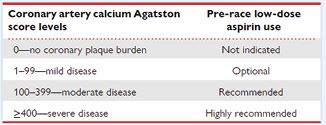
Table 1 Coronary artery calcium scores and the anticipated benefit of enhanced primary prevention with low-dose pre-race aspirin for reducing the risk of marathon-related cardiac arrest. Reproduced from: Siegel A. Pre-race aspirin to attenuate the risk for marathon related cardiac arrest: deconstructing the legacy of Pheidippides. Eur Heart J. 2023, ehad641. (Ref 40).
Informed medical decision-making….
The transiently increased risk for sudden cardiac arrest during marathons invites sports medicine clinicians and others to consider the rationale for low dose aspirin guided by coronary artery calcium scoring especially in middle-aged male patients entertaining this activity. Beyond promoting a heart-healthy lifestyle and prescribing pharmacotherapy based on traditional risk scores, coronary artery calcium scoring provides actionable findings for enhanced primary prevention in persons with subclinical atherosclerotic coronary heart disease. Fully informed decisions on aspirin use can then be made on a case by case basis.
Wake-up call:
“Just because the incidence of sudden cardiac arrest during marathons is low does not mean that it cannot be lower”, opined Amby Burfoot, editor in chief emeritus of Runners World magazine and then1967 Boston Marathon champion. Low-dose aspirin use guided by coronary artery calcium scoring is prudent for every runner wishing to minimize sudden cardiac arrest risk. This approach may have finally provide us with the capacity to identify athletes at risk for sudden cardiac death [9].
REFERENCES
- Kim JH, Malhotra R, Chiampas G, Troyanos C, Cianca J, Smith RN, et al. Cardiac arrest during long-distance running races. N Engl J Med. 2012; 366: 130-140.
- Kim JH, Rim AJ, Miller JT, Jackson M, Patel N, Rajesh S, et al. Cardiac arrest during long-distance running races. JAMA. 2025; 333: 1699-1707.
- Siegel A. Pre-race aspirin to enhance primary prevention of marathon-related cardiac arrest: confronting Pheidippides’ legacy. Am J Med. 2023; 136: 613-615.
- Siegel A. Pre-race aspirin to attenuate the risk for marathon-related cardiac arrest: deconstructing the legacy of Pheidippides. Eur HeartJ. 2024; 45: 488
- Steering Committee of the Physicians’ Health Study Research Group. Final report on the aspirin component of the ongoing Physicians’ Health Study; N Engl J Med. 1989; 321: 129-135.
- Arnett DK, Blumenthal RS, Alpert MA, Buroker AB, Goldberger ZD, Hahn EJ, et al. 2019 ACC/AHA guideline on primary prevention of cardiovascular disease. Areport of the ACC/AHA task force on clinical practice guidelines. Claas SA. 2019ACC/AHA Guideline for prevention of CVD. J Am Coll Cardiol. 2019; 74: e177-e232.
- Mohlencamp S, Schmermund A, Kroger K, Kerkhoff G, Adams V, Hensel M, et al. Coronary atherosclerosis and cardiovascular risk in Masters male marathon runners. Herz Kardiovasculare Erkrankungen 2006; 31: 575-585.
- McHugh C, Boyd KS, Wasfy MM. Too much of a good thing: Can high dose exercise promote chronic low–great inflammation and cardiovascular risk in competitive athletes? J Sci Med Sports. 2026; 18: S1440-2440.
- Williams RG, Chen AY. Identifying athletes at risk for sudden death. J Am Coll Cardiol. 2003: 42: 1964-1966.