47-Year-Old with Brain and Spinal Cord Lesions: An Atypical Presentation of CADASIL
- 1. RUSH Medical College, Chicago, Illinois, USA
- 2. Department of Neurology, RUSH Medical College, Chicago, Illinois, USA
Abstract
This case describes an uncommon CADASIL phenotype with concomitant spinal cord lesions that initially mimicked a neuroinflammatory demyelinating disorder. CADASIL is a NOTCH3-mediated small-vessel arteriopathy classically presenting with migraine with aura, subcortical ischemic events, psychiatric symptoms, and progressive cognitive decline; spinal cord involvement and inflammatory Cerebrospinal Fluid (CSF) profiles are unusual and may lead to misdiagnosis. We report a 47-year-old man with vitiligo, Hashimoto thyroiditis, and tobacco use who presented with right-hand incoordination and facial paresthesia a decade before diagnosis, with brain MRI showing periventricular white matter hyperintensities and cystic encephalomalacia; CSF was non-specific and he was lost to follow-up. Ten years later he developed left-sided weakness and gait instability, with exam demonstrating hyperreflexia, ankle clonus, spasticity, vibratory loss, and a positive Romberg sign. MRI showed an acute right corona radiata infarct with extensive leukoencephalopathy involving the corpus callosum, periventricular regions, and anterior temporal lobes, plus subtle cervical and thoracic cord T2 hyperintensities. CSF revealed mildly elevated protein, three mirror-pattern oligoclonal bands, and mildly elevated anti-SSA antibodies. High-dose intravenous methylprednisolone produced no clinical benefit, and he was initially diagnosed with relapsing-remitting multiple sclerosis. Disclosure of a sister with genetically confirmed CADASIL and a paternal history of early stroke, dementia, and psychiatric illness prompted NOTCH3 testing, which was positive. He was transitioned to secondary stroke prevention as recommended for CADASIL. This case highlights that spinal cord lesions and mild inflammatory biomarkers may occur in CADASIL, and the importance of a detailed patient history to prompt NOTCH3 testing.
Keywords
• CADASIL; NOTCH3; Multiple sclerosis; Cerebral small-vessel disease; Spinal cord lesion
Citation
Jenson A, Ashary Z, Sierra-Morales F (2026) 47-Year-Old with Brain and Spinal Cord Lesions: An Atypical Presentation of CADASIL. J Neurol Disord Stroke 13(2): 1253.
ABBREVIATIONS
CADASIL: Cerebral Autosomal Dominant Arteriopathy with Subcortical Infarcts and Leukoencephalopathy; MS: Multiple Sclerosis; CSF: Cerebrospinal Fluid; MRI: Magnetic Resonance Imaging; FLAIR: Fluid-Attenuated Inversion Recovery
INTRODUCTION
CADASIL is a rare hereditary small-vessel arteriopathy caused by mutations in the NOTCH3 gene, leading to progressive vascular smooth muscle degeneration, recurrent subcortical ischemic events, migraine with aura, cognitive decline, and psychiatric disturbance [1,2]. Neuroimaging typically demonstrates confluent periventricular white matter hyperintensities with characteristic involvement of the external capsule and anterior temporal lobes [3,4]. Spinal cord involvement is exceedingly rare, described in only a handful of reports [5,6], and inflammatory CSF findings such as oligoclonal bands and elevated protein are similarly uncommon [7,8]. We describe a genetically confirmed case of CADASIL combining brain and spinal cord lesions with inflammatory CSF findings and positive anti-SSA antibodies that initially prompted consideration of a neuroinflammatory demyelinating disorder.
CASE PRESENTATION
A 47-year-old man with a history of vitiligo, Hashimoto thyroiditis, hyperlipidemia, and tobacco use initially presented in 2014 with right-hand incoordination and right lower facial paresthesias. Brain MRI at that time demonstrated innumerable periventricular and subcortical T2/FLAIR hyperintensities with small areas of cystic encephalomalacia involving the corona radiata. Cerebrospinal fluid analysis was nonspecific, and he was diagnosed with an undefined autoimmune disorder. He was nonadherent with recommended treatment and was subsequently lost to follow-up.
Approximately ten years later, the patient presented three days of progressive left-sided weakness and gait instability. Neurological examination demonstrated left lower extremity strength of 4/5, diffuse hyperreflexia with bilateral ankle clones, mild lower-extremity spasticity, impaired distal vibration sensation, and a positive Romberg sign. Repeat brain MRI revealed an acute diffusion-restricting lesion in the right corona radiata together with extensive leukoencephalopathy involving the corpus callosum, periventricular regions, and anterior temporal lobes (Figures 1-4). Cervical and thoracic spine MRI demonstrated subtle central cord T2 hyperintensities spanning the mid-to-lower cervical cord and multiple thoracic levels (T8–T10).
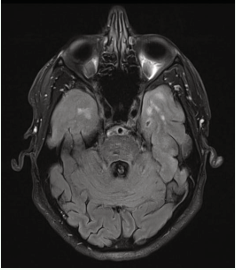
Figure 1: Axial T2/FLAIR MRI demonstrating anterior temporal lobe white matter involvement.
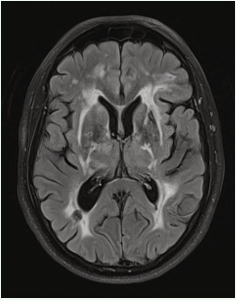
Figure 2: Axial T2/FLAIR MRI demonstrating external capsule involvement.
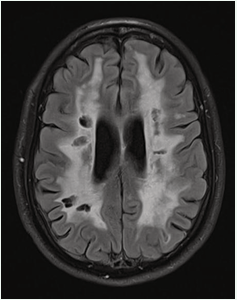
Figure 3: Axial T2/FLAIR MRI demonstrating confluent periventricular white matter disease.
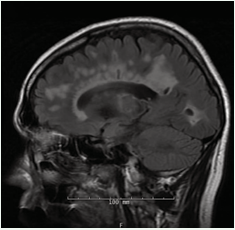
Figure 4: Sagittal FLAIR MRI demonstrating prominent periventricular lesions.
Lumbar puncture demonstrated mildly elevated CSF protein (59 mg/dL), three mirror-pattern oligoclonal bands, and mildly elevated serum anti-SSA antibodies. Given the combination of multifocal white matter disease, spinal cord lesions, and inflammatory CSF findings, the patient was diagnosed with relapsing-remitting multiple sclerosis and received three days of high-dose intravenous methylprednisolone, without clinical benefit.
On further follow-up, the patient reported persistent weakness of the lower left extremity, later attributed in part to concurrent hip pain, as well as new mood changes including irritability and anger, alongside subjective memory impairment. Review of the family history revealed that the patient’s sister had genetically confirmed CADASIL, while his father and paternal grandfather both suffered premature strokes, and additional relatives reportedly experienced dementia and psychiatric illness. These findings prompted NOTCH3 genetic testing, which confirmed the diagnosis of CADASIL.
The patient was subsequently referred to vascular neurology and transitioned to secondary stroke prevention with aspirin and vascular risk factor modification. He received counseling regarding smoking cessation and the natural history of CADASIL. Further follow-up has shown a rapid decline in neurocognition alongside an increase in neuropsychiatric mood disorders, especially aggressive episodes. The patient has been recommended for palliative care and continues to follow with our team.
DISCUSSION
This case contributes to a small but growing body of literature describing atypical CADASIL phenotypes with combined brain and spinal cord involvement. CADASIL is a non-amyloid arteriopathy affecting leptomeningeal and perforating arteries of the brain [1], classically presenting with migraine with aura, recurrent subcortical ischemic events, cognitive decline, and psychiatric disturbance [2]. Migraine with aura is typically the earliest manifestation, appearing around the third decade of life and occurring roughly five times more frequently than in the general population, while ischemic events characteristically occur at a mean age of 49 years, often without conventional vascular risk factors [1]. Our patient’s early age of stroke onset, together with a strong paternal family history of early stroke, dementia, and psychiatric illness, ultimately favored CADASIL over a primary demyelinating process such as MS, which most often presents in young adulthood, whereas CADASIL can continue to declare into the third and fourth decades of life [9].
A distinguishing feature of our patient’s course was the decade-long interval between his initial, nonspecific presentation labeled only as an “undefined autoimmune disorder” after an unremarkable CSF study, and his eventual diagnosis, during which he was nonadherent with treatment and lost to follow-up. Prolonged diagnostic delay is not unique to our patient. Carone described a similarly protracted misdiagnosis of CADASIL as MS [10], and a recent observational review by Mandia et al., highlights how frequently genetic small-vessel and other monogenic diseases are mistaken for MS before eventual recognition [11]. Our case adds a further dimension to this literature, as the initial episode likely represented an early CADASIL-related event that went unrecognized for a decade before the patient returned with a markedly more severe, multifocal presentation.
Spinal cord involvement in CADASIL remains rare. Bentley et al., first described cord lesions in association with a novel, atypical NOTCH3 mutation [5], and Jing et al., subsequently reported an additional case with an accompanying literature review, underscoring how infrequently this finding has been documented [6]. Motolese et al., described a comparably aged, 48-year-old man with severe leukoencephalopathy and spinal cord involvement misdiagnosed as MS, a presentation closely paralleling our patient’s course [12]. Our patient’s central cervical and thoracic cord T2 hyperintensities, combined with mildly elevated CSF protein, three mirror-pattern oligoclonal bands, and mildly positive anti-SSA antibodies, place this case among a small number worldwide reported to combine spinal cord and inflammatory CSF abnormalities within genetically confirmed CADASIL [8]. Elevated CSF protein is recognized as the most common CSF abnormality in CADASIL, hypothesized to reflect disruption of the blood-CSF barrier from vascular basal membrane deposition or as a secondary consequence of periventricular stroke lesions [7,8]. Oligoclonal bands, though a hallmark of MS, have also been reported in a small number of CADASIL cases, including three cases described in the late 1990s without paired serum analysis [8]. The type III pattern identified in our patient, in contrast to the type IV pattern more typical of MS, may suggest a distinct, CADASIL-associated immune mechanism rather than a co-existing demyelinating process.
One additional differential that complicates the CADASIL work-up is primary CNS vasculitis. CADASIL and vasculitis can present similarly with strokes and white matter lesions, but distinct features aid differentiation. CADASIL is a genetic small-vessel disease often presenting with a family history of early strokes, migraine with aura, and psychiatric symptoms, with CSF that is typically normal or shows only mild protein elevation and negative autoimmune markers, whereas vasculitis is an inflammatory condition that may present with systemic symptoms, positive autoimmune markers, CSF pleocytosis, and vascular imaging irregularities such as beading or stenosis, and requires immunosuppressive rather than preventive vascular treatment. Our patient’s family history, imaging pattern, and lack of systemic inflammatory features favored CADASIL with atypical spinal cord involvement over vasculitis or a primary demyelinating process.
To our knowledge, this case is among a limited number reported to combine spinal cord lesions, inflammatory CSF abnormalities, and positive autoimmune serology within a single, genetically confirmed CADASIL patient, further distinguished by a decade-long diagnostic delay following an initially ambiguous presentation. Recognition of this atypical phenotype broadens the known clinical spectrum of CADASIL and reinforces the importance of integrating detailed family history and NOTCH3 genetic testing into the diagnostic evaluation of patients with overlapping vascular and inflammatory features, particularly when corticosteroid response is absent and family history suggests a hereditary vascular process.
ACKNOWLEDGEMENTS
The authors thank the patient and his family for their cooperation. No specific grant funding from public, commercial, or not-for-profit agencies was received for this work.
REFERENCES
- Chabriat H, Joutel A, Dichgans M, Tournier-Lasserve E, Bousser MG. Cadasil. Lancet Neurol. 2009; 8: 643-653.
- Wu S, Zhao N, Sun T, Cui F, Sun X, Lin J. Cerebral autosomal dominant arteriopathy with subcortical infarcts and leukoencephalopathy (cadasil) with multiple different onset forms of frequent recurrent attacks: A case report and literature review. Medicine (baltimore). 2024; 103: 37563.
- O’Sullivan M, Jarosz JM, Martin RJ, Deasy N, Powell JF, Markus HS. MRI hyperintensities of the temporal lobe and external capsule in patients with CADASIL. Neurology. 2001; 56: 628-634.
- Bersano A, Bedini G, Markus HS. The role of clinical and neuroimaging features in the diagnosis of CADASIL. J Neurol. 2018; 265: 2934-2943.
- Bentley P, Wang T, Malik O. CADASIL with cord involvement associated with a novel and atypical NOTCH3 mutation. J Neurol Neurosurg Psychiatry. 2011; 82: 855-860.
- Jing XZ, Jiang W, Gan L, Zhu WA, Dong M, Yu P. CADASIL with spinal cord involvement: A case report and literature review. J Neurol. 2019; 266: 2330-2333.
- Schiess N, Huether K, Szolics M, Agarwal G, El-Hattab AW, Sathe S. Multiple sclerosis or “inflammatory CADASIL?”: Case Report and review of the literature. Clin Neurol Neurosurg. 2018; 173: 196-199.
- Khan A, Abedi V, Li J, Malik MT, Esch M, Zand R. CADASIL vs. Multiple Sclerosis: Is It Misdiagnosis or Concomitant? A Case Series. Front Neurol. 2020; 11: 860.
- Carone DA. CADASIL and multiple sclerosis: A case report of prolonged misdiagnosis. Appl Neuropsychol. 2017; 24: 294-297.
- Mandia D, Shor N, Carlson AK. Genetic diseases misdiagnosed as multiple sclerosis: Observational study and review of literature. Mult Scler Relat Disord. 2025; 99: 106439.
- Motolese F, Rossi M, Gangemi E, Bersano A, Scelzo E, Di Lazzaro V, et al. CADASIL as Multiple Sclerosis Mimic: A 48-year-old man with severe leukoencephalopathy and spinal cord involvement. Mult Scler Relat Disord. 2020; 41: 102014.