Effectiveness of Ultra-Brief Psychological Interventions for Suicide Prevention: A Meta-Analysis
- 1. Department of Clinical Psychology, Leiden University, The Netherlands
- 2. 113 Suicide Prevention, Paasheuvelweg 25, Amsterdam, The Netherlands
- 3. Vrije Universiteit, de Boelelaan 1105, Amsterdam, The Netherlands
- 4. Amsterdam UMC locatie VUmc, de Boelelaan 1117, Amsterdam, The Netherlands
METHODS
The data were obtained from the Metapsy Suicide Prevention Database, a living systematic review and meta analytic research domain on the effect of psychotherapy on suicidal ideation and suicide attempts [8]. Detailed methods are described elsewhere [9]. We conducted a comprehensive literature search of randomised trials published up to 1 April 2025, with study inclusion, data extraction, and risk of bias assessments being conducted independently by two researchers. Conflicts were resolved through discussion, and if needed, a third researcher. For this meta-analysis, we included only ultra-brief trials (i.e. the intervention was 1-4 sessions). For each comparison between a psychotherapeutic treatment and a control condition, we calculated the effect sizes. For suicidal thoughts, this indicated the difference in suicidal severity between the two groups (Hedges’ g). For suicide attempts, the relative risk (RR) was calculated as the proportion of people who attempted suicide in the intervention group divided by the proportion in the control group. We extracted the effect immediately after treatment, as well as follow-up data to investigate medium- and long-term effects.
Data were analysed using the metapsyTools package in R [10]. Effect sizes were pooled in a random effects model. As a measure of heterogeneity, we calculated the I2 statistic. Four primary meta-analyses were conducted in total: two for each outcome, for both post-treatment and follow-up data. Publication bias was assessed using the trim-and-fill method.
RESULTS
Overall, 25 articles were eligible for inclusion, with 8 reporting on suicidal thoughts, and 7 on suicide attempts, and 10 on both. Most studies were from the United States of America (k = 13), followed by the United Kingdom (k = 5) and the Netherlands (k = 2). The other studies were from individual countries, including China, Finland, Hong Kong, and Iran. The average percentage of women included in the studies was 56%. Most studies were conducted among adults (k = 17), with a mean age of 38.8, with the rest of the studies focusing on adolescents and young adults, with a mean age of 16.3. Outpatient care was most common (k = 16). The average number of sessions was 2.84. Nearly all studies were at high risk of bias (72%).
In total, there were 19 comparisons for suicidal thoughts. The random-effects meta-analysis showed a pooled effect size of g=-0.10 (CI-0.29;0.08, p=.258) for suicidal thoughts post-treatment (Figure 1). Heterogeneity was moderate at 48.7% and the number needed to treat was 32.8. An investigation of publication bias using the trim-and-fill method revealed no difference in the pooled effect size or significance. 4 studies reported suicidal thoughts at follow-up, with one study reporting 2 follow ups. A meta-analysis of these 5 comparisons revealed a negligible effect of g=-0.06 (CI-0.47;0.35, p=.686). Because there was substantial heterogeneity, several moderator analyses were conducted to investigate potential sources. We investigated differential effects based on the number of sessions, mean age, and the type of control condition. However, none of these revealed significant differences.

Figure 1: Forest plot for suicidal thoughts post-treatment
For suicide attempts, there were 15 comparisons, and the pooled effect size was small, RR=0.83 (CI 0.66; 1.06, p=.127) at post-treatment (Figure 2). This suggests a reduction of suicide attempts in the intervention group of 17% compared to the control group, though this effect was not statistically significant. Heterogeneity was small at 2.9%. The trim-and-fill method showed no indication of publication bias, with the effect size and significance level staying the same. 3 studies reported on suicide attempts at follow-up, with one study reporting 2 follow-ups. A meta analysis of these 4 comparisons resulted in a larger effect, though it did not reach statistical significance, RR=0.68 (CI 0.1; 4.77, p=.570).
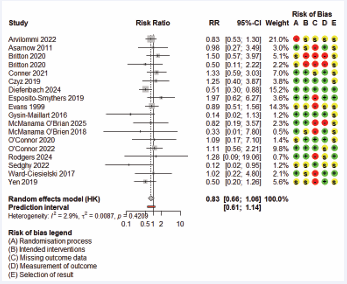
Figure 2: Forest plot for suicide attempts at post-treatment
DISCUSSION
With this study, we aimed to find more conclusive evidence on the effect of ultra-brief interventions on suicidal thoughts and attempts. However, where previous studies found indications for small effects on suicide attempts, we were unable to find evidence for an effect on either suicide attempts or suicidal thoughts. While there was moderate statistical heterogeneity for the effect on suicidal thoughts, there was virtually no heterogeneity between studies reporting on suicide attempts, which means differences between studies likely do not explain our result. Potentially, ultra-brief interventions could have an effect in the longer term, as the effect size increased for follow-up data, but with only 4 trials reporting on this, this effect was not statistically significant. Across studies patients received various other interventions in addition to the intervention. However, the intervention conditions which (also) offered the ultra-brief intervention, did not show significant differences from the control condition, from which we can conclude that there is no evidence for the effect of ultra-brief interventions whether or not this was combined with other interventions.
A possible explanation for this lack of effect could be similarities between intervention and control conditions [11]. When conducting research in a highly vulnerable population, many components that contribute to effective crisis management may be present in control conditions, either as part of treatment as usual, or as additional component to keep participants safe, mandated by institutional review boards. This may decrease the risk of suicide attempts in both groups, thereby limiting the effect between groups.
Another reason ultra-brief interventions may not be as effective could be related to the complexity of suicidality. Research shows that multilevel interventions are more effective in preventing (fatal) suicide attempts. Longer interventions may be able to address more effective elements, resulting in higher effects overall.
Moreover, given the distinct pathways to suicidal thoughts and suicidal behavior [12,13], interventions that are effective in reducing one may not be effective in reducing the other. This extends to subgroups, as interventions that may be effective for some but ineffective for others may lead to an overall null effect when investigated across the entire population. More detailed work on subpopulations and treatment moderators can identify what works for whom.
CONCLUSION
In conclusion, we would not recommend clinical guidelines for suicide prevention to include ultra-brief interventions based on the current evidence. Future research should focus on investigating which elements make up effective interventions, as well as investigating context and client characteristics.
REFERENCES
- Hetrick SE, Robinson J, Spittal MJ, Carter G. Effective psychological and psychosocial approaches to reduce repetition of self-harm: a systematic review, meta-analysis and meta-regression. BMJ Open. 2016; 6: e011024.
- Itzhaky L, Davaasambuu S, Ellis SP, Cisneros-Trujillo S, Hannett K, Scolaro K, et al. Twenty-six years of psychosocial interventions to reduce suicide risk in adolescents: Systematic review and meta-analysis. J Affect Disord. 2022; 300: 511-531.
- Calati R, Courtet P. and J Psychiatr. Is psychotherapy effective for reducing suicide attempt and non-suicidal self-injury rates? Meta-analysis and meta-regression of literature data. J Psychiatr Res. 2016; 79: 8-20.
- Stanley B, Brodsky B, Monahan M. Brief and Ultra-Brief Suicide-Specific Interventions. Focus (Am Psychiatr Publ). 2023; 21: 129-136.
- McCabe R, Garside R, Backhouse A, Xanthopoulou P. Effectiveness of brief psychological interventions for suicidal presentations: a systematic review. BMC Psychiatry. 2018; 18: 120.
- Doupnik SK, Rudd B, Schmutte T, Worsley D, Bowden CF, McCarthy E, et al. Association of Suicide Prevention Interventions With Subsequent Suicide Attempts, Linkage to Follow-up Care, and Depression Symptoms for Acute Care Settings: A Systematic Review and Meta-analysis. JAMA Psychiatry. 2020; 77: 1021-1030.
- Nuij C, van Ballegooijen W, de Beurs D, Juniar D, Erlangsen A, Portzky G, et al. Safety planning-type interventions for suicide prevention: meta-analysis. Br J Psychiatry. 2021; 219: 419-426.
- Ballegooijen WV, Rawee J, Palantza C, Miguel C, Harrer M, Cuijpers P. Database of psychological interventions for suicide prevention trials with control conditions. Published online. 2024.
- Van Ballegooijen W, Rawee J, Palantza C, Miguel C, Harrer M, Cristea I, et at. Suicidal Ideation and Suicide Attempts After Direct or Indirect Psychotherapy: A Systematic Review and Meta-Analysis. JAMA Psychiatry. 2025; 82: 31-37.
- Harrer M, PaulaKuper metapsy-project/metapsyTools: Version 0.3.3-5. Published online. 2022.
- Gaynor K, O’Reilly MD, Redmond D, Nealon C, Twomey C, Hennessy E. A meta-analysis of targeted interventions for reducing suicide-related behaviour and ideation in adolescents: Implications for trial design. Compr Psychiatry. 2023; 122: 152374.
- Berardelli I, Forte A, Innamorati M, Imbastaro B, Montalbani B, Sarubbi S, et al Clinical Differences Between Single and Multiple Suicide Attempters, Suicide Ideators, and Non-suicidal Inpatients. Front Psychiatry. 2020; 11: 605140.
- O’Connor RC, Kirtley OJ. The integrated motivational-volitional model of suicidal behaviour. Philos Trans R Soc Lond B Biol Sci. 2018; 373: 20170268.
Abstract
Introduction: Suicidal crises call for quick action to prevent suicides, with the field calling for shorter add-on treatment options. However, evidence for such ultra-brief interventions (one to four sessions) on suicidality is limited. This study aims to evaluate their effectiveness in reducing suicidal ideation and suicide attempts.
Methods: We systematically searched databases up to April 1st, 2025, for randomized controlled trials reporting on suicidal outcomes. Interventions with four sessions or less were included in the meta-analyses. Data screening and extraction was conducted by two independent researchers.
Results: A total of 25 articles were included, of which 8 reported on suicidal thoughts, 7 on suicide attempts, and 10 on both. Results at post-treatment showed that ultra-brief interventions were not associated with a significant reduction in suicidal ideation (g=-0.10,p=.258) or suicide attempts (RR=0.83, p=.127). Looking at results at follow-up yielded no differences, nor did various moderator analyses.
Discussion: These findings suggest that no conclusive evidence for the effectiveness of ultra-brief interventions can be given. To prevent suicide, longer, multilevel interventions are recommended. More research is needed on specific subgroups to identify whether ultra-brief interventions could be effective as add-on in some groups but not others.
Keywords
• Suicide
• Meta-analysis
• Psychotherapy
• Ultra-brief intervention
Citation
van Eijk NL, Marchand ACE, Gilissen R, Geerdink M, van Ballegooijen W (2026) Effectiveness of Ultra-Brief Psychological Interventions for Suicide Prevention: A Meta-Analysis. J Subst Abuse Alcohol 13(2): 1113.
INTRODUCTION
Psychological and psychosocial interventions are generally effective in significantly reducing suicidal thoughts, although with a small effect [1,2], as well as suicide attempts [3]. However, suicidality fluctuates significantly and a suicidal crisis can have a sudden onset, leading to the development of brief (6-12 sessions) and ultra-brief (1-4 sessions) interventions [4]. These interventions can be used as add-ons to regular care when needed, often focusing on specific treatment goals that directly target suicidal crises and mitigating (future) risk. Such ultra-brief interventions include safety planning interventions (SPI) and the Attempted Suicide Short Intervention Program (ASSIP). Previous research on the effectiveness of ultra brief interventions is mixed, with some suggestions ultra brief interventions may be successful in reducing suicide attempts but not ideation [5-7]. However, the research methodology varied widely between these studies, with one meta-analysis only investigating single-session interventions [6]. In this study, we aim to investigate the effect of ultra-brief interventions from randomised trials on suicidal ideation and suicide attempts using a series of meta-analyses.