Vocalization of Camels (Camelus bactrianus). Analysis of Verbal Communication between a mother and its Calf
- 1. Department for Veterinary and Animal Sciences (IVH), University of Copenhagen, Denmark
Abstract
It is well known that newborns vocalize with their mothers, who in turn use vocalization as a means of communicating with their offspring. However, relatively little is known about the type of signals used in vocalization, as well as their repeatability. The aim of this study, therefore, was to investigate the vocal communication of camels, specifically the communication between mother and calf. Recordings of vocalizations between a Bactrian camel (Camelus bactrianus), mother and her calf held in captivity in Denmark were made over the course of four days. An FFT-analysis of the vocalizations was performed to reveal their profiles and frequencies (Hz). The results, which are the first of their kind, show that camel mothers and their calves communicate vocally post-partum and that these vocalizations represent a variety of sounds, many of which are highly repeatable. It is concluded that camels use vocalization between mother and calf and that these sounds seem to be related to behaviour, which might suggest that vocal communication plays an important role in mother-offspring socializing. Further research on this subject is now needed.
Keywords
• Mother-Offspring
• Behaviour
• Auditory
• Socialization
Citation
Nørgaard JB, Harrison AP (2025) Vocalization of Camels (Camelus bactrianus). Analysis of Verbal Communication between a mother and its Calf.. Ann Otolaryngol Rhinol 12(3): 1363.
INTRODUCTION
Camels are an ungulate follower-species in which the mother-offspring relationship is strong [1]. In the wild they live in herds, most likely comprising about 10 animals [2]. It is known that wild Bactrian camels live in Mongolia and China but that they are an endangered species in both places [2,3]. Many ungulates use vocal communication post-partum. These vocalizations have been suggested as being a neonatal survival strategy [4], in which sounds are used as a sign of recognition for maternal care [5,6], as well as calls of distress [7]. In camels, maternal behaviour includes guarding the calf [8], as well as sniffing and vocalizing [9]. Vocalization is a part of behaviour seen post-partum and is reported in both the mother and the calf [9]. In camels, not much is known about this specific behaviour or its purpose, since vocalization in camels is a relatively unresearched field, especially with regard to post-partum vocalizations that are derived from the calf. The same is true for data concerning the vocal repertoire and sound frequencies of both mother and calf.
For the reasons stated above, this study has investigated the vocal communication of a Bactrian camel (Camelus bactrianus) and its calf, held in captivity in Denmark. The mother and calf were observed for a period of four days, during which spontaneous vocalizations from both the mother and the calf were recorded and analyzed. The aim of this study was to observe and shed light on vocalization post-partum as a means of behaviour between individual camels, as well as to broaden our general understanding of behaviour. The following hypotheses were therefore tested, 1) camels communicate verbally with their offspring post-partum; 2) vocalizations from the mother and the calf are not identical but instead represent a variety of sounds;3) vocalizations play a role in the mother-offspring relationship in Bactrian camels.
METHODS
Ethical consideration
The recordings and data collected in this study were done so in accordance with Danish Ethical Regulations and Laws. Interaction between the personnel making the recordings and the camels was non-invasive and no animals were harmed or manipulated during the period of this study.
Study design
The measurements and recordings were performed as an observational study of a single Bactrian camel mother (Camelus bactrianus) and her bull calf. The camels were observed in their home pasture at the owner’s property in Denmark where they were kept alongside three adult, male Bactrian camels (not included in this study).The mother was 7 years old at the time of the study and the calf was 3.5 months old (born 01/08-2022). The calf was the first to be born to this mother. The study was conducted over the course of four days in November 2022 and the camels were observed from outside the fence for approximately 5 hours each day. Neither of the camels were touched or interfered with except for when they sought contact, coming to the fence themselves since they are used to being handled. When the mother or the calf were heard to vocalize, the sounds they made were recorded using a portable Roland R-05 digital audio recorder (Roland Corp. Hamamatsu, Shizuoka, China). The camels were also filmed during the sound recordings using an iPhone 7 (Apple Inc. Cupertino, California, USA) when they vocalized.
Data analysis
All the sound recordings were transferred to a portable computer (ASUS Computer Inc. R465J, Taipei, China) as WAV-files. They were sorted into two categories: recordings with vocalizations and recordings without vocalizations (see Appendix 1). Data editing and analysis was performed using the program WavePad Sound Editor (NCH Software v17.02 downloaded 30/01-2023, Australia). Background noise was removed using the cleanup tool, although it was not possible to remove the background noise from all the recordings owing to wind noise and the noise made by other nearby animals (birds, pigs, donkeys) – such recordings were not analyzed further. Subsequent selected recordings were divided into their individual sounds and amplified 200-300%. A frequency analysis was performed for each selected sound using the Fast Fourier Transform tool found in WavePad Sound Editor. The frequency in Hertz (Hz) for each spike and for every sound was then noted and written into a Microsoft Excel sheet (Microsoft v.16.78), (see Appendix 2).
RESULTS
Vocalization frequencies
All vocalizations were observed as a closed mouth sound. The mother’s vocalizations sounded very much different from those from the calf, being more like “growling”, whereas the calf’s vocalizations were a lighter tone akin to “humming” sounds.Recordings were split into two categories: dialogue and monologue. For those classified as dialogue, there were a total of 12 recordings with dialogue between the mother and her calf. Of these, three recordings were selected because they were free of wind and other extraneous noises, and from these three recordings, it was possible to distinguish a total of 7 sounds from the calf and 5 sounds from the mother, which were subsequently analyzed in detail.For those classified as monologue recordings, there were a total of 14 recordings with monologue from the mother and the calf combined. Of these, three recordings were once again selected because they were free of wind and other extraneous noises, and from these three one was a monologue from the mother, and two were a monologue from the calf. These were also subsequently analyzed in detail. Sounds were only identified as being identical if their frequencies in each FFT peak did not vary by more than 2%.
Mother vocalizing
No sounds were found to be qualified as having identical FFT-profiles although similarities were found. The sounds from the mother were termed Dialogue Mother (DM). DM1 and DM2 started with the same frequency (12 Hz) but then moved on to different frequencies in the second FFT peak before again being almost similar in the third FFT peak (813 and 806 Hz, respectively). The sounds DM3 and DM4 were also very similar in terms of frequency for the first FFT peak (24 Hz) but then moved on to become quite different from each other in subsequent peaks. The sound DM5 started very differently from the other sounds with a higher frequency of 54 Hz, but similarities to DM1 were found in the second and third FFT peaks (Table 1).
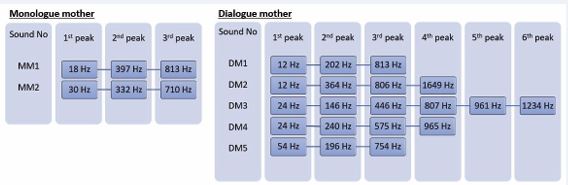
Table 1 Results of the FFT-analysis for mother vocalizations in dialogue (left)(Dialogue Mother; DM) and monologue (right)(Monologue Mother;MM). No sounds were found to be qualified as identical in either of these two categories. Values for each peak are given in Hertz (Hz).
For the monologue (Monologue Mother; MM) classified sounds a total of two sounds were chosen for analysis. The two sounds resembled each other but were not qualified as being identical (Table 1).
Calf vocalizing
Two sounds were classified as being identical, these were DC3 and DC4; Dialogue Calf (DC). Similarities were found for the remaining sounds. DC1 and DC3 were very similar for the second and third FFT peaks but were otherwise different and have thus not been classified as being identical.The sounds DC2 and DC7 were also almost similar except for the first FFT peak, and have therefore not been classified as being identical (Table 2).
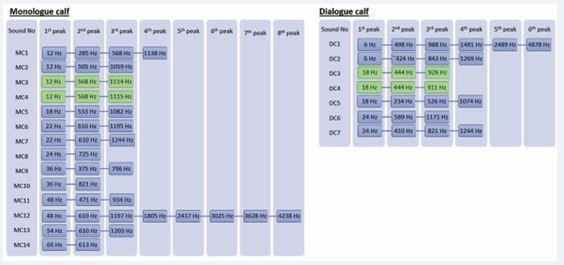
Table 2 Results of the FFT-analysis for calf vocalizations in dialogue (left)(Dialogue Calf; DC) and monologue (right)(Monologue Calf; MC). Twosounds were qualified as being identical in each category and are marked in green. Values for each peak are given in Hertz (Hz).
For the monologue sounds, two were qualified as being identical: MC3 and MC4; Monologue Calf (MC).Similarities were also found for other sounds, but these were not qualified as being identical as they showed differences in frequencies for some of the FFT peaks that were greater than 2%.The sounds MC6 and MC7 were identical for the first and second FFT peaks, and although they were very close for the third FFT peak, they differed more than 2% and were therefore not qualified as being identical.The sounds MC12 and MC14 were also very similar for the first, second and third FFT peaks, but because of the continuation of MC12, they were also not deemed to be qualified as being identical (Table 2). The waveform and spectrogram for each sound were analyzed, and an example of these can be found below (Figure 1).
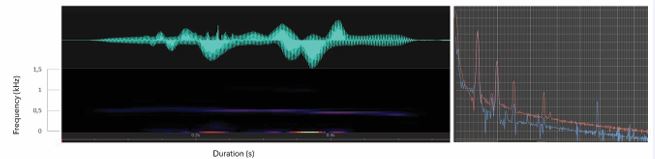
Figure 1 A typical waveform and spectrogram with linear scale (left) and FFT-profile (right) for DC1. The red and blue lines for the FFT-profile (right panel) indicate the right and left channels for the recording made using the Roland R-05 sound device.
The figure shows the FFT-profile analysed for one of the sounds (DC1), and below the blue-green waveform, you can see an example of the spectrogram represented as a blue, purple, red to yellow coloured line at the bottom of the figure. To the right, you can see a typical FFT profile with the first to sixth peaks shown clearly. FFT-profiles, spectrograms and waveforms for all of the analyzed sounds can be found in Appendix 3.
Duration of vocal calls
Not only the frequency with which the camels vocalized but also the duration of the sounds was analyzed in this study. The precise duration of each analyzed call can be found in Appendices 2 & 3, but the mean duration (± Std Dev) can be found in the following table (Table 3).
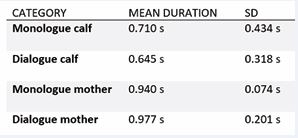
Table 3 The mean duration with standard deviation (SD) of each vocalization presented as the four categories DC, MC, DM, MM. Duration was measured in seconds (s).
Behaviour
From the video recordings taken in this study, it was clear that the camels expressed different behaviours. These behaviours have been listed as bullet points below and have been classified using the same terms as those used for dialogue and monologue.
Dialogue behaviour
- Mother vocalizing prior to walking around in the pasture, calf vocalizes and follows, mother continues walking while lifting her head and looking around all whilst vocalizing, calf vocalizing and following.
- Calf being interested in the recorder, mother turning her head towards the calf, calf vocalizing,mother vocalizing and walking away, another camel approaches and the calf walks away.
- Calf vocalizing prior to attempting to nurse, mother answering but walks away, calf follows but no more vocalization.
- Calf and mother are standing together, calf vocalizing as taking a few steps, mother vocalizes but does not move.
- Calf vocalizing in between feeding, mother answers but then walks in a circle around the calf.
- Calf vocalizes while following mother. She vocalizes and stops as the calf catches up.
- Mother walks and vocalizes, calf follows and vocalizes.
- Mother lifting her head and vocalizing, mother vocalizing prior to calf feeding.
- Mother walking, calf vocalizes as it follows prior to attempting to feed, mother stops and vocalizes, calf nurses, calf vocalizes after nursing.
- Calf and mother vocalize as calf is nursing.
These observed behaviours suggest that dialogue vocalization mainly happens in connection with nursing and feeding situations, but also when the mother and calf are moving somewhere else in the enclosure.
Mother monologue behaviour
- Mother vocalizing while calf is nursing, the mother walks in a circle around the calf.
Mother monologue behaviour was only observed when the calf was nursing. Additionally, the mother was observed snorting and unintentionally spitting at the calf when it bit her ear and while they were both eating hay. The calf walked away after being snorted at.
Calf monologue behaviour
- Calf vocalizing while mother is sitting down, calf lays over her, jumps on her with its front legs, swings its head all while vocalizing.
- Calf walks towards the recorder.
- Calf sits behind the mother as in a mating position.
- Calf walks around mother while vocalizing.
- Calf vocalizes as it is walking away from the mother.The mother does not follow.
These results suggest that monologue behaviour also occurs during nursing and that the calf vocalizes when expressing behaviour such as laying on top of and jumping with its front legs on its mother, sitting behind the mother as if in a mating position, whilst swinging its head and walking around on its own.
DISCUSSION
To the authors knowledge this is the first study to measure and provide an insight into vocal communication in camels, and in particular the vocalization that occurs between mother and calf. The results support the hypothesis that camels communicate verbally with their offspring post-partum, and even goes so far as to identify some key behaviours. Furthermore, the data support the idea that vocalizations from the mother and the calf are not identical but instead represent a variety of sounds, which could be interpreted as true communication.It should be noted that this study has a very small population size, focusing rather on the vocalizations between just one mother and its calf, rather than a cohort of animals. For this reason, no statistical analysis was performed on the recordings. There are only very few recordings in the category monologue, for the mother, which is due to the fact that the mother would make a single vocalization and then no more, and since the camels were recorded manually, these were not recorded. In future studies constant sound recordings with video surveillance would be a better option. Of course, this study only recorded the sounds that were audible to the human ear and may as a result have missed some low frequency or very high frequency communications (human auditory range: 20-20kHz). Indeed, the precise auditory range of camels has yet to be determined, and it may turn out to be very different from that of humans. Future studies should also try to address the issue of recording outdoors and the interference posed by wind, passing cars, birds and other animals. Finally, future studies may wish to examine the effect of an observer on the vocalizations made by camels, since it is not known whether the presence of a human subject has an influence on camel vocalization.
Postpartum vocalization
Postpartum verbal communication between mother and calf has also been reported previously. One study of maternal and neonatal behaviour during the first week postpartum in dromedary camels (Camelus dromedarius) found that calves and their mothers vocalize postpartum especially the first two days [9]. The present study, conducted over a period of four days supports the findings of Hammadi and colleagues but also extends their work by showing that mother and calf communicate verbally for at least 3.5 months postpartum. Hammadi, Chniter, Atigui et al. [9], reported in their study that the number of vocalizations rapidly declined to less than 2 times within a 30 minute period for multiparas camels and less than 1 time for primiparas camels 7 days postpartum. The same was reported in the calves with less than 2 total vocalizations in 30 minutes for male calves and less than 1 for female calves 7 days postpartum [9]. Hammadi, Chniter, Atigui et al. [9], also reported multiparas mothers to vocalize more than primiparas mothers.
Sound variations
The FFT-analysis of the vocalizations in this study show that the majority of the vocalizations are different in their frequencies (Hz) and only very few are identical. This supports the hypothesis that vocalizations from the mother and the calf represent a variety of sounds, and as such may indicate true communication rather than an example of calves mimicking the sounds made by their mother. In a study performed on adult animals (four C. bactrianus and two C. dromedarius) Volodin and colleagues found the camels to perform high frequency “whistling” sounds [10], with Bactrian camels vocalizing at 1700 Hz (± 160 Hz). A whistling sound has been reported in camel males when grinding their teeth and the sound has been reported to be “higher” in dromedary camels than Bactrian camels but whether that means a higher frequency or decibel (volume) was not specified by the authors [8]. Such whistling sounds are very different from the “growling” sounds recorded in the present study, although we cannot ignore the possibility that there is far more variation in camel vocalization than recorded in the present study. Only closed mouth sounds were recorded in the present study from both the mother and the calf, although both closed (low pitch bleat), and open mouth (high pitch bleat), vocalizations have been reported in camels [9].
Vocalization behaviour
In the present study, dialogue vocalization was observed mostly in connection with the calf feeding and mother and calf walking somewhere else in the enclosure. However, it should be noted that they were also observed to walk in the enclosure without vocalizing. Volodin and colleagues [10], found that camels vocalized when aroused by activity from people or other nearby camels. They found that high frequency whistles were produced by males in the autumn and winter and by females in the spring. This finding is in contrast to the present study, where the mother camel vocalized during the autumn months in Denmark. Volodin and colleagues [10], also reported one female Bactrian camel to produce high frequency calls postpartum when a researcher examined the calf and while guarding her calf. Guarding behaviour was not observed in the present study, most likely since the camels were not interfered with. Of further interest is the finding that vocalization towards the calf were not reported by Volodin and his colleagues [10].
In the present study the calf was recorded vocalizing repeatedly without a response from the mother (monologue). In one video recording the calf was observed leaning its head on the mother, jumping and putting its front legs on the mother, standing and sitting behind her (a mating-like behaviour [8]) all while the mother remained seated and ruminating, yet there was no response to the calf’s vocalizations (this behaviour was observed in relation to recordings MC3, MC4, MC6, MC7, MC12 and MC14).A study with Asian elephant calves (Elephas maximus; n=6) aged 6 to 27 months from two Zoological parks categorized vocalization in regard to behaviour [11]. They reported that most vocalizations were emitted during play or play fighting but that the elephant calves also
vocalized as a response to other elephants vocalizing, not just the mother. The calves were also reported vocalizing in connection with feeding, human interaction, being let in from an enclosure, when in need of assistance and when in physical contact with another elephant. The play behaviour and play fighting seen in elephants is comparable to that observed in the camel calf and may suggest that this behaviour observed with monologue is a form of play.Vocal contact calls: The camels in the present study exhibited vocal communication, here labeled as dialogue, and this was observed when the mother and her calf walked together, also in connection with feeding. This suggests a mother-offspring relationship. Sadly, the authors know of no other studies in which the mother-offspring relationship and recognition has been studied in camels, making it hard to either confirm or deny the existence of such a relationship. The only potential supporting material may be found on UNESCO’s website, which reports a coaxing ritual traditional to Mongolia. The coaxer sings to a female camel and thereby coaxes her to accept or adopt an orphaned calf, although others have reported that it is very difficult to get a female camel to accept an orphaned calf [1].
CONCLUSION
The aim of this study has been to investigate the hypothesis that a camel mother and her calf vocalize postpartum as well as the hypothesis that vocalizations from the mother and the calf represent a variety of sounds. The camel mother and her calf were recorded to vocalize at least up to 3.5 months postpartum, whilst others have reported vocalization to exist only within the first few weeks of life [9]. The present study presents evidence that camels communicate verbally with their offspring postpartum, and the FFT-analysis of vocalizations from the mother and calf have shown that vocalizations are mostly different. It is concluded that vocalizations play a role in the mother-offspring relationship in Bactrian camels.
ACKNOWLEDGEMENTS
The authors have contributed equally to the process of writing this paper, JBN undertook the study design and recordings, and data analysis. The authors acknowledge the kind help and assistance of Henrik Svanholm Møller for welcoming JBN and AH on his property and letting JBN record his camels for this purpose of this project.
REFERENCE
- Wilson RT. Natural and man-induced behaviour of the one-humpedcamel. J Arid Environments. 1990; 19: 325-340.
- Reading RP, Mix H, Lhagvasuren B, Blumer ES. Status of wild Bactriancamels and other large ungulates in south-western Mongolia. Oryx.1999; 33: 247-255.
- Hare J. Status and distribution of wild Bactrian camels (Camelus bactrianus ferus) in China. J Camel Practice and Res. 1997; 4: 107- 110.
- Sibiryakova OV, Volodin IA, Frey R, Zuther S, Kisebaev TB, Salemgareev AR, et al. Remarkable vocal identity in wild-living mother and neonate saiga antelopes: a specialization for breeding in huge aggregations? Naturwissenschaften. 2017; 104: 11.
- Torriani MV, Vannoni E, McElligott AG. Mother-young recognition in an ungulate hider species: a unidirectional process. Am Nat. 2006; 168: 412-420.
- Mónica Padilla de la Torre, Elodie F. Briefer, Tom Reader, Alan G. McElligott. Acoustic analysis of cattle (Bos taurus) mother-offspring contact calls from a source-filter theory perspective. Applied Animal Behaviour Science. 2015; 163: 58-68.
- Sibiryakova O, Volodin I, Landete-Castillejos T, Sibiryakova OV,Volodin IA, Matrosova VA, et al. The power of oral and nasal calls to discriminate individual mothers and offspring in red deer, Cervus elaphus. Front Zoology. 2015; 12.
- Nath K, Ranjan R, Narnaware SD, Sawal RK, Patil NV. A comparative study on sexual and maternal behaviour of Bactrian and dromedary camel. Indian J Animal Reproduction. 2016; 37: 9-13.
- Hammadi I, Chniter M, Atigui M, Brahmi M, Seddik MM, Salem WB, et al. Dam parity and calf sex affect maternal and neonatal behaviors during the first week postpartum in stabled Maghrebi dairy camels. Animal. 2021; 15: 100149.
- Volodin IA, Volodina EV, Rutovskaya MV. Camel whistling vocalisations: male and female call structure and context in Camelus bactrianus and Camelus dromedarius. Bioacoustics. 2021; 31: 132-147.
- Herler A, Stoeger AS. Vocalizations and associated behaviour of Asian elephant (Elephas maximus) calves. Behaviour. 2012; 149: 575-599.