Genetic Basis of Retinitis Punctata Albescens (RPA) and Fundus Albipunctatus (FA): Overlapping Phenotypes and Diagnostic Approaches
- 1. Center for Biomedical Innovation and Technology, Puai Medical College, Shaoyang University, China.
- 2. Department of Zoology, Faculty of Biological Sciences, Quaid-i-Azam University, Pakistan
- 3. Department of Ophthalmology, The First Affiliated Hospital of Shaoyang University, China
Abstract
We reviewed recent scientific literature and clinical guidelines to summarize the clinical utility of genetic testing for Retinitis Punctata Albescens (RPA) and Fundus Albipunctatus (FA), which are rare forms of inherited retinal dystrophies. Despite overlapping phenotypes, they differ in clinical progression and genetic etiology, with RLBP1 and RDH5 as primary causative genes. Molecular testing, including next-generation sequencing, whole exome and whole-genome sequencing, is widely available in accredited laboratories and enables accurate diagnosis. The prevalence of the condition remains largely unknown. Accurate differentiation between progressive and stationary forms is essential for appropriate clinical management and informed genetic counseling. Moreover, comprehensive genetic analysis may reveal unexpected findings, including carrier status for unrelated conditions or variants associated with other retinal disorders. These results underscore the importance of careful interpretation and counseling to support patient management and reduce the risk of disease transmission.
Keywords
• Retinitis Punctata Albescens
• Fundus Albipunctatus
• Retinal dystrophies
• RLBP1
• RDH5
Citation
Khan R, Channa J, Wang H (2026) Genetic Basis of Retinitis Punctata Albescens (RPA) and Fundus Albipunctatus (FA): Overlapping Phenotypes and Diagnostic Approaches. JSM Ophthalmol 13(1): 1099.
INTRODUCTION
Inherited retinal dystrophies (IRDs) represent a genetically heterogeneous group of disorders characterized by progressive degeneration of photoreceptors and retinal pigment epithelium (RPE) [1]. Among these conditions, Retinitis Punctata Albescens (RPA) and Fundus Albipunctatus (FA) are rare retinal disorders that present with similar ophthalmoscopic findings, particularly the presence of numerous white or yellowish dots scattered throughout the retina. Despite their overlapping phenotypes, the two diseases differ in clinical progression and genetic background, which complicates clinical diagnosis and proper management [1,2].
Retinitis punctata albescens (RPA) (OMIM: 136880) is generally considered a subtype of retinitis pigmentosa characterized by progressive night blindness (nyctalopia), attenuated retinal vessels, and gradual photoreceptor degeneration. Patients typically exhibit progressive visual field compression and reduced electroretinogram (ERG) responses due to rod photoreceptor dysfunction. Mutations in genes involved in the visual cycle particularly RLBP1 (OMIM: 180090) have been identified as a major genetic cause of RPA. Variants in other genes such as PRPH2 (OMIM: 179605), RHO (OMIM: 180380) and occasionally in RDH5 (OMIM: 601617) have also been implicated, highlighting the genetic heterogeneity of the disease [3,4].
Fundus albipunctatus (FA) (OMIM: 136880) is typically classified as a form of congenital stationary night blindness characterized by numerous discrete white dots distributed throughout the fundus, especially in the mid peripheral retina. Unlike RPA, FA is generally considered non-progressive or slowly progressive and is frequently associated with delayed dark adaptation rather than severe retinal degeneration. Mutations in the RDH5 gene (OMIM: 601617) are the most common cause of FA. RDH5 encodes 11-cis-retinol dehydrogenase, an enzyme essential for the retinoid cycle in the retinal pigment epithelium. Variants in RLBP1, RPE65, and other retinoid cycle genes have also been reported to produce FA like phenotypes, indicating shared molecular pathways between FA and RPA [5].
Recent genetic studies have established that mutations in RLBP1 and RDH5 can produce overlapping phenotypes ranging from stationary night blindness to progressive rod-cone dystrophy. This phenotypic continuum suggests that RPA and FA may represent different clinical manifestations within a spectrum of visual cycle disorders. For example, individuals with RLBP1 variants may initially present with FA like findings but later develop progressive retinal degeneration consistent with RPA [5,6].
Advances in molecular genetics, particularly next generation sequencing (NGS), have greatly improved the identification of causative variants in inherited retinal diseases. Comprehensive testing, including targeted panels, WES, and WGS, enhances diagnostic accuracy, enables genotype–phenotype correlation, and supports genetic counseling. Given the clinical overlap between RPA and FA, genetic testing is essential for confirming diagnoses, distinguishing progressive from stationary forms, and identifying patients eligible for emerging gene based therapies and clinical trials.
PURPOSE OF GENETIC TESTING
The clinical objectives of genetic testing for RPA and FA are summarized in Figure 1
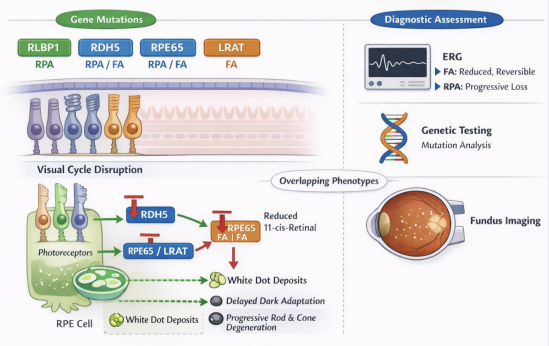
Figure 1 Genetic and phenotypic overlap between Retinitis Punctata Albescens (RPA) and Fundus Albipunctatus (FA). Mutations in shared genes (RDH5, RPE65) disrupt the visual cycle, leading to white dot deposits and delayed dark adaptation. RPA shows progressive rod/ cone degeneration, while FA typically presents reversible functional deficits. Diagnostic approaches include ERG, genetic testing, and fundus imaging.
- Identify pathogenic variants in genes associated with flecked retinal dystrophies.
- Confirm the molecular diagnosis in patients with clinical features of RPA and FA.
- Differentiate between progressive dystrophies and stationary night blindness. retinal
- Enable accurate genetic counseling and reproductive risk assessment.
- Facilitate eligibility for gene-based therapies and clinical trials.
MOLECULAR DIAGNOSTIC TESTING
Genetic testing for flecked retinal disorders are available in accredited laboratories across Europe and the United States as listed in the Orphanet and Genetic Testing Registry (GTR) databases. These laboratories follow internationally recognized standards for molecular diagnostics, including quality assurance and validation protocols. Clinical guidance from MedlinePlus Genetics, the American College of Medical Genetics and Genomics (ACMG), and the European Society of Human Genetics (ESHG) emphasizes integrating clinical evaluation, ophthalmologic examination, electrophysiology, and molecular testing. This combined approach ensures accurate diagnosis, supports appropriate interpretation of results, and guides patient management, counseling, and potential therapeutic interventions.
GENETIC TESTING STRATEGY AND PROTOCOL
A multi-gene NGS panel is employed to detect nucleotide variations in the coding exons and flanking introns of the PRPH2, RDH5, RHO, and RLBP1 genes. Potentially pathogenic variants and regions with insufficient coverage are further analyzed using Sanger sequencing. For the detection of deletions or duplications in PRPH2, RHO, and RLBP1, MLPA is utilized. Sanger sequencing is also applied for family segregation studies to confirm inheritance patterns. This testing approach allows the identification of variations in known causative genes in patients suspected of having Retinitis punctata albescens (RPA) or Fundus albipunctatus (FA). Typically, a single biological sample is sufficient for molecular diagnosis, which may consist of 1 mL of blood collected in a sterile tube containing 0.5 mL K3EDTA, or 1 mL of saliva in a sterile tube with 0.5 mL of 95% ethanol. Repeat sampling is rarely necessary. As gene disease associations and the interpretation of genomic variants continue to advance with ongoing research and data accumulation, the set of genes included in diagnostic panels and the classification of specific variants may be updated to reflect emerging evidence. Variants currently designated as of “uncertain significance” may subsequently be reclassified as benign, likely benign, likely pathogenic, or pathogenic as additional clinical, functional, or population data become available according to ACMG/AMP guidelines and observed reclassification trends in clinical practice. [7].
INTERPRETATION OF TEST RESULTS
Positive Result
A positive genetic test result indicates the presence of a pathogenic or likely pathogenic variant in a gene associated with RPA or FA, confirming the molecular diagnosis. This information can guide prognosis, clinical management, and family counseling. The specific inclusion and exclusion criteria for testing are detailed in Table 1, ensuring appropriate patient selection and accurate interpretation of results.
Table 1: Inclusion and Exclusion Criteria.
|
Category |
Criteria |
|
Inclusion Criteria |
|
|
|
Night blindness (nyctalopia) |
|
|
Multiple white retinal dots observed on fundus examination |
|
|
Abnormal or delayed dark adaptation |
|
|
Reduced or absent rod responses on electroretinography (ERG) |
|
|
Family history of inherited retinal disease |
|
|
Clinical suspicion of retinitis pigmentosa or flecked retina dystrophy |
|
|
Multiple white retinal dots observed on fundus examination |
|
Exclusion Criteria |
|
|
|
Patients with acquired retinal lesions caused by inflammatory or infectious conditions |
|
|
Individuals with retinal white dots resulting from drug toxicity or metabolic disorders |
|
|
Cases where clinical findings clearly indicate a non-genetic retinal pathology |
Negative Results
A negative result does not exclude the disease because:
- The causative variant may lie in non-coding regions not covered by the test.
- The responsible gene may not yet be identified.
- Structural variants or complex rearrangements may not be detected by certain platforms.
UNEXPECTED OUTCOMES
Genetic testing for RPA and FA may occasionally reveal findings beyond the primary diagnostic target. Individuals may be carriers of pathogenic variants in unrelated genes, indicating potential risk for offspring. Testing can also identify variants linked to other retinal dystrophies or syndromic conditions, requiring further evaluation. Sometimes, detected variants may not fully match the observed clinical phenotype, suggesting complex or overlapping genetic backgrounds. These outcomes underscore the need for comprehensive interpretation within the context of clinical findings and family history, as well as thorough genetic counseling to guide patient management, reproductive planning, and follow-up.
These unexpected outcomes highlight the importance of:
- Comprehensive interpretation of test results within the context of clinical findings and family history.
- Genetic counseling, to inform patients and families about potential health implications, reproductive risks, and the need for further testing or follow-up.
ANALYTICAL SENSITIVITY AND SPECIFICITY
Molecular testing for RPA/FA demonstrates high analytical performance across different platforms. Next-generation sequencing (NGS) achieves an analytical sensitivity of >99% with a minimum coverage of 10× and an analytical specificity of 99.99%. Sanger sequencing provides both sensitivity and specificity >99.99%, making it ideal for confirming detected variants. Multiplex ligation-dependent probe amplification (MLPA) also demonstrates sensitivity and specificity exceeding 99.99%. These high analytical metrics ensure accurate detection of single nucleotide variants, small insertions/deletions, and copy-number variations in genes such as RLBP1 and RDH5, which underlie RPA and FA [8].
CLINICAL SENSITIVITY AND SPECIFICITY
Clinical sensitivity of genetic testing for RPA and FA depends on the gene and cohort studied. Recent cohort data show that patients with confirmed RLBP1 variants exhibit a spectrum of retinal changes, with macular atrophy and structural progression identifiable in most cases, and a subset of hypomorphic variants producing milder phenotypes detectable by full-field ERG and imaging measures, highlighting significant phenotypic variability and aiding diagnostic yield [9]. Cases with RDH5-associated retinopathy similarly present congenital night blindness and progressive macular involvement in some adults, reflecting expanded phenotype beyond classic stationary FA. Screening panels including both genes have improved variant detection, though precise mutation frequency varies by population and clinical ascertainment [10]. Clinical specificity of targeted molecular testing remains high (~99.99%) in accredited laboratories, given rigorous validation and consensus variant classification. A detailed description of the analytical and clinical sensitivity is summarized in Table 2, while the clinical specificity is estimated at approximately 99.99% based on the author’s laboratory data. [10]
Table 2: Analytical and Clinical Performance of Genetic Testing for RPA and FA
|
LIMITATIONS
Despite significant advances, genetic testing for inherited retinal diseases has several limitations: Not all causative genes are known. Some variants may be classified as variants of uncertain significance (VUS). Certain structural variants or deep intronic mutations may escape detection. Coverage gaps may occur in targeted sequencing panels. Phenotypic overlap between retinal disorders may complicate genotype–phenotype interpretation.
REFERENCES
- Nebbioso M, Artico M, Gharbiya M, Mannocci A, Limoli PG, Iannetta D, et al. State of the Art on Inherited Retinal Dystrophies: Management and Molecular Genetics. J Clin Med. 2025; 14: 3526.
- Stöhr H, Weber BH. Genetics and diagnostics of inherited retinal diseases in the era of whole genome sequencing. Medizinische Genetik. 2025; 37: 3-10.
- Scimone C, Donato L, Esposito T, Rinaldi C, D’Angelo R, Sidoti A. A novel RLBP1 gene geographical area-related mutation present in a young patient with retinitis punctata albescens. Human Genomics. 2017; 11: 18.
- Khan R, Shabbir RM, Raza I, Abdullah U, Naeem MA, Ahmed A, et al. A founder RDH5 splice site mutation leads to retinitis punctata albescens in two inbred Pakistani kindreds. Ophthalmic Genetics. 2020; 41: 7-12.
- Dong Y, Xue R, Zhang Y, Jia X, Jiang M, Xue M, et al. Fundus albipunctatus disease-associated RDH5/L310delinsEV mutation undertakes AMFR-mediated polyubiquitination and degradation in proteasome. Exp Eye Res. 2026: 110927.
- Bianco L, Antropoli A, Benadji A, Condroyer C, Antonio A, Navarro J, et al. RDH5 and RLBP1-associated inherited retinal diseases: refining the spectrum of stationary and progressive phenotypes. Am J Ophthalmol. 2024; 267: 160-171.
- Richards S, Aziz N, Bale S, Bick D, Das S, Gastier-Foster J, et al. Standards and guidelines for the interpretation of sequence variants: a joint consensus recommendation of the American College of Medical Genetics and Genomics and the Association for Molecular Pathology. Genet Med. 2015; 17: 405-423.
- Chen B, Gagnon M, Shahangian S, Anderson NL, Howerton DA, Boone JD, Centers for Disease Control and Prevention (CDC). Good laboratory practices for molecular genetic testing for heritable diseases and conditions. MMWR Recomm Rep. 2009; 58: 1-37.
- Hipp S, Zobor G, Glöckle N, Mohr J, Kohl S, Zrenner E, Weisschuh N, Zobor D. Phenotype variations of retinal dystrophies caused by mutations in the RLBP 1 gene. Acta ophthalmologica. 2015; 93: e281-286.
- Ford LM. RDH5-/-Cats as a Model for Macular Degeneration and Retinal Dysfunction in Humans (Doctoral dissertation, Michigan State University).