Changes by Aqueous Extracts from Atemoya in Energy Metabolism and Mitochondrial Activity of Tumor and Normal Renal Cells
- 1. Department of nutrition, Potiguar University, Brazil
- 2. Department of nutrition, Federal University of Rio Grande do Norte, Brazil
- 3. Department of Health Sciences, Federal University of Rio Grande do Norte, Brazil
- 4. Department of Biochemistry and Molecular Biology, Federal University of Grande do Norte, Brazil
- 5. Department of Biochemistry, Federal University of Rio Grande do Norte, Brazil
- 6. Department of nutrition, Federal University of Rio Grande do Norte, Brazil
Abstract
Atemoya is a hybrid fruit containing phenolic substances, mainly flavonoids, which can provide antioxidant, and antimicrobial properties, among others. The phenolic compounds inhibit the action of free radicals, protecting organic molecules, thus being able to prevent carcinogenic processes. Thereby, the present paper aims to evaluate the phytochemical compounds and the cellular viability of atemoya extracts in human renal carcinogenic lineages. For such, the cytotoxicity capacity of three extracts of the fruit (seed, pulp and peel) was tested for tumor (786-0) and normal (HEK-273) lineages. Cytotoxicity was evaluated indirectly by the enzymatic reduction of 3-(4,5-dimethylthiazol-2-yl)-2,5-diphenyltetrazolium bromide (MTT) for formazan crystals and the mitochondrial activity was evaluated by coenzyme Q10 (HPLC) and creatine kinase (chemical kinetics) dosages. The results show that there is an increase in normal cell mitochondrial activity, and inhibition of mitochondrial activity in tumor cells in specific concentration tests. Therefore, it is suggested that atemoya extracts alter the metabolism of normal and tumor cells, thus being a potential biomarker for tumor cells, allowing several benefits to emerge, such as the reduction of side effects from innovative treatments.
Keywords
• Annona
• Phytochemicals
• Mitochondrial stress
• Cytotoxicity
Citation
Floripes AL, de Moura AYS, de Carvalho FMC, da Silva DCP, Serquiz RP, et al. (2017) Changes by Aqueous Extracts from Atemoya in Energy Metabolism and Mitochondrial Activity of Tumor and Normal Renal Cells. J Hum Nutr Food Sci 5(2): 1108.
INTRODUCTION
Cancer occurrences grow as consequence of the industrial society. Urbanization modifies the population’s life and consumption patterns, combining smoking, obesity, sedentary lifestyle, diets poor in vegetables, increased consumption of fats and processed meats, and exposure to agrochemicals [1]. These factors may explain the Brazilian National Cancer Institute’s estimate for 2016 of nearly 600,000 new cancer cases in Brazil [2]. Different mechanisms may promote the development of cancer. Among these is the exacerbated production of free radicals, and reactive oxygen and nitrogen species, due to external and internal factors. Those radicals and reactive oxygen and nitrogen species) act on cells, altering their membranes and causing a decline in their functions. They are then eliminated by the immune system. However, the increase of altered cells, caused by the excess of free radicals, and the chronological aging of the organism may render the elimination of these cells unfeasible. Thereby, some of them survive and begin to function inadequately, thus altering the physiology of the organism [3,4]. The forms of evaluate and to research the develop of cancer is by observational studies played with isolated and established cells. Some activities detected in basic researches in a variety of organisms become advanced, specific and clinical studies. The cancer researchers have recent studies [5] done with molecules that been pre-identified for a long time [6,7]. A variety of cell mechanisms can be tested to elucidate the influence of samples in their metabolism, and the mitochondrial arsenal complexes are the most frequently chosen targets. Creatine kinase (CK) is an enzyme responsible by regenerate the ATP levels by transfer of the phosphoryl group to ADP, both their mitochondrial and cytosolic isoforms, which together constitute an energy transport system in cell’s energetic metabolism [8]. Q10 Coenzyme (Cq10) is a molecule that has function in bioenergetics, playing a fundamental role in mitochondrial membrane for the ATP production, specifically in electron transport chain. In addition to participation in energy coupling, Cq10 performs activities in oxidative stress, cell signalization and gene expression, evince that Cq10 can mark cell metabolism by mitochondrial activity [9,10]. Studies suggest that frequent consumption of fruits and vegetables is associated with a reduction in the incidence of various diseases, including cancer, sincethe former are rich in natural antioxidants [11]. However, there is little information on the medicinal and nutritional value of tropical and subtropical fruits, especially on the more exotic species, of which atemoya can be highlighted. Atemoya (Annona x atemoyaMabb.) is a hybrid fruit originating from the crossing of the cherimoya (Annona cherimola Mill.) and the sugar apple (Annona squamosa L.), belonging to the Annonaceae family. Its chemical composition comprises carbohydrates, proteins, fibers, potassium, magnesium, ascorbic acid, α and β-carotene, calcium and traces of lipids [12,13]. Furthermore, the aforementioned hybrid fruit contains phenolic substances, mainly flavonoids, which can provide antioxidant and antimicrobial properties, as shown in previous studies [14]. Phenolic compounds inhibit the action of free radicals, protecting molecules of the body, such as the deoxyribonucleic acid (DNA). This enables the prevention of some degenerative diseases based on damage to the DNA, notwithstanding others with the same basis, such as the carcinogenic processes [15]. Residues such as peel and seed of fruits and vegetables are often discarded by consumers and industries. Those could, otherwise, be used as an alternative source rich in nutrients, and safely be used in food. Some studies have addressed a relationship between fruit and vegetable consumption and the positive impact on health, prevention of chronic diseases, reduction of mortality risk and achievement of food benefits. Other studies point to the nutritional potential of residues like seeds, bagasse and bark of vegetable, for production of new foods. Although wasteful, present in their composition are: fibers, minerals, antioxidant compounds and vitamins – useful nutrients for human consumption. Often in residues there is a higher content of nutrients when compared to the edible part [15,16]. It is acknowledged that the properties of atemoya and its residues are unknown or little studied, so it becomes important to explore their biotechnological and pharmacological potentials. Due to reduced number of studies about atemoya found in the literature, the present study aims to evaluate the phytochemical compounds and the influence of atemoya extracts in normal and carcinogenic renal cells metabolism, by evaluation of mitochondrial activity.
METHODOLOGY
Raw material collection
The atemoya samples were commercially obtained, through supermarkets in the city of Natal/RN, Brazil. They were washed in running water, treated in a 2.5% sodium hypochlorite solution for fifteen minutes. They were, then, rewashed in running water and stored in a conventional freezer until the analyzes were performed.
Extract preparation
To obtain the aqueous extracts different parts (peel, seed and pulp) from atemoya fruits were used. For this purpose, the 1:1 (w/v) of fruit parts (grams) and distilled water (in ml) was used. These solutions were homogenized for three hours. The crude extract was obtained after being filtered on filter paper and dried in a lyophilizer. Posteriorly, it was weighed, reconstituted in distilled water and centrifuged, and then the supernatants at the concentrations (8, 10 and 50 μg) were used for the tests.
Qualitative analytical phytochemical test
The extracts obtained from peel, pulp and seed were submitted to qualitative phytochemical tests to determine the presence of reducing sugars (reaction with Fehling’s reagent), alkaloids (reaction with Bouchardat’s reagent), anthraquinones (reaction with benzene solution and Ammonium hydroxide), depsides and depsidones (reaction with diethyl ether solution, methanol and ferric chloride), steroids (reaction with chloroform solution, acetic anhydride and sulfuric acid), polysaccharides (reaction with lugol), purines (reaction with hydrogen peroxide) , Saponins and tannins (reaction with ferric chloride), as to procedures previously described in the literature [17].
Mitochondrial activity evaluation
The viability of commercially available renal tissue tumor (786-0), or normal (HEK-273) cell lineages regarding the aqueous extracts of atemoya at the concentrations of 8, 10 and 50 μg was indirectly evaluated by the enzymatic reduction of 3-(4,5-dimethylthiazol-2-yl)-2,5-diphenyltetrazolium bromide (MTT, Sigma Aldrich, St. Louis, USA) for formazan crystals [18]. The cells are tested in 96 well plate with density of 3.0×10³ cells/ well in the same conditions of maintenance: was used Dulbecco’s Modified Eagle Medium (DMEM, Gibco, Grand Island, NY, USA) supplemented with 10% of fetal bovine serum and the antibiotics penicillin (100 UI/ml) and streptomycin (100 µg/ml), in a 37°C and 5% CO2 atmosphere. Moreover, aimed to corroborate with mitochondrial activity elucidated byformazan crystals formation, the supernatant of cells obtained post-treatment with aqueous extracts of atemoya was evaluated to measure Q10 coenzyme (Cq10) and Creatine Kinase (CK).The kinetic reaction described by Tanzer and Gilvard (1959) was used to detect levels of CK on the samples [19]. Cq10 was measured by high pressure liquid chromatography (HPLC) with electrochemical detection [20].
Statistical analysis
All the data from the experiments were expressed as mean ± standard deviation. To test differences between samples, as well as different treatments of the same sample, the Graphpad Prism 7.0a, CA, USA was used.
RESULTS AND DISCUSSION
The results presented in Table 1 refer to the qualitative analysis of phytochemical compounds found in the extracts.
|
Table 1: Qualitative analysis of phytochemical compounds present in the aqueous extracts of the peel, seed and pulp of the atemoya fruit at the ratio of 1:1. |
|||||
|
Presence |
Reagents Employed |
Positive Result |
Observed Results |
||
|
Peel |
Pulp |
Seed |
|||
|
Reducing sugars |
Distilled water, Fehling's reagent and hydrochloric acid |
Red precipitate formation |
+ |
+ |
- |
|
Alkaloids |
Distilled water and hydrochloric acid |
Precipitate Formation |
+ |
+ |
+ |
|
Anthraquinones |
Distilled water, benzene and ammonium hydroxide |
Emergence of red or violet coloration |
+ |
+ |
- |
|
Depsides and depsidones |
Distilled water, ethyl ether, methanol and ferric chloride |
Emergence of green, blue or grey coloration |
+ |
+ |
- |
|
Steroids |
Distilled water, chloroform, acetic anhydride and sulfuric acid |
Emergence of blue or green coloration |
- |
- |
- |
|
Polysaccharides |
Distilled water and Lugol (Iodine + potassium iodide) |
Emergence of blue coloration |
+ |
- |
- |
|
Purines |
Hydrochloric acid and hydrogen peroxide |
Red residue formation |
+ |
- |
- |
|
Saponins |
Distilled water and ethanol |
Foam layer for over half an hour |
- |
- |
- |
|
Tannins |
Distilled water and ferric chloride |
Coloration change or precipitate formation |
+ |
+ |
+ |
The presence of reducing sugars, alkaloids, anthraquinones, depsides and depsidones, and tannins was identified in the pulp extract. In the peel extract, further to the phytochemicals found in the pulp, the presence of polysaccharides and purines was verified. For the seed extract, in its turn, only the presence of alkaloids and tannins was observed. Alkaloids and anthraquinones, present in the Annonaceae family, have shown significant anti-leishmanicidal activity, as shown by Santos [21]. Another study, performed by Macedo et al. [22], shows that the presence of depsides and depsidones has been recognized as having antitumor properties, and may induce cell cycle arrest and/or tumor cells death by apoptosis. This activity may contribute to the development of numerous effective substances in controlling and treating cancer. Studies point to the antimicrobial action of tannins related to their ability to inactivate microbial adhesins or cell envelope enzyme transport protein, and may also be toxic to filamentous fungi, yeasts and bacteria [23], and this correlation propose A. atemoyaas a likely source of biomolecules with a variety of activities. Considering the benefits presented, it can be said that atemoya probably presents some molecules which are able to aid in the treatment of several diseases. Moreover, it is important to emphasize its integral use, taking into consideration that the peel and the seed present functional features and are culturally wasted parts [24]. The growing consumer interest in healthier products, such as fruit and vegetables, for beneficial effects on health and prevention of chronic diseases is ever increasing. Among these chronic diseases, cancer, whose primary cause is related to oxidative stress [2], can be highlighted. In view of the increased incidence of cancer, several studies with molecules available in nature and found in several foods are performed. However, there are no conclusive studies on atemoya and its correlation with cancer, despite its richness in phytochemical compounds. Nevertheless, constant research is extremely important to know molecules with activities which provide less side effects in cancer treatment, aiding the carrier of the disease. Among the several studies on these molecules, the evaluation of cell viability can be highlighted. To evaluate cell viability, the aqueous extracts (peel, pulp and seed) were used in the test demonstrating the mitochondrial activity of the cell, indicating different possibilities. Among these, the probable cytotoxicity when there is a decrease in viability. The results obtained are shown in Figure 1, Table 2 and Table 3.
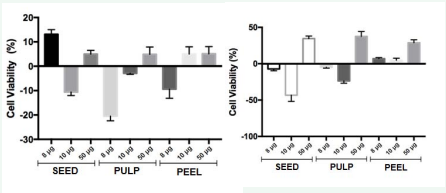
Figure 1: Percentages of cell viability in normal renal cells (HEK-273) (A) and tumor renal cells (786-0)(B), evaluated by MTT method in a 96 well plate with density of 3.0×10³ cells/well. The cells are incubated by 72 hours with aqueous extracts (seed, pulp and peel) from atemoya with different treatment concentrations.
|
Table 3: Quantitative analysis of CK – Creatine kinase and Cq10 – Coenzyme Q10, in supernatant culture medium of tumor renal cell (786-0) with different treatments of pulp, seed and peel aqueous extracts from atemoya. Standard refers to cells without treatment. The values of CK are expressed in units/L × number of cells on well ± SD (standard deviation). The values of Cq10 are expressed in µM/L × number of cells on well ± SD. |
||||||||||
|
Standard |
PEEL |
SEED |
PULP |
|||||||
|
8mg |
10mg |
50mg |
8mg |
10mg |
50mg |
8mg |
10mg |
50mg |
||
|
CK (U) |
10,08 ±2,32 |
10,04 ±2,01 |
13,33 ±2,14 |
20,20 ±1,23 |
10,38 ±1,34 |
9,23 ±1,43 |
24,32 ±1,54 |
6,00 ±1,64 |
8,48 ±1,76 |
20,83 ±1,83 |
|
Cq10 (µM) |
0,21 ±0,06 |
0,18 ±0,05 |
0,33 ±0,08 |
0,71 ±0,10 |
0,19 ±0,08 |
0,58 ±0,07 |
0,22 ±0,08 |
0,09 ±0,06 |
0,15 ±0,07 |
0,33 ±0,04 |
It was observed that in the normal renal cell (HEK-273), there was an increase in mitochondrial activity at the concentrations of 50 μg for the three atemoya extracts and at the concentration of 10 μg in the peel extract, demonstrated by MTT assay (Figure 1). While the Cq10 and CK dosages (Table 2) present that there appears to be no significant changes in the energy metabolism cells, in this high concentration. It is also worth noting the 8 μg concentration of the seed extract, which presented more than 10% of cell viability, following the crescent Cq10 and CK levels. In the pulp extract, at the concentrations of 8 and 10 µg there was a decrease in cell viability, with 20% less viability at 8 μg. Although the 8 μg decrease the cellular viability and this event is accompanied by CK levels, the increase Cq10 levels may indicate an increase in oxidative stress and the cell’s attempt to overcome it. There was also low mitochondrial activity at the concentrations of 8 μg and 10 μg in the peel and seed extracts, respectively, both reaching 10% inhibition. Some of these samples may favor tissue recovery caused by tumor damage or previous surgical removal, considering that there was a small increase in mitochondrial activity, and considering that only the 8 μg concentration of the pulp and peel extracts and the 10 μg of the seed extract showed inhibition results greater than 10%. These results suggest that the presence of atemoya extracts does not allow for significant toxic effects, delaying the mitochondrial activity of the cells, thus being a probable extract free from renal cytotoxic effects. The extracts were also evaluated in tumor cells (786-0). The results suggest a decrease in cellular activity at the concentrations of 8 and 10 μg of both extracts, differing from the 50 μg concentration, whose cellular activity increased. In this high concentration, the Cq10 levels remained stable while CK levels doubled, indicating that the reposition of ATP is required by tumor cells without primary production of ATP. This implies a decrease in mitochondrial activity, indicating that the extracts of atemoya comprise components which act as probable tumor cells markers, since the mitochondrial activity was increased in the healthy cells and proved to be diminished in the tumor cells. Therefore, the extracts studied have substances which allow the viability decrease in the tumor cells and do not interfere in the growth of normal cells. Nevertheless, further studies are needed to lay bare the substances involved in these mechanisms. Under the conditions tested, the seed and pulp extracts of Annona x atemoya Mabb. Presented an effect of decreasing the viability of renal tumor cells at the concentrations of 8 and 10 μg, with highlight for the 10 μg seed extract, which showed approximately 50% inhibition of 786-0 cell viability and an increase of Cq10 activity, suggesting attempt of survivor under oxidative stress and request for energy supply. The 10 μg tests of seed and pulp extracts present less CK levels, and this could indicate that the tumor cells cannot restore ATP levels by regenerating ADP, weakening their energy supply. Besides that, there was no inhibition of mitochondrial activity in the atemoya peel aqueous extracts. In the study by Malta et al. [25], which evaluated the antiproliferative activity of cerrado fruits (Brazilian mainland vegetation) on the growth of human liver cancer cells (HepG2), gabiroba (Campomanesia xanthocarpa), murici (Byrsonima crassifolia) and Guapeva pulp (Pouteria torta) also showed potent inhibitory activity on the growth of HepG2 cells, with results depending on the dose. No extract presented toxicity at the concentrations applied in the experiments. In the study carried out with extracts of Terminalia chebula, by its turn, it was shown that at low concentrations, cellular pathways leading to apoptosis are initiated, whereas at high concentrations the extract has direct toxic effects, leading to cell death by rapid necrosis of PC-3 cells (prostate cancer cell)[26]. In the same study, the data also showed a positive correlation between the decrease in mitochondrial activity and the content of phenolic compounds, leading the authors to suggest that these compounds would be responsible for the decrease in cellular activity. The results obtained showed that the A. atemoya seed and pulp extracts may interfere with the viability of renal tumor cells, which concludes that the fruit has potential for use in nutritional applications and may be an alternative to prevent or delay the tumor formation. The use of fruits and, concurrently, studies on sources of bioactive compounds which act to inhibit the cellular activity of carcinomas without reaching healthy cells are very important. Inasmuch as cancer patients are in a weakened state of health, the use of natural products acting precisely on the disease, without further compromising the health of the individual, bear merit, besides being potential sources of study for the pharmaceutical industry. Despite the biomedical and biotechnological advances regarding the diagnosis and treatment of renal cancer in recent years, other studies have come into play to improve new techniques to identify the behavior of this disease. Considering that there was a divergence between the performance of the extracts in normal and cancer cell lineages, with cellular specificity, it can be said that molecules present in atemoya aqueous extracts presents biotechnological potential for cellular identification of carcinogen, acting as a biomarker. Taran and his partners [27] have shown in in situ comparative studies using Wilms’ tumor tissues and normal renal cortex that the presence of nitrogen and carbon isotopes may be new biomarkers for the worst prognosis of the disease, since the values of these isotopes do not remain stable as the disease progresses, and can be attributed to amino acid metabolism and variations in the metabolic pathways used in their synthesis. Thereby, the extracts evaluated herein may be a possible alternative for biomedical and biotechnological studies, suggesting molecules, which may aid in the treatment and researches related to cancer. This is feasible through the isolation of tumor localizing molecules, thus reducing the side effects caused by the treatments adopted. With this action mechanism, herbal medicines could act directly in the region of the tumor, not compromising other parts of the organism. Moreover, the use of these herbal medicines can reduce the costs generated by chemotherapy, radiation therapy, hormone therapy and surgery. However, further studies are needed to investigate which mechanisms and chemical structures elucidate the life of tumor cell inhibition.
CONCLUSION
The various types of phytochemical compounds and the interference in the viability of normal and tumor cells found in pulp and residue (seed and peel) extracts of atemoya suggest that this fruit is of great biotechnological and pharmacological interest, since it is a source of bioactive compounds. The atemoya extracts evaluated presented increase of normal cell mitochondrial activity (HEK-273) in the concentrations of 50 μg in the three extracts of atemoya, while maintained CK and Cq10 normal levels, and in the concentration of 10 μg in the peel extract, highlighting the seed extract concentration of 8 μg, which presented slightly over 10% of cell viability with elevation of CK and Cq10. The atemoya seed and pulp extracts on tumor cell (786-0) presented a decrease in cell viability, especially at the concentration of 10 μg in the seed extract, which presented greater percentage of cell viability inhibition with discrete decrease of CK and doubling Cq10 levels, indicating stress in energetic metabolism and possible oxidative stress. Given these circumstances, it is suggested that the atemoya extracts alter the metabolism of normal and tumor cells, which may enable them to be used as a biomarker of tumor cells. This allows for the emergence of several benefits with future studies, such as reduction of side effects from innovative treatments. Thereby, it can be stated that atemoya, including its commonly neglected parts, presents great potential for the use of its molecules in biotechnology and pharmacology.
REFERENCES
2. Instituto Nacional de Câncer (Brasil). Epidemiologia: A previsão dos números. Rede Câncer 2016 Abr:15-7.
6. Bauer J, Reich Z, III. Antitryptic action of urine. Med Klin. 1909; 5: 1744–1777.
7. Faarvang HJ. Urinary trypsin inhibitor in man. Scand J Clin Lab Invest. 1965; 120: 1-83.
10. Crane FL. Biochemical functions of coenzyme Q10. J Am Coll Nutr. 2001; 20: 591-598.
19. Tanzer ML, Gilvarg C. Creatine and creatine kinase measurement. J Biol Chem, 1959; 234: 3201-3204.
21. Santos AG. Estudo fitoquímico e atividade leishmanicida de AnnonaimpressiveniaSafford (Annonaceae) [dissertação]. Manaus: Universidade Federal do Amazonas. 2007.
24. Silva EB, Santos ER, Rosa J, Cardoso FT, Souza GG, Nogueira R, et al. Aproveitamento integral de alimentos: avaliação físico-química e sensorial de um doce obtido a partir de cascas do maracujá amarelo (Passiflora edulis f. Flavicarpa). Rev Augustus. 2015; 19: 44-60.